
Use a DEX aggregator when you're swapping more than a few hundred dollars, moving across chains, or trading a thin-liquidity token. Use a single exchange when the trade is tiny, the pair is deep and simple, or you specifically want a centralized platform's custody and support. The rule of thumb: bigger, weirder, or cross-chain trades favor aggregators; small, simple, same-chain trades often don't need one.
Before you swap anything, check four cost components: on-chain gas, the DEX pool fee baked into the price, the aggregator's own margin (if any), and slippage. A tool like Omnirout shows all four side by side before you sign anything.
- Prefer an aggregator for cross-chain moves, illiquid tokens, or trades above roughly $1,000.
- Prefer a single exchange for small trades in deep, well-known pairs where routing gains won't beat the gas cost.
- Check both when you're unsure, since one live quote comparison takes under a minute.
Key Takeaways
Aggregators win on routing efficiency for larger or cross-chain trades, while single exchanges suit small, simple, same-chain swaps where speed matters more than price-shopping.
| Point | Details |
|---|---|
| Match tool to trade size | Aggregators tend to pay off above roughly $1,000; smaller trades often lose value to extra gas. |
| Custody changes everything | Non-custodial routes (aggregators, single DEXs) keep recovery in your hands; CEX custody does not. |
| Check the full cost stack | Compare gas, pool fees, aggregator margin, and slippage together, not just the headline rate. |
| Cross-chain adds risk | Bridge legs inside a route carry their own settlement risk separate from the aggregator itself. |
| Verify before signing | Omnirout previews fees, gas, and slippage across 30+ chains so you can check a route before committing. |
Table of Contents
- Aggregator Vs Exchange: What Each One Actually Does
- How Aggregators Find You a Better Price
- Comparing an Aggregator and an Exchange Side by Side
- When an Aggregator Actually Saves You Money
- Where Aggregators Fall Short and What Can Go Wrong
- How to Choose Between an Aggregator and a Single Exchange
- Real Trade Scenarios: Aggregator or Direct Exchange?
- How Omnirout Approaches Route Transparency
- Frequently Asked Questions
- Sources
Aggregator Vs Exchange: What Each One Actually Does
A DEX aggregator is a non-custodial routing layer. It doesn't hold your funds or run its own liquidity pool. Instead, it scans multiple decentralized exchanges (and often bridges) simultaneously, then returns the route that gets you the best realistic price after fees and slippage. You keep your keys the entire time.
An exchange is different depending on which kind you mean. A centralized exchange (CEX) custodies your funds. You deposit crypto, it sits in the platform's wallets, and you trade against its internal order book. A single DEX, meanwhile, is non-custodial but routes you through exactly one liquidity pool. There's no price-shopping happening. You get whatever that pool quotes.
- CEX: custodial, platform holds keys, settlement risk sits with the exchange.
- Single DEX: non-custodial, one pool, no comparison shopping.
- Aggregator: non-custodial, compares many pools (and often bridges), settlement risk passes to whichever underlying route gets chosen.
That last point matters: aggregators price-shop and return ranked routes but disclaim settlement themselves. If a trade fails, the failure traces back to the DEX or bridge in the route, not the aggregator's own contract.
How Aggregators Find You a Better Price
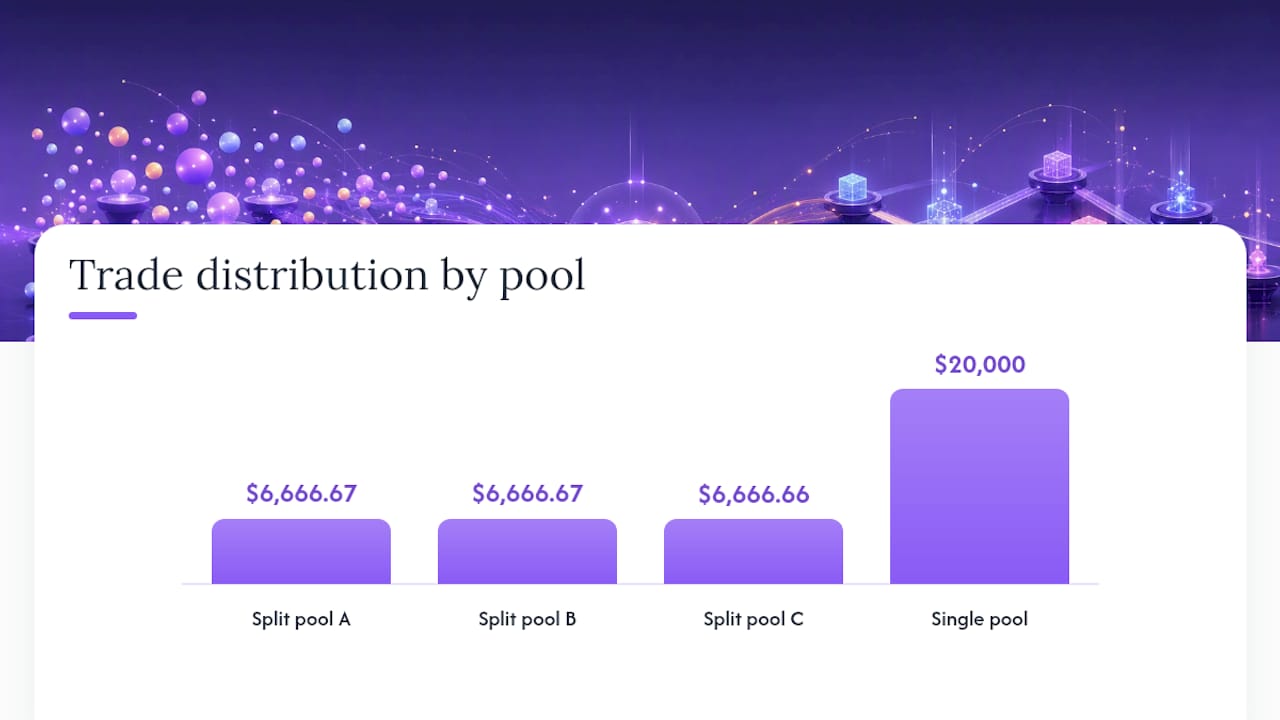
Smart order routing is the core mechanism. Instead of dumping your entire trade into one pool, an aggregator can split it across several, which cuts the price impact you'd otherwise take on a single deep order. A $20,000 swap split across three pools moves each pool's price less than the same $20,000 hitting one pool alone.
Newer aggregators use solver or intent-based architectures. Rather than broadcasting your trade to a public mempool (where bots can front-run it), you state what you want, and competing solvers bid to fill it off-chain or through private channels. This is one of the more effective defenses against MEV extraction, though it's not universal across every aggregator.
A typical routing sequence looks like this:
- Collect live quotes from multiple DEXs and, if relevant, bridges.
- Estimate gas across the candidate routes.
- Simulate the route to catch failures before you sign.
- Execute the winning route, sometimes splitting across pools.
Pro Tip: Never sign a transaction until you've actually read the route summary. Check the number of hops, the estimated gas, and whether any leg touches a bridge. A three-hop route through an unfamiliar bridge might save two dollars in fees and cost you far more in risk.
Comparing an Aggregator and an Exchange Side by Side
Run the same trade through both, and the differences show up fast:
- Custody: aggregators and single DEXs are non-custodial (you control recovery); a CEX holds funds, so recovery depends entirely on the platform staying solvent and cooperative.
- Routing: single-pool execution on a lone DEX versus split or solver-based routing on an aggregator, which usually means less price impact on the aggregator side.
- Fees: a single DEX charges its pool fee only; an aggregator adds a possible router margin on top of whatever pool fees the route touches, plus gas for each hop.
- Slippage: concentrated in one pool for a direct DEX trade; usually lower on an aggregator because the trade avoids overloading any single pool.
- Cross-chain support: single DEXs generally can't do it; aggregators often bundle a bridge leg into the route automatically.
- Liquidity depth: a single DEX is limited to its own pool; an aggregator taps dozens of pools across a network.
- Speed and UX: a direct DEX swap is usually faster and simpler; an aggregator adds a quote-comparison step that takes a few extra seconds but often pays for itself.
- MEV exposure: higher on public-mempool DEX trades; lower on aggregators running solver or private-relay modes.
Custody is the dimension traders underweight. If a CEX freezes withdrawals, your recovery options depend on that company. With a non-custodial route, your funds never left your wallet in the first place.
When an Aggregator Actually Saves You Money
Break the cost of any swap into four pieces: gas, the DEX pool fee embedded in the price, any aggregator margin or retained positive slippage, and slippage from price impact. Fee practices vary widely between aggregators: some advertise a 0% router fee but quietly keep positive slippage, while others charge a small explicit margin, often in the 0.04% to 0.15% range.
Rules of thumb by trade size:
- Under roughly $100 to $200: gas usually dominates. An aggregator's extra hop can cost more in gas than it saves in price improvement.
- $1,000 to $50,000: this is where aggregators tend to shine. Real swap tests running identical trades at $1,000, $10,000, and $50,000 on Ethereum and Solana found aggregators materially improved execution at mid-to-large sizes, though results varied by chain.
- Above $50,000: routing and split-execution matter even more, since a single pool at that size can produce serious price impact.
Always compare the all-in price, meaning the final amount you receive after gas, fees, and slippage, not the headline exchange rate.
Where Aggregators Fall Short and What Can Go Wrong
Aggregators aren't risk-free. Smart-contract bugs in the router or in an underlying DEX can cause failed fills or, in rare cases, fund loss. Trades routed through a public mempool can still get front-run even on an aggregator if it doesn't use a solver or private-relay mode. Token approvals given to a router contract are a standing risk if that contract is ever compromised.

Cross-chain routes carry additional settlement risk tied to whichever bridge the route uses, since aggregators don't custody funds themselves but still depend on that bridge completing its side of the transfer. The upside: because aggregators don't hold large sums for extended periods the way bridges do, they carry lower systemic risk even though execution-time risk remains.
Aggregators also don't help with:
- Tiny swaps where gas swamps any routing gain.
- Extremely illiquid tokens where every route is thin.
- Cases where quote simulation fails outright, signaling a problem before you sign.
Protect yourself with limited-time approvals, route simulation before every signature, solver modes for large trades, and a hardware wallet for anything sizable.
How to Choose Between an Aggregator and a Single Exchange
- Decide your custody need. If you must self-custody, cross a single DEX or CEX off the list; go non-custodial.
- Size the trade. Above roughly $1,000, routing gains usually justify the extra hop.
- Pull two live quotes. Compare an aggregator's all-in price against a deep single DEX's quote for the same pair.
- Check the route simulation. Confirm it doesn't fail and note whether it uses a solver or MEV-protected mode.
- Confirm bridge settlement guarantees if the route is cross-chain.
- Execute once the numbers and route summary both check out.
Ask yourself: is this over $1,000? Does it cross chains? Is the token thin? Two or more "yes" answers point straight at an aggregator.
Real Trade Scenarios: Aggregator or Direct Exchange?
- Mid-size swap on a thin token: an aggregator splits the order across pools, cutting price impact that a single DEX would absorb in full.
- Moving assets cross-chain: an aggregator bundles the bridge leg and shows the total cost upfront instead of leaving you to research a bridge separately.
- Large rebalancing trade: solver-based routing avoids tipping your hand to front-runners watching the mempool.
- Micro swap in a deep, common pair: a direct DEX or CEX is often cheaper once you factor in the aggregator's extra hop of gas.
How Omnirout Approaches Route Transparency
Omnirout is a non-custodial DEX and bridge aggregator supporting more than 30 blockchains. You never hand over your keys. Every quote shows fees, gas costs, and slippage side by side before you commit to anything.
- Transparent all-in quotes across every candidate route, not just the headline rate.
- Route simulation so you can catch a failing trade before it costs you gas.
- Wallet integrations that keep custody with you throughout.
- Developer integration options for teams building on top of aggregated liquidity.
Before your next cross-chain or larger swap, pull a route comparison and see what the numbers actually say.
A trader's honest take
Custody and price are the two things that actually decide whether a tool was worth using, not brand recognition or interface polish. If you're trading more than pocket change or touching more than one chain, get a live quote comparison every single time. Skipping that step is the most expensive habit in DeFi.
Compare Your Route Before You Sign
Every swap you've read about above hinges on one habit: checking the numbers before you commit. Omnirout gives you that check in one screen. It's a non-custodial aggregator, so your keys never leave your wallet, and it previews fees, gas, and slippage across more than 30 blockchains before you execute anything.
If your next trade is cross-chain, sizable, or sitting in a thin-liquidity pair, that's exactly the situation where routing comparison earns its keep. Wallet integrations mean you can plug in and start comparing routes in minutes rather than hours. Head to Omnirout's route comparison tool and run your trade through it before you sign a single transaction.
Frequently Asked Questions
Is a DEX aggregator the same as a broker? Not quite. An aggregator vs broker comparison comes down to custody and mechanism: a broker typically executes on your behalf and may hold funds temporarily, while a non-custodial aggregator routes your trade through pools without ever taking custody.
What's the difference between a DEX aggregator and a bridge? A dex aggregator vs bridge distinction matters most for cross-chain trades: a bridge moves assets between chains, while an aggregator often uses a bridge as one leg of a larger route and compares several such routes for you.
What is an exchange in the context of crypto trading? It's either a centralized platform that custodies your funds and matches orders internally, or a single decentralized pool that executes trades against its own liquidity without comparing outside prices.
What types of aggregators exist? Broadly: router aggregators that split trades across pools, intent-based or solver aggregators that use competitive bidding to fill orders, and meta-aggregators that compare other aggregators' quotes.
How do I choose an aggregator? Check non-custodial status, supported chains, fee transparency (explicit margin versus retained positive slippage), and whether it offers solver or MEV-protected execution for larger trades.
This article is general information, not a substitute for advice from a qualified financial advisor. Consult a qualified financial professional about your own circumstances before acting on anything here.
Sources
- Crypto DEX Aggregators: 9 Best Ranked 2026 | CoinCodeCap
- Cross-Chain Bridges vs DEX Aggregators: What’s Safer in 2026?
- Intent vs Bridge vs Aggregator 2026: Cross-Chain Architecture Compared | Support