
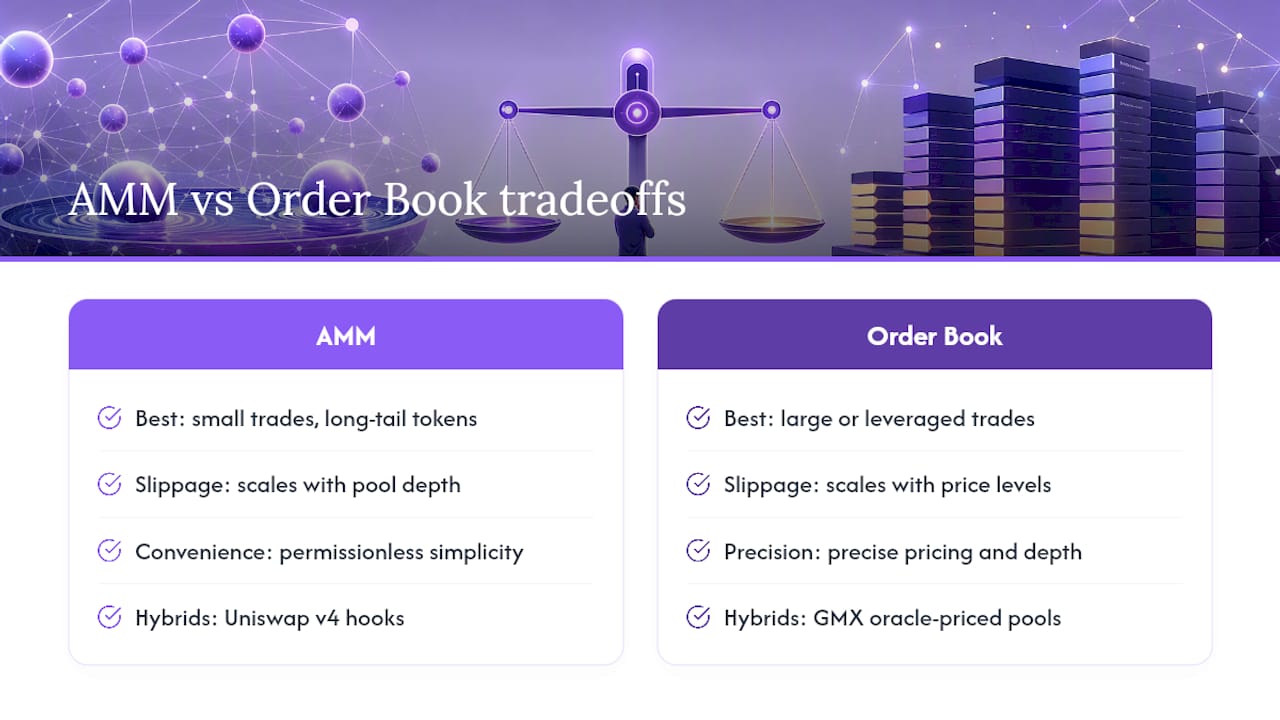
Use an AMM for small swaps, long-tail tokens, and passive liquidity provision. Use an order book for large tickets, leveraged positions, and any trade where you need a precise entry price. AMMs price assets algorithmically against a pool; order books match live bids and asks from real participants. Three triggers decide which one you want:
- Trade size: anything that would move a thin pool's price belongs on a deep order book.
- Order type needs: stop-losses, OCO orders, and scaled limit entries mean you need a matching engine, not a formula.
- Yield intent: if you're providing liquidity for fee income rather than executing a trade, AMMs are the only game in town.
Key Takeaways
AMMs win on always-on liquidity and passive yield, while order books win on precision, control, and cost for large or leveraged trades.
| Point | Details |
|---|---|
| Match venue to trade size | Small swaps suit AMM pools; large tickets need order-book depth to avoid slippage. |
| MEV hits AMMs hardest | Mempool-visible swaps invite sandwich attacks; batch auctions and protected routing reduce exposure. |
| LVR is a real LP cost | Concentrated liquidity providers can lose fee income to arbitrageurs during volatile price moves. |
| Order types drive control | Stop, limit, and OCO orders exist only on order books, not on pool-based AMMs. |
| Hybrid execution wins | Splitting trades across both models, checked via a route comparison tool, cuts cost and risk. |
Table of Contents
- AMM vs Order Book: How Pool-Based Pricing Works
- What Is an Order Book and How Does Matching Work?
- AMM vs Order Book: Side-By-Side Comparison
- Pros and Cons of Each Trading Model
- MEV, Slippage, and Execution Risk You Need to Know
- Which Model Fits Your Trading Style?
- Real Protocol Examples Worth Knowing
- Are AMMs and Order Books Converging?
- Practical Tips to Cut Cost and Execution Risk
- Blending Both Models Is the Real Answer
- Frequently Asked Questions
- Sources
AMM vs Order Book: How Pool-Based Pricing Works
An automated market maker prices assets with a formula, not a counterparty. The classic version, popularized by early Uniswap pools, is the constant product invariant: x times y equals k. Deposit two tokens into a pool, and every swap shifts the ratio between them, which shifts the price. No buyer has to be waiting on the other side. The pool itself is the counterparty, and Coinbase's overview of AMM mechanics frames this as the reason AMMs let anyone spin up a market for even the most obscure token without needing an order book to fill it.
Not every AMM uses the same curve. Constant product suits volatile pairs. Constant mean pools (weighted baskets, like Balancer's) handle multi-asset exposure. Concentrated liquidity, introduced in Uniswap v3 and extended in v4, lets liquidity providers park capital in a specific price range instead of spreading it across the entire curve, which sharply improves capital efficiency. Curve's stable-swap function is a hybrid built specifically to minimize slippage between assets that are supposed to trade near parity, like stablecoins or wrapped tokens.
Liquidity providers earn a cut of every swap fee, but concentrated positions carry real risk: if price moves outside your chosen range, you stop earning fees and hold whichever asset depreciated. That's on top of standard impermanent loss, which affects any two-sided pool position when the underlying prices diverge.
- Pool depth relative to your trade size determines your actual price impact, not the pool's total value locked.
- Fee tier selection (often 0.01% to 1%) trades off volume against per-trade income.
- Tick ranges in concentrated liquidity need active management or they go stale fast.
Pro Tip: Before swapping through any pool, check depth at your specific trade size, not the headline TVL number. A pool can show millions in liquidity and still slip you 3% on a $50,000 order if that liquidity is spread thin.
What Is an Order Book and How Does Matching Work?
A limit order book lists every open bid and ask, ranked by price and then by time of submission. When a buy order's price matches or crosses a sell order's price, the matching engine fills it instantly, following strict price-time priority. Makers post resting orders and add liquidity; takers cross the spread and remove it, and most order-book exchanges charge takers more to reward the makers who built the depth in the first place.
Order types are where books earn their keep. Market orders execute immediately at whatever price is available. Limit orders only fill at your specified price or better. Stop orders trigger once a threshold is breached. Immediate-or-cancel and fill-or-kill orders control partial fills, and one-cancels-the-other orders let you set a target and a stop simultaneously. None of that exists in a pure AMM.
Depth and spread determine how much a large order actually costs. A thin book can look fine at the top but hide almost nothing a few price levels down.
A $50,000 market order against a shallow order book can chew through five or six price levels, each one worse than the last, and land you 2 to 4 percent below the best quote. The same order routed into a deep AMM pool, or split across several venues, might slip a fraction of that. Depth at the top of book means nothing if it evaporates one level in.
- Price-time priority rewards early, well-placed limit orders over late market orders.
- Hidden or iceberg orders can mask true depth on centralized-style books.
- On-chain order books face latency and gas costs that off-chain matching engines don't, though purpose-built execution layers are closing that gap.
AMM vs Order Book: Side-By-Side Comparison
The two models solve the same problem (getting you a price) through completely different mechanics, and that difference shows up in every column that matters to a trader.
| Dimension | AMM | Order Book |
|---|---|---|
| Best for | Small to mid swaps, long-tail tokens, passive LPing | Large tickets, derivatives, precise entries |
| Order types | Market swap only (limit-like behavior emerging via hooks) | Market, limit, stop, IOC/FOK, OCO |
| Liquidity depth & price impact | Depends on pool TVL and curve shape; degrades on thin pools | Depends on real resting orders; can be very deep on majors |
| Fees & gas | Swap fee plus on-chain gas per transaction | Maker/taker fees; gas only if settlement is on-chain |
| MEV / front-running risk | High. Swaps sit visible in the mempool before confirmation | Lower for off-chain matching, still present on-chain |
| Capital efficiency | Improved by concentrated liquidity, still range-bound | Naturally high on liquid books, thin on illiquid ones |
| Complexity & UX | Simple: connect wallet, swap | More moving parts: order types, margin, funding rates |
| Examples | Uniswap, Curve, GMX | dYdX, Hyperliquid |
The pattern that matters: AMM slippage beats a thin order book when the asset barely trades anywhere, because there's no book to speak of. A deep order book beats an AMM on any asset with real two-sided flow, because market makers are actively quoting tighter than any static curve can.
A workable routing rule: size and volatility decide the venue. Small, low-volatility swaps in blue-chip pairs run fine through an AMM. Large or leveraged positions, especially in fast-moving markets, typically belong on an order book with real market depth behind the quote. Coin Bureau's comparison of the two models reaches the same conclusion: active, high-volume traders lean toward books, while casual users and long-tail discovery lean toward pools.
Pros and Cons of Each Trading Model
AMM strengths: liquidity is always on, even at 3 a.m. with zero counterparties awake. Long-tail tokens get a market on day one. Anyone can become a liquidity provider without permission. The tradeoff: impermanent loss and MEV exposure eat into returns, and large orders slip hard against shallow pools.
Order book strengths: precise control over entry and exit price. Advanced order types support real risk management. Spreads on major pairs are often razor-thin because professional market makers compete for the flow. The tradeoff: books for smaller altcoins are often too thin to be usable, the operational learning curve is steeper, and fully on-chain books still carry gas and latency costs pool-based swaps mostly avoid.
- AMM: instant liquidity for anything, at the cost of predictable exit prices on size.
- Order book: exact pricing and order control, at the cost of needing real depth to work.
MEV, Slippage, and Execution Risk You Need to Know
Every AMM swap sits in a public mempool for a moment before it confirms, and that moment is long enough for bots to sandwich it: buy ahead of your trade, let your swap push the price up, then sell into you. Formal models of AMM behavior confirm this isn't a bug so much as a structural feature: AMMs can function as accurate price oracles under rational arbitrage2022), but that same arbitrage mechanism is what makes them exploitable by transaction-ordering attacks. Order books shift the attack surface rather than eliminating it. Off-chain matching with on-chain settlement reduces mempool exposure significantly, though fully on-chain books still face some of the same risk.
Concentrated liquidity providers face a related but distinct hazard called loss-versus-rebalancing. During fast price moves, arbitrageurs and high-frequency traders can extract value from LP positions faster than fee income replaces it, which can erase weeks of fee revenue in a single volatile session.
- Set slippage tolerance tight on major pairs, wider only when the pool genuinely requires it.
- Use tools like Flashbots-protected transactions or CoW Protocol's batch auctions to reduce sandwich exposure.
- Watch pool oracle sources; manipulated price feeds have caused real exploits on undercollateralized designs.
Statistic Callout: LVR quantifies the exact cost concentrated-liquidity LPs pay to arbitrageurs during volatile moves, and research on this microstructure risk shows it can offset most or all of the fee income a position earns in calm markets.
Which Model Fits Your Trading Style?
Small swaps in liquid pairs rarely need anything beyond an AMM. Mid-size trades depend entirely on pool depth versus book depth for that specific asset. Anything larger, or anything leveraged, generally belongs on an order book with real market makers behind it.
- Market-making and arbitrage: order books, for the precision and order types the strategy demands.
- Directional, large-ticket trades: order books, to avoid slippage decay across a shallow curve.
- Perpetuals and leverage: order books almost exclusively; funding and liquidation mechanics need a matching engine.
- Altcoin discovery: AMMs, since most new tokens launch with pool liquidity and no book at all.
- LP income strategies: AMMs, the only venue where you can earn passive fee revenue.
Pro Tip: Combine both in one workflow: route large or leveraged legs through an order-book venue, and handle the smaller, long-tail leg of the same strategy through an AMM. An aggregator that compares routes across both model types before you sign a transaction removes the guesswork.
Real Protocol Examples Worth Knowing
Uniswap runs concentrated liquidity AMM pools, and v4's hook system now lets developers build limit-order-like behavior directly into pools, narrowing the gap with books. Curve specializes in stable-swap AMM curves built for low-slippage trades between correlated assets. dYdX runs an order-book perpetuals model with precise entries and funding mechanics built for active derivatives traders. Hyperliquid takes that further with a fully on-chain order book optimized for low latency, appealing to traders who want book-style execution without leaving the chain. GMX uses pool-based perpetuals priced by oracle feeds rather than a matching engine, a middle path between AMM simplicity and derivatives functionality. CoW Protocol batches orders off-chain and settles them together, which blunts sandwich attacks by removing the sequential mempool exposure. Jupiter aggregates across Solana's DEXs, including AMM pools, to route swaps for better effective pricing.
Route a $40,000 ETH position through an order-book venue like dYdX or Hyperliquid for tight execution, and route a small position in a newly launched token through an AMM pool because no book exists yet. Same trader, two venues, one session.
Each design choice reflects a different bet on what traders actually need: dYdX bets on precision, GMX bets on simplicity, Curve bets on correlated-asset efficiency.
Are AMMs and Order Books Converging?
The line between the two models is blurring fast. Uniswap v4's hooks let pools mimic limit-order behavior, letting a swap only execute once price crosses a threshold, something previously exclusive to books. High-throughput chains are enabling fully on-chain order books, like Hyperliquid's, that avoid the latency problems that plagued earlier attempts. RFQ (request-for-quote) systems, used by CoW Protocol and increasingly by aggregators, let off-chain market makers quote firm prices that settle on-chain, combining book-like pricing with AMM-style simplicity for the end user.

For traders, this means narrower spreads even on pool-based swaps, new limit-order features showing up inside AMMs, and smarter aggregator routing that treats books and pools as one liquidity surface rather than two separate categories. Watch latency improvements and MEV mitigation tooling like batch auctions; that's where the next real gains show up.
Practical Tips to Cut Cost and Execution Risk
Set slippage tolerance based on actual pool depth, not a default 1% you never think about. Check effective depth at your trade size before you submit, not just the top-of-book quote. Split large trades across multiple venues or time windows to avoid moving the market against yourself. Use an aggregator to scan both AMM pools and order books simultaneously rather than manually comparing quotes.
For liquidity providers: choose concentrated ranges around realistic expected price movement, not just the current price. Avoid adding liquidity right before high-volatility events like major token unlocks or macro announcements. Track LVR exposure alongside fee income, not just fee income alone.
Pro Tip: Run your trade through a route comparison tool like OmniRout before executing. Seeing gas, fees, and slippage side by side across multiple routes takes the guesswork out of choosing between a pool and a book.
- Check depth, not just headline liquidity, before every trade.
- Split size, don't dump it all into one route.
- Manage LP ranges actively; don't set and forget.
Blending Both Models Is the Real Answer
Most experienced traders stop treating this as an either/or decision. Majors and large positions go through order books because that's where the depth and precision live. Long-tail tokens and passive yield go through AMMs because that's the only place they exist. The research backs this hybrid pattern rather than picking one model and forcing every trade through it. What actually separates good execution from bad execution isn't which model you prefer. It's whether you check routes across both before you sign anything, which is exactly the habit an aggregator like OmniRout is built to support.
Frequently Asked Questions
Is an AMM or order book better for trading? Neither is universally better. AMMs suit small trades and long-tail tokens; order books suit large or leveraged positions where precise pricing and depth matter more than convenience.
Does AMM vs order book affect slippage differently? Yes. AMM slippage scales with pool depth relative to trade size, while order-book slippage scales with how many price levels a large order has to sweep through.
Can I avoid MEV on an AMM? You can reduce it using protected transaction relays or batch-auction protocols like CoW Protocol, but you can't eliminate mempool exposure entirely on a public chain.
Why do some DEXs use both models? Hybrid designs, like Uniswap v4's hooks or GMX's oracle-priced pools, borrow precision from order books while keeping the permissionless simplicity of AMM pools.
Should liquidity providers worry about order books at all? Only indirectly. LPs care about pool-side risks like impermanent loss and LVR, but tighter order-book spreads on the same asset can pull volume away from a pool and reduce fee income.
This article is general information, not a substitute for advice from a qualified financial advisor. Consult a qualified financial professional about your own circumstances before acting on anything here.
Sources
- Order Book vs Automated Market Maker (AMM): Which Model Works Better? - Coin Bureau
- Order Book vs Automated Market Maker (AMM) - Injective blog
- Order book vs AMM: Microstructure & HFT arbitrage guide - Exmon Academy
Formal AMM models and microstructure research both point to the same conclusion: neither design eliminates execution risk, they just relocate it.