
For most traders, the best chain for swaps isn't actually a single chain at all. It's a non-custodial aggregator that routes across many chains and picks the cheapest, fastest path for each specific trade. OmniRout does this across dozens of blockchains, comparing fees, gas, and slippage before you sign anything, so you keep your keys while still getting a competitive rate.
That said, the "best" pick depends on what you're optimizing for:
- Lowest total cost on EVM chains: an aggregator running on Uniswap v4-style pools, which cuts gas on multi-hop routes.
- Fastest settlement: Solana-based swaps, where block times run near 400 milliseconds.
- Privacy-first, no-signup swaps: instant exchangers like ChangeNOW or SimpleSwap.
- MEV protection on large trades: intent-based routing through resolver networks such as 1inch Fusion+.
- Maximum chain coverage in one interface: LI.FI or OmniRout, both built for cross-chain rather than single-chain routing.
The rest of this guide breaks down exactly how these options compare in coverage, fees, speed, liquidity, custody, and security, so you can match the route to the trade instead of guessing.
Key Takeaways
Non-custodial aggregators that compare fees, gas, and slippage across multiple bridges consistently deliver lower total cost than single-route exchanges or manual bridge use.
| Point | Details |
|---|---|
| Default recommendation | Non-custodial aggregators covering 30+ chains give the broadest route comparison without giving up key control. |
| Compare total cost, not headline fee | Add platform fee, bridge fee, and gas together before judging any quoted rate. |
| Check bridge trust signals | Prefer audited bridges with meaningful TVL and published multisig or timelock protections. |
| Match platform to trade size | Instant exchangers suit quick, smaller trades; aggregators suit trades where cost comparison matters more. |
| Test before committing large amounts | Send a small transfer through a new route before moving a significant position. |
| Omnirout's role | OmniRout provides non-custodial route comparison across 30+ chains, showing fees, gas, and slippage before execution. |
Table of Contents
- Best Chain for Swaps: Comparing the Top Platforms
- How Do You Choose the Right Chain or Platform for a Swap?
- Platforms and Chains Every Trader Should Know
- How Do You Execute a Cross-Chain Swap Safely?
- What Risks Come With Cross-Chain Swaps, and How Do You Manage Them?
- What Do Swap Platforms Actually Charge Beyond the Headline Fee?
- How Long Do Cross-Chain Swaps Actually Take?
- Does Customer Support Quality Matter When Choosing a Platform?
- How Does Regulatory Status Affect Platform Reliability?
- How Do You Judge User Reviews and Platform Reputation?
- How Do You Evaluate Liquidity Depth Before Swapping?
- Frequently Asked Questions
- Sources
Best Chain for Swaps: Comparing the Top Platforms
Here's how the platforms traders ask about most often stack up against each other. Fees and settlement times shift by route and network congestion, so treat these as typical ranges, not fixed quotes.
Aggregators like OmniRout and LI.FI compare liquidity across multiple venues and construct multi-step routes instead of locking you into one bridge's pricing. That structural difference is why aggregator quotes often beat single-route instant exchangers on total cost, even when the sticker fee looks similar.
Instant exchangers like ChangeNOW, SimpleSwap, StealthEX, Exolix, Godex.io, and LetsExchange trade some of that cost optimization for simplicity: paste an address, get a quote, send funds. There's no wallet connection required, which appeals to traders who don't want to sign multiple approvals. The tradeoff is that you're trusting a single quoted rate rather than seeing several routes compared side by side.
- Best for lowest total cost across EVM chains: OmniRout or LI.FI, since both surface the full fee stack before execution.
- Best for anonymous, no-account swaps: ChangeNOW, SimpleSwap, or Exolix.
- Best for comparing rates across several instant exchangers at once: LetsExchange, which pulls quotes from partner liquidity providers.
- Best for a straightforward fixed-rate quote: Godex.io or StealthEX.
Pro Tip: Run the same trade size through an aggregator and an instant exchanger before committing. The spread between quotes tells you more about real cost than either platform's marketing page.
How Do You Choose the Right Chain or Platform for a Swap?
The right answer changes with trade size, urgency, and how much you value staying non-custodial. Run through these criteria before picking a route:
- Supported chains: confirm both your source and destination chains are covered, not just the popular ones.
- Total cost: add platform fee, bridge fee, and gas together. A "0% platform fee" route can still be the most expensive option once bridge costs are included.
- Settlement time: cross-chain finality varies widely; some bridges confirm in minutes, others take much longer during congestion.
- Liquidity depth: thin liquidity means higher slippage on larger trades, even when the quoted rate looks good.
- Custody model: non-custodial routes never take control of your keys; custodial exchanges do, in exchange for a simpler UX.
- Audit and TVL history: a bridge with a longer track record and published audits carries less structural risk.
Before signing, run this 30-second check:
- Does the platform show a full route cost breakdown, not just a final quote?
- Is the route non-custodial, or does it require depositing into a custodial wallet?
- Has the bridge involved been audited, and does it carry meaningful TVL?
- Is the quoted spread in line with current market pricing, or noticeably wider?
- Does your wallet actually support the destination chain and token standard?
Walk away if any of these show up: no visible cost breakdown, an unaudited bridge with low TVL, a spread well outside market rate, or a route that only exists on an obscure or unverified bridge. Bridge-specific risks including contract vulnerabilities and liquidity gaps are exactly why this checklist matters more on cross-chain swaps than single-chain trades.
Pro Tip: If a quote looks too good compared to every other route you check, that's usually a sign of a wider spread hidden somewhere in the execution, not a genuine deal.
Platforms and Chains Every Trader Should Know
OmniRout aggregates routes across 30+ chains and shows the fee, gas, and slippage breakdown for each option before you commit, all while you keep custody of your funds. Best for traders who want to compare multiple paths for the same trade in one interface.
LI.FI covers similarly broad chain territory and stitches together bridges and DEXs to minimize total cost. It's a strong developer-facing option and often shows up embedded inside other wallets and apps rather than as a standalone destination.
Godex.io runs a simple instant-exchange model: pick your pair, get a rate, send funds. No account needed. Best for traders who want a quick, no-frills swap without comparing multiple routes.
ChangeNOW supports a large asset list and keeps KYC minimal for most trade sizes. Best for privacy-conscious traders moving moderate amounts who don't need route comparison.
SimpleSwap mirrors ChangeNOW's instant-exchange approach with a clean interface and fixed or floating rate choices. Best for first-time swappers who want a guided, low-friction flow.
StealthEX emphasizes anonymity and a wide coin list, with rates built into the spread rather than a separate platform fee. Best for traders prioritizing simplicity over rate optimization.
Exolix keeps fees low and transparent for an instant exchanger, with fast processing on popular pairs. Best for smaller, frequent swaps where speed matters more than deep route comparison.
LetsExchange pulls quotes from multiple partner liquidity sources and shows you the best available rate among them. Best for traders who want some rate comparison without a full non-custodial aggregator interface.
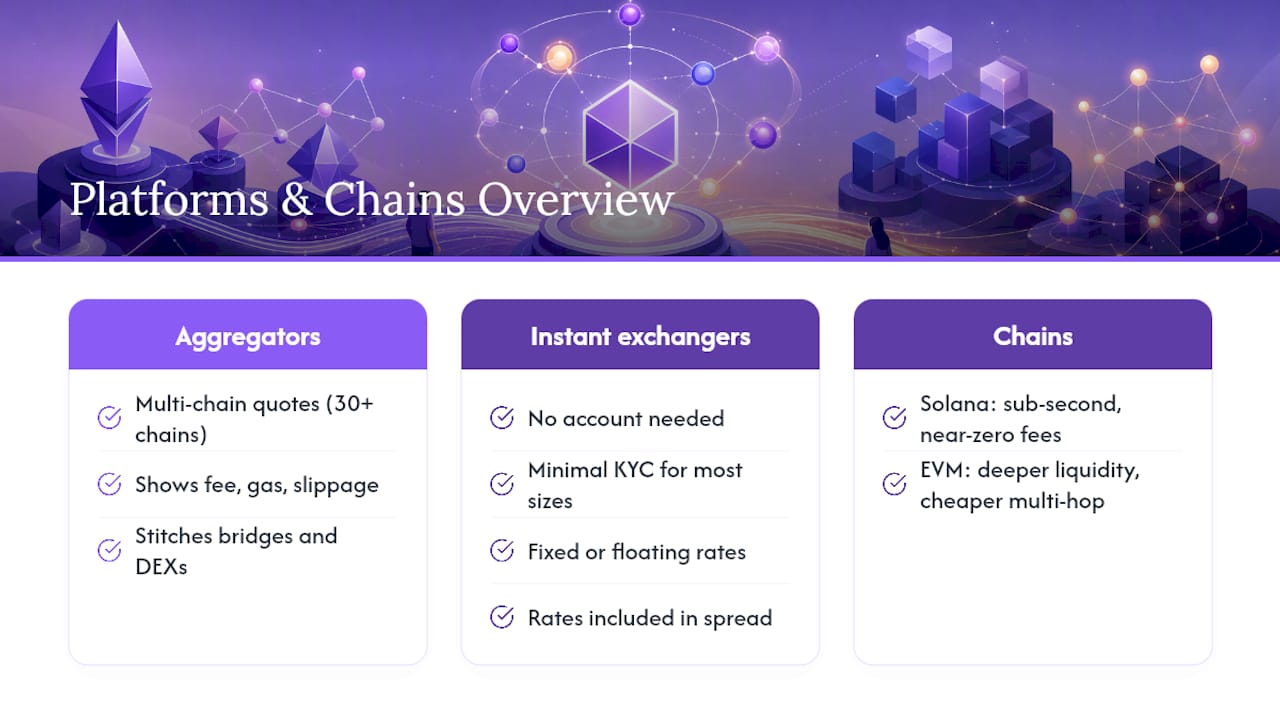
On the chain side, Solana's sub-second block times and near-zero fees make it the fastest, cheapest environment for same-chain swaps, but it requires a Solana-compatible wallet and isn't always the cheapest leg once you're bridging in from an EVM chain. EVM chains benefit from deeper aggregate liquidity and, increasingly, cheaper multi-hop routing thanks to protocol-level efficiency gains in newer AMM designs.
How Do You Execute a Cross-Chain Swap Safely?
- Confirm chain and wallet readiness. Check that your wallet supports both the source and destination chains, and hold enough native gas token on the source chain.
- Compare routes. Run the trade through an aggregator to see fee, gas, and slippage side by side rather than accepting the first quote.
- Set your slippage tolerance. Tight tolerances protect against bad fills but can cause failed transactions on volatile pairs.
- Approve the token spend. Grant only the allowance needed for this trade, not an unlimited approval, when the interface offers the choice.
- Sign the swap or intent. Intent-based routes let a resolver execute on your behalf, which adds a layer of MEV protection.
- Verify final settlement. Check the destination wallet balance and confirm the transaction on a block explorer before considering the trade complete.
Pro Tip: Send a small test amount through a new route before moving a large position. It costs a few dollars in gas and can save you from a stuck bridge or wrong-chain address.
- Common error: approving the wrong contract address. Fix by double-checking the approval target against the official platform URL.
- Common error: sending to a chain the destination wallet doesn't support. Fix by verifying token standard and network before broadcasting.
- Common error: a bridge transaction stuck mid-settlement. Fix by checking the bridge's status page and support channel rather than resubmitting.
What Risks Come With Cross-Chain Swaps, and How Do You Manage Them?
Cross-chain swaps carry risk categories that single-chain trades don't. Bridges are frequent attack targets, and weakly secured or low-TVL bridge contracts are the most common entry point for exploits.
Core risks worth tracking:
- Bridge contract risk: smart contract bugs or admin key compromises on the bridge itself.
- Routing complexity: multi-hop routes have more points of failure than a direct swap.
- MEV and front-running: public mempool transactions can be sandwiched by bots watching for large trades.
- Custodial intermediaries: any step that takes custody of your funds, even briefly, adds counterparty risk.
- Liquidity failure: thin pools cause slippage to spike well beyond the quoted estimate.
- Finality delays: some chains take longer than others to reach irreversible settlement, leaving funds in limbo.
Mitigation steps, in order of impact:
- Favor audited bridges with a multi-year track record over new, unverified ones.
- Test new routes with a small transfer first.
- Use intent-based execution where available for MEV protection.
- Stick to established networks for large transfers rather than experimental chains.
- Read the full route cost breakdown, not just the headline rate.
When you check a security audit, look for timelocks on upgrades, multisig control over admin functions, and whether the audit assessed bridge-specific attack vectors rather than just the token contract. A published audit with no timelock or multisig protection is a weaker signal than one with both.
How OmniRout's Route Comparison Works
OmniRout scans routes across 30+ chains and multiple bridges and DEXs, then shows you the fee, gas cost, and expected slippage for each before you sign anything, all without ever taking custody of your funds.
Running a comparison takes three steps: pick your source and destination assets, review the ranked route list with its cost breakdown, and select the route that fits your priority, whether that's lowest cost, fastest settlement, or the deepest liquidity path.
The value isn't picking one "best" route. It's seeing five options side by side, with real numbers, before you commit funds you can't easily pull back once a bridge transaction starts.
- Supported chain list published directly on the platform
- Non-custodial execution, keys stay in your wallet throughout
- Route comparison covers fees, gas, and slippage in one view
What Do Swap Platforms Actually Charge Beyond the Headline Fee?
The advertised fee rarely tells the whole story. A "0.3% platform fee" ignores the bridge fee stacked on top, plus the gas cost on both the source and destination chain. Instant exchangers like ChangeNOW, SimpleSwap, and StealthEX often build their margin into the exchange rate itself rather than listing a separate fee line, which makes their true cost harder to compare at a glance.
Bridges add their own charges independent of the platform routing through them, and these can shift with network congestion. A route that looks cheapest at quote time can end up costlier if gas spikes before your transaction confirms. Aggregators that show the full stack, platform fee plus bridge fee plus gas, before you sign give you a real number instead of a partial one.
Watch for a few hidden costs specifically: withdrawal minimums that eat into small trades disproportionately, dynamic spreads on instant exchangers that widen during volatile markets, and destination-chain gas that some interfaces forget to include in the upfront quote. Moving stablecoins is a good example: aggregated routes can come in far cheaper than a direct mainnet transfer, which can run 10 to 20 times more expensive on congested networks.
The safest habit is comparing the final settled amount, not the advertised rate. That number accounts for every fee layer at once.
How Long Do Cross-Chain Swaps Actually Take?
Settlement time depends more on the bridge and destination chain than on the platform's interface. Same-chain swaps on fast networks like Solana can finalize in under a second. Cross-chain swaps routed through a bridge typically take several minutes, and can stretch to 30 minutes or longer during network congestion or when a bridge requires multiple confirmations for security.
Instant exchangers like Godex.io, ChangeNOW, SimpleSwap, StealthEX, Exolix, and LetsExchange generally quote settlement in the same range, minutes to half an hour, since most rely on similar bridge infrastructure behind the scenes. Aggregators like OmniRout and LI.FI show an estimated settlement time per route, which lets you pick a faster path if speed matters more than shaving off a fraction of a percent in fees.
Delays usually come from one of three places: the source chain is congested and your transaction sits in the mempool, the bridge requires extra confirmations for larger amounts, or the destination chain itself has slower finality. Large transfers routed through bridges with conservative security models will often take longer by design, since additional confirmation time reduces the risk of processing a reorg'd transaction.
If a swap is taking noticeably longer than the platform's own estimate, check the transaction hash on a block explorer before assuming something went wrong. Many "stuck" swaps are simply waiting on chain confirmations rather than failing outright.
Does Customer Support Quality Matter When Choosing a Platform?
It matters more than most traders expect, especially on cross-chain swaps where a stuck bridge transaction can leave funds in limbo for longer than usual. Instant exchangers like ChangeNOW, SimpleSwap, and Exolix typically offer live chat support, which helps when a transaction needs manual review or a support ticket needs quick attention.
Non-custodial aggregators work differently. Since you hold your own keys throughout, there's no account for a support team to intervene on directly. Instead, good documentation, a clear route status tracker, and responsive community channels matter more than a traditional support ticket system. That's a fair tradeoff for most traders: you lose a phone-a-friend option, but you also remove the custodial risk that made the support ticket necessary in the first place.
Community forums and developer discussion threads often surface real issues faster than official support channels do. Threads on platforms like bitcointalk frequently flag settlement delays or UX friction before it shows up in official documentation, which makes them a useful, if informal, signal when researching a platform's track record.
Before relying on a platform for a large trade, check whether support is available at the hours you're likely to need it, whether there's a public status page for bridge health, and whether unresolved complaints pile up in the same places repeatedly. A platform with slow or inconsistent support isn't necessarily untrustworthy, but it does raise the cost of things going wrong.
How Does Regulatory Status Affect Platform Reliability?
Regulatory posture varies sharply across this category, and it directly affects how a platform operates day to day. Custodial exchanges that hold user funds typically face stricter licensing requirements and KYC obligations in the jurisdictions where they operate. Non-custodial aggregators like OmniRout and LI.FI never take custody of funds, which changes their regulatory footprint entirely since they're facilitating a swap rather than holding assets on a user's behalf.
Instant exchangers occupy a middle ground. Platforms like ChangeNOW, SimpleSwap, StealthEX, Exolix, Godex.io, and LetsExchange generally keep KYC minimal for smaller trade sizes but may require identity verification once a transaction crosses certain thresholds, often tied to anti-money-laundering rules in the jurisdictions they serve.
None of this is static. Regulatory frameworks for crypto swaps and bridges continue to shift by country, and a platform's compliance posture today may not match its posture next year. Traders should treat regulatory status as one input among several rather than a guarantee of reliability. A fully compliant platform can still have weak bridge security, and a lightly regulated one can still run a well-audited, high-TVL bridge. Checking both compliance posture and technical trust signals gives a fuller picture than either alone.
How Do You Judge User Reviews and Platform Reputation?
Star ratings alone don't tell you much on their own. A platform with thousands of five-star reviews can still have a handful of unresolved complaints about stuck transactions buried in the details, and those details matter more than the aggregate score.
A more reliable approach: read reviews that specifically mention transaction size, chain pair, and outcome. A cluster of complaints about one specific route (say, a particular bridge between two chains) tells you something actionable. A handful of generic five-star reviews doesn't.
Cross-reference review sentiment against harder trust signals. Open-source repositories and published audit materials give you something more concrete to check than a review score. A platform that publishes its code and audit history publicly is giving you a way to verify claims independently, rather than asking you to take its reputation on faith.
On-chain volume is another useful check. A platform or bridge processing meaningful volume over an extended period without a major incident has a track record you can actually verify on-chain, unlike a review score that can be gamed or skewed by a small sample size. When in doubt, weigh recent reviews more heavily than old ones. Bridge security and platform reliability change over time, and a review from two years ago may no longer reflect current operations.
How Do You Evaluate Liquidity Depth Before Swapping?
Liquidity depth determines whether your quoted rate survives contact with the actual trade. A pool with thin liquidity can show an attractive headline rate that falls apart once your trade size moves the price, a problem known as slippage.
Start by checking the size of the liquidity pool relative to your trade. A $50,000 swap against a $200,000 pool will move the price significantly; the same swap against a $10 million pool barely registers. Most aggregators, including OmniRout, show an estimated slippage percentage before you commit, which is the fastest way to spot a thin route without digging into the pool data yourself.
Compare that estimate across multiple routes for the same trade. If one route quotes 0.1% slippage and another quotes 3% for the same pair and size, the second route is likely pulling from a shallower pool, even if its headline fee looks lower. DEX aggregators exist specifically to route around this problem, splitting large trades across multiple pools or picking the deepest available path rather than forcing your entire trade through one thin pool.
For genuinely large trades, consider splitting the transaction into smaller pieces across time or across multiple routes. This reduces the price impact of any single execution and often nets a better average fill than one large swap through a single pool.
Why a Non-Custodial Aggregator Is the Right Default
Custody control is the reason a route-comparison aggregator makes sense as a starting point rather than an afterthought. Seeing the full fee stack before signing, and never handing over your keys to execute a swap, removes an entire category of risk that custodial platforms simply carry by design.
That doesn't mean custodial exchanges never make sense. For very large trades where deep centralized order-book liquidity beats on-chain pool depth, a reputable custodial venue can still be the more practical choice, even with the counterparty tradeoff. Speed also cuts both ways: instant exchangers win on simplicity, aggregators win on comparison depth.
Before choosing, ask yourself three things: Do I need to compare multiple routes, or is a single quoted rate fine for this trade size? Does this trade size justify the extra minutes an aggregator's comparison step takes? Am I comfortable holding my own keys through settlement? If the answer favors control and comparison, an aggregator is the better starting point.
Try Route Comparison Before Your Next Swap
Comparing five different bridges and DEXs by hand, one tab at a time, is how traders end up overpaying without realizing it. OmniRout runs that comparison for you across 30+ chains in one place, showing fees, gas, and slippage side by side before you sign anything, all without giving up custody of your funds.
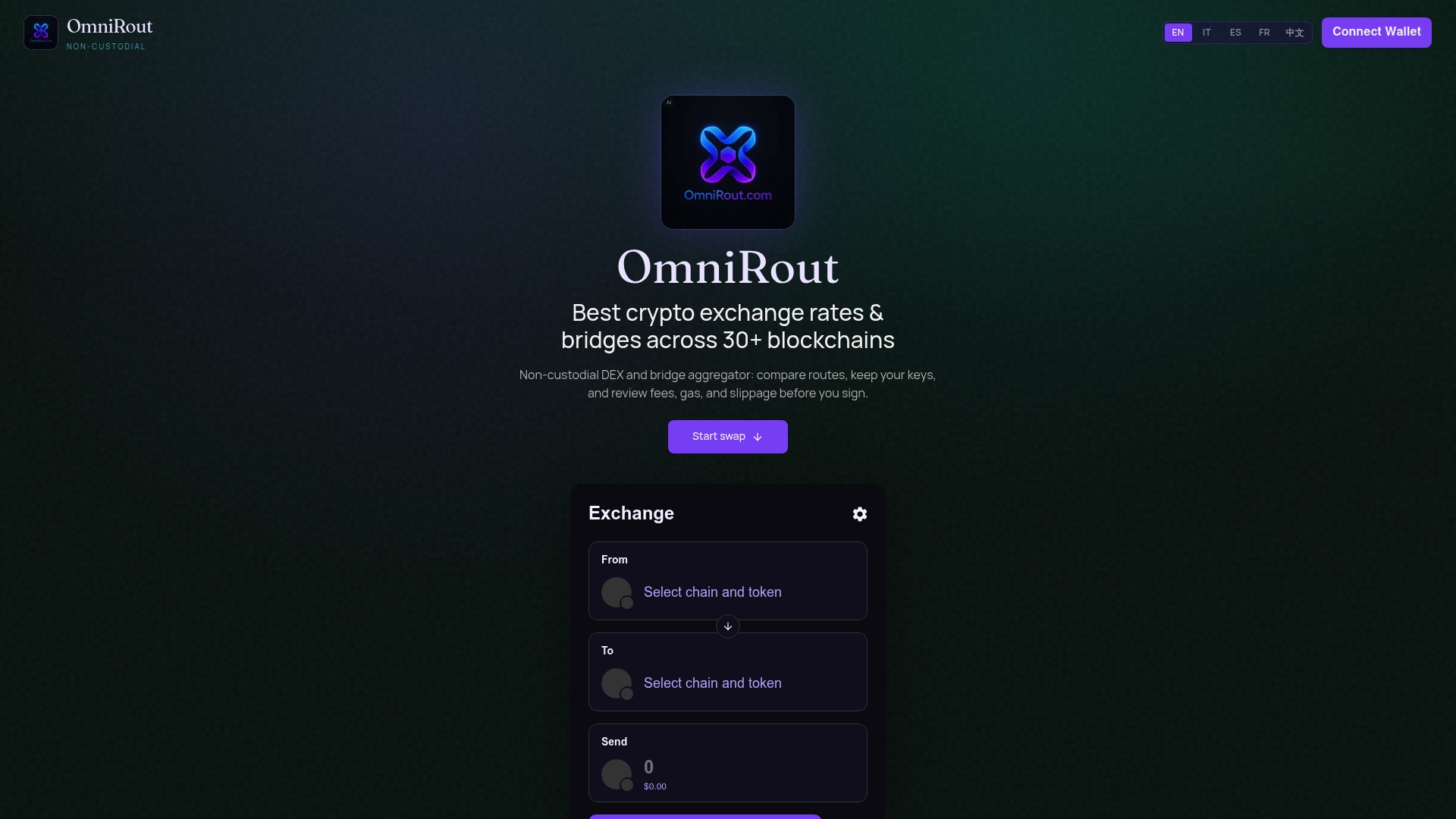
The platform connects with standard wallet setups, so there's no new account or custodial deposit step between you and your first comparison. If a route doesn't fit your trade, you see that before committing, not after a transaction is already stuck on a bridge. For developers, OmniRout's aggregation logic is also available for integration into existing wallet and dApp interfaces.
Head to OmniRout and run a route comparison on your next cross-chain trade to see the full cost breakdown before you decide.
Frequently Asked Questions
Which chain is best for swaps overall? There's no single best chain for every swap. Solana wins on raw speed and cost for same-chain trades, while EVM chains offer deeper aggregate liquidity for cross-chain routing through aggregators like OmniRout or LI.FI.
Which DEX is best for swaps? Aggregators that compare multiple DEXs and bridges, rather than a single-venue DEX, typically deliver better total pricing because they route around thin liquidity pools automatically.
What is better than Uniswap for cross-chain swaps? Uniswap operates on-chain, single-chain liquidity pools. For cross-chain trades, an aggregator like OmniRout or LI.FI serves a different purpose: comparing routes across multiple chains and bridges rather than a single pool.
Is it safer to use an aggregator or a direct bridge? An aggregator that shows the full cost breakdown and lets you pick from audited bridge options generally reduces risk compared to manually choosing a single bridge without comparison data.
Do I need KYC to swap across chains? It depends on the platform and trade size. Non-custodial aggregators typically require no KYC since they never take custody of funds. Instant exchangers often skip KYC for smaller trades but may require it above certain thresholds.
How much should I expect to pay in fees for a cross-chain swap? Total cost varies by route, chain congestion, and bridge choice. Comparing the final settled amount across multiple routes, rather than the advertised rate alone, gives the clearest picture of real cost.