A cross-chain swap moves or exchanges tokens across different blockchains in a single logical flow, without you manually bridging assets between steps. The fastest safe path: use a non-custodial aggregator, confirm your gas coverage on the source chain, and run a small test swap before committing larger amounts.
Before your first swap, run through this quick checklist:
- Connect a non-custodial wallet (MetaMask, Rabby, or similar) and verify you hold the correct gas token for the source chain
- Confirm the source chain, destination chain, token contracts, and chain IDs before approving anything
- Send a small test amount first, verify it arrives on the destination chain, then proceed with the full transfer
Omnirout is the recommended non-custodial route-comparison aggregator for this guide, covering 30+ chains with transparent fee and slippage previews before you confirm.
Key Takeaways
A cross-chain swap moves tokens across different blockchains in one flow, and the single most important safety practice is running a small test swap before transferring significant value.
| Point | Details |
|---|---|
| What a cross-chain swap is | A single coordinated flow that moves or exchanges tokens across different blockchains without manual bridging steps. |
| Top security practice | Run a small test swap first; blockchain transactions are irreversible once confirmed on the source chain. |
| Fee layers to expect | Source-chain gas, bridge fee, DEX swap fee, and any aggregator service fee all add to the total cost. |
| Native BTC limitation | Native Bitcoin cannot participate in most cross-chain swap flows; only wrapped representations like WBTC are swappable. |
| Omnirout recommendation | Use Omnirout for non-custodial route comparison across 30+ chains, with full fee and slippage visibility before you confirm. |
Table of Contents
- What exactly is a cross-chain swap?
- How does a cross-chain swap actually work?
- Step-by-step: how to run a non-custodial cross-chain swap
- What are the real security risks, and how do you reduce them?
- What fees and timing should you expect?
- Which chains and tokens are supported, and what are the limits?
- How Omnirout reduces complexity for non-custodial swaps
- Why route comparison matters more than most users realize
- Omnirout makes your first cross-chain swap straightforward
- Sources
What exactly is a cross-chain swap?
A cross-chain swap is the process of exchanging or transferring a token from one blockchain to a different blockchain in one coordinated flow. You start with, say, ETH on Ethereum and end up with USDC on Base, without manually managing each step in between.
That is different from a standard same-chain swap, which just exchanges one token for another on the same network. A bridge, strictly speaking, only moves an asset from chain A to chain B without necessarily swapping it for a different token. Wrapped assets (like WBTC) are representations of a native asset minted on a foreign chain, often created as part of a bridge step.
A non-custodial aggregator abstracts all of that. It can combine a bridge step and a DEX swap into a single user-facing transaction, so you never manually touch the wrapped asset or the intermediate chain.
How does a cross-chain swap actually work?
Three core mechanisms power most cross-chain swaps in practice.
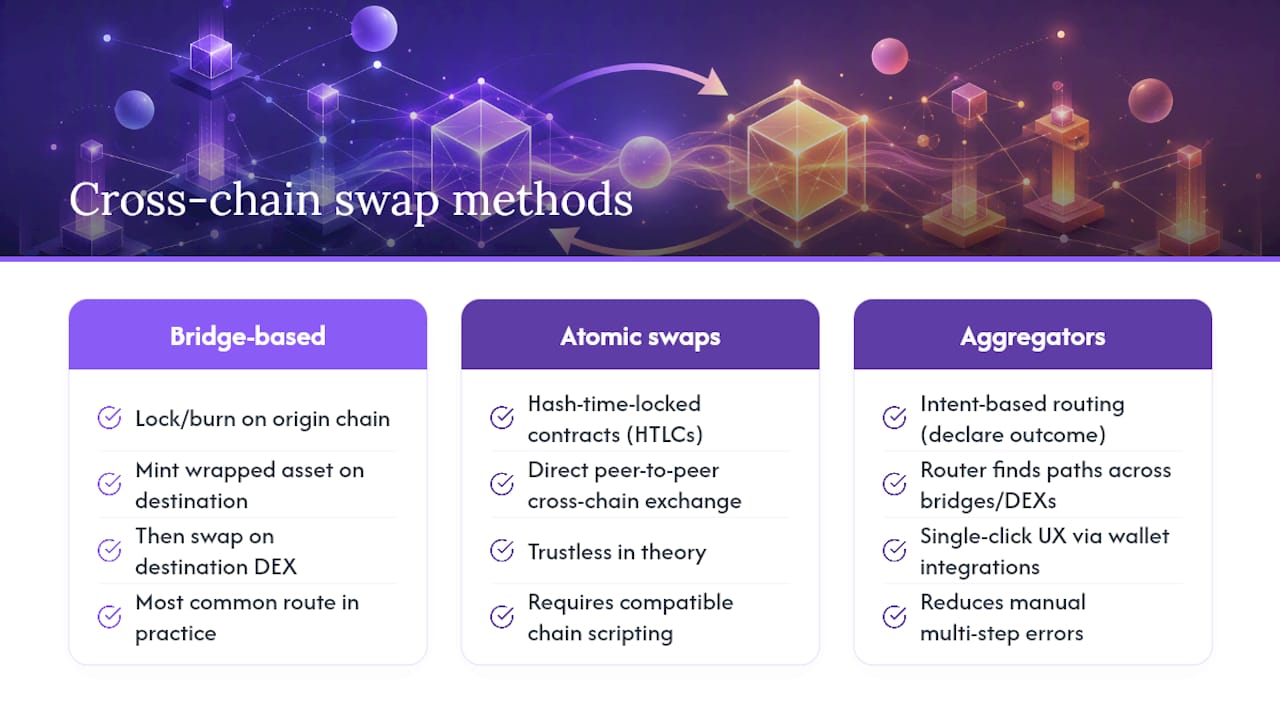
Bridge-based flows are the most common. Your source token is locked (or burned) on the origin chain, and a corresponding wrapped or synthetic asset is minted on the destination chain. That wrapped asset can then be swapped on a destination-chain DEX for the token you actually want. This is how a route like ETH on Ethereum to USDC on Polygon typically works: ETH is locked, a bridged ETH representation is minted on Polygon, and a DEX swap converts it to USDC.
Atomic swaps use cryptographic hash-time-locked contracts to exchange assets directly between two parties on different chains, with no custodian. In theory, they are trustless. In practice, they require both chains to support compatible scripting, both parties to be online, and liquidity to exist on both sides simultaneously. That combination is rare enough that atomic swaps remain mostly a niche mechanism rather than the backbone of every day multi-chain trading.
Aggregators and intent-based routing are where the real UX improvement lives. Instead of you selecting a bridge, then a DEX, then confirming each step, you declare your desired outcome: "I want USDC on Base." The router finds the best path across available bridges and liquidity pools to deliver that result. Chainlink's education hub describes this as shifting technical complexity to the protocol, reducing manual errors during multi-step transfers.
Wallet integrations like MetaMask now bundle bridging and swap routing into a single UX, which shows how mainstream this pattern has become. Axelar's General Message Passing (GMP) is one infrastructure layer that enables this kind of automated, single-click cross-chain execution by passing function calls across chains alongside asset transfers.
Emerging standards like ERC-7786 / OpenBridge aim to make cross-chain messaging more standardized and auditable, which matters for evaluating whether a bridge in your route has been formally specified.
Step-by-step: how to run a non-custodial cross-chain swap
Follow these steps in order. Skipping the test swap is the most common mistake.
- Prepare your wallet. Install a non-custodial wallet and confirm you hold the gas token for the source chain. ETH for Ethereum and Arbitrum, BNB for BNB Smart Chain, MATIC for Polygon, and so on.
- Fund gas on the source chain. You need enough gas to cover the outbound transaction. Some aggregators offer gasless or fee-abstracted swaps on specific networks such as Ethereum Mainnet, Linea, BNB Smart Chain, Arbitrum, and Base, per Blockchain.com's cross-chain swap documentation.
- Select source and destination. Choose your source chain and token, then your destination chain and target token. Double-check chain IDs and token contract addresses, not just ticker symbols.
- Preview the route. A good aggregator shows you the full path: which bridge, which DEX, estimated gas, bridge fee, slippage, and expected output. Read this before approving.
- Run a small test swap. Send a minimal amount first. Confirm it arrives on the destination chain using a block explorer for that chain.
- Approve token spending. Grant only the amount you need for this transaction, not unlimited approval.
- Submit the full swap. Once the test confirms, submit the main transaction and monitor it on both the source and destination chain explorers.
Quick troubleshooting:
- Stuck transaction: check the source chain explorer; if pending, you may need to speed up or cancel with a higher gas fee
- Insufficient gas: add the correct gas token to your source wallet before retrying
- Failed route: the bridge or liquidity pool may be temporarily unavailable; try a different route or wait and retry
Pro Tip: Use your aggregator's route preview to check which bridge is in the path. If you don't recognize the bridge name, look it up before confirming. Audited, well-known bridges carry meaningfully lower risk than obscure ones.
What are the real security risks, and how do you reduce them?
Cross-chain swaps carry more attack surface than same-chain swaps. Here is what actually matters:
- Bridge hacks: Bridges hold large pools of locked assets, making them high-value targets. Axelar's research cites aggregated bridge losses as a primary reason to prefer composable, audited routing systems over single-bridge solutions.
- Smart contract bugs: Every contract in the route (bridge, DEX, aggregator) is a potential failure point. Prefer protocols with public audits from recognized firms.
- Unlimited token approvals: Granting max allowance to a contract means any future exploit of that contract can drain your wallet. Revoke or limit approvals after each swap using a tool like Revoke.cash.
- Phishing and fake UIs: Scammers clone aggregator interfaces with near-identical URLs. Always navigate directly to the official domain and verify the URL before connecting your wallet.
- MEV and front-running: On public mempools, bots can detect your pending swap and sandwich it. Use aggregators that route through private mempools or offer MEV protection where available.
- Replay attacks: Some tokens or contracts behave differently across chains with the same address. Verify contract addresses on the destination chain independently.
Blockchain transactions are irreversible. Once a cross-chain swap is submitted and confirmed on the source chain, there is no undo. A small test swap is not optional caution — it is the minimum responsible practice before moving significant value.
Even when a swap looks seamless in the UI, security is still anchored to the underlying bridges and liquidity pools the router selects. The Chainlink Education Hub makes this point directly: a polished interface does not change the trust assumptions of the infrastructure underneath it.
Pro Tip: After any swap, visit Revoke.cash and revoke token approvals you no longer need. It takes two minutes and closes a real attack vector.

What fees and timing should you expect?
Total cost on a cross-chain swap is the sum of several layers, not one flat fee.
- Source-chain gas: paid in the native token of the origin chain, priced by network congestion at the moment you submit
- Bridge fee: charged by the bridge protocol, usually a percentage of the transferred amount or a flat fee
- DEX swap fee: typically 0.05%–0.3% of the swap amount, depending on the liquidity pool
- Aggregator service fee: some platforms add a small fee on top; others earn through spread
Timing varies by chain pair. Ethereum to Arbitrum or Optimism often settles in under two minutes because Arbitrum and Optimism post batches to Ethereum frequently. Ethereum to Solana or Ethereum to Avalanche can take longer, from a few minutes to over ten, depending on bridge finality requirements and congestion.
Ways to reduce costs:
- Route through Layer 2 chains (Arbitrum, Base, Optimism) where gas is a fraction of Ethereum mainnet costs
- Compare multiple routes in your aggregator before confirming; the cheapest bridge is not always the fastest
- Swap during off-peak hours when Ethereum mainnet gas is lower
- Use gasless swap options where your aggregator supports fee abstraction on networks like BNB Smart Chain or Base
The scale of historical bridge losses, cited by Axelar, is the clearest argument for using aggregators that route through audited, liquid bridges rather than chasing the lowest fee through an unknown protocol.
Which chains and tokens are supported, and what are the limits?
Most major aggregators cover the chains below, though exact support varies by platform and liquidity availability.
| Chain | Token standard | Notes |
|---|---|---|
| Ethereum | ERC-20, ETH | Highest liquidity; highest gas costs |
| BNB Smart Chain | BEP-20, BNB | Low fees; wide token selection |
| Polygon | ERC-20, MATIC | Fast finality; popular for gaming/NFT tokens |
| Arbitrum | ERC-20, ETH | Layer 2; low gas, deep DeFi liquidity |
| Optimism | ERC-20, ETH | Layer 2; growing ecosystem |
| Base | ERC-20, ETH | Coinbase-backed Layer 2; gasless options available |
| Avalanche | ERC-20, AVAX | Fast finality; C-Chain compatible |
| Solana | SPL tokens, SOL | Different VM; bridge support varies by aggregator |
The native BTC problem: Bitcoin does not run EVM-compatible smart contracts, so it cannot participate in most cross-chain swap flows natively. What you can swap is a wrapped representation like WBTC (an ERC-20 on Ethereum) or cbBTC (on Base). These are not the same as holding actual BTC on the Bitcoin network. If your goal is to end up with native BTC in a Bitcoin wallet, most aggregators cannot deliver that directly.
Other practical limits: some token pairs simply lack liquidity on the destination chain, making a route unavailable or extremely high-slippage. Bridge availability between specific chain pairs is not universal. Token standard incompatibilities (ERC-20 vs. SPL, for example) require a bridge that handles the translation, and not every bridge does.
How Omnirout reduces complexity for non-custodial swaps
Omnirout is built specifically for the problem this guide addresses: executing a cross-chain swap without handing custody of your keys to anyone.
Key features:
- Non-custodial routing: your private keys never leave your wallet; Omnirout routes the transaction but does not hold assets
- Route comparison: before you confirm, you see fees, gas estimates, slippage, and the full path across bridges and DEXs
- 30+ chain coverage: Ethereum, BNB Smart Chain, Polygon, Arbitrum, Base, Avalanche, and more
- Transparent UI: no hidden fees buried in the spread; the cost breakdown is visible before you sign
A practical example: swapping ETH on Ethereum to USDC on Base. Omnirout surfaces multiple routes, each showing which bridge handles the ETH transfer, what the bridge fee is, what the DEX swap fee on Base will be, and the expected USDC output after slippage. You pick the route that fits your priority, whether that is lowest cost or fastest settlement, and confirm. The intent-based design means you state the destination asset and Omnirout handles the routing logic.
Run a small test swap first. Confirm the USDC arrives in your wallet on Base before sending a larger amount.
Why route comparison matters more than most users realize
Most people doing their first cross-chain swap focus on the destination token and ignore the route. That is the wrong priority.
A route that saves $2 in gas but routes through an unaudited bridge is not a bargain. Omnirout was built around route comparison precisely because the path matters as much as the destination. The team's practical recommendation: always preview the full route, check the bridge name, and run the test swap. Larger transfers deserve the extra thirty seconds.
Omnirout makes your first cross-chain swap straightforward
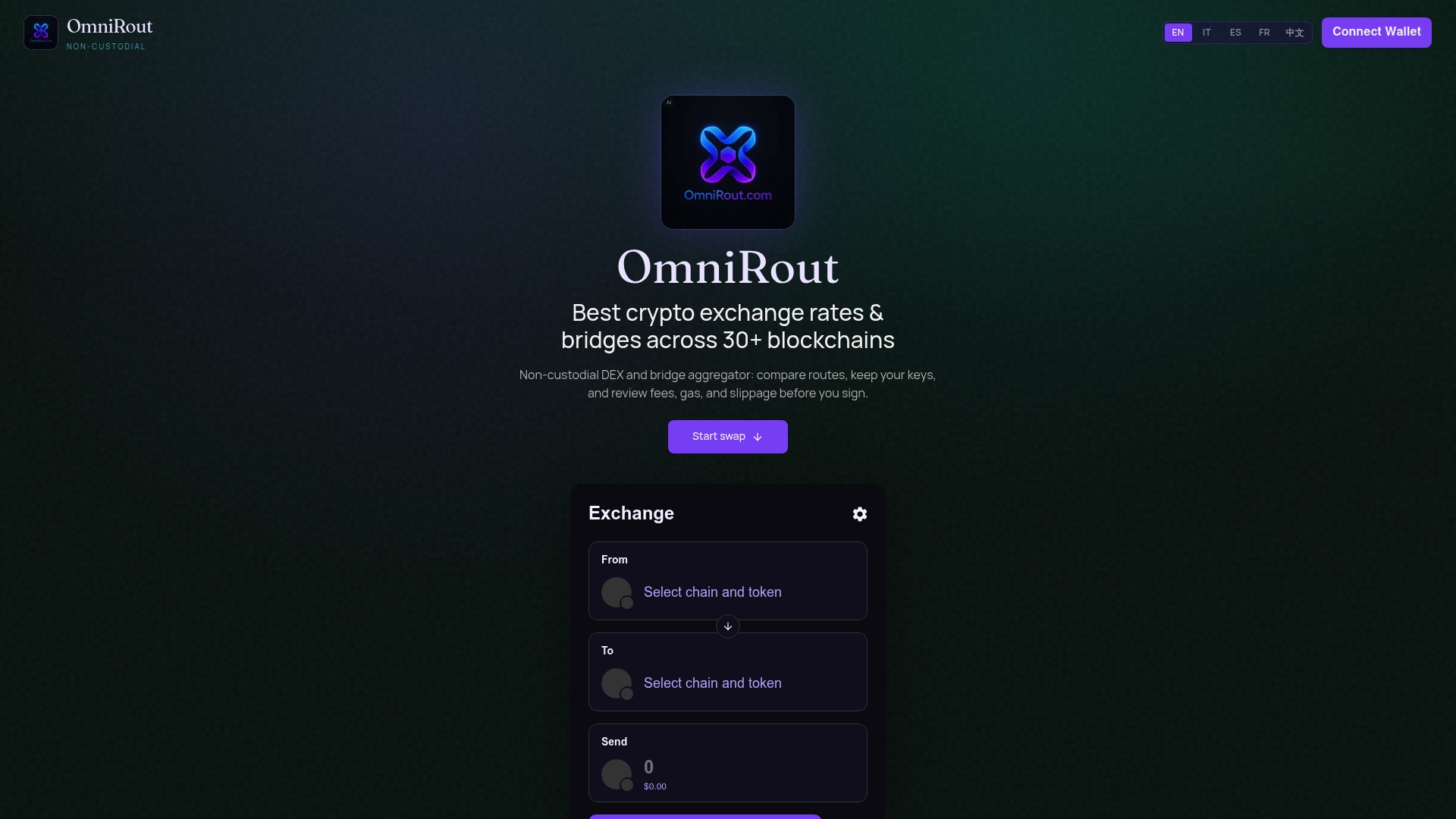
Omnirout is a non-custodial DEX and bridge aggregator that lets you compare routes across 30+ blockchains before committing to a transaction. You keep your keys, see the full cost breakdown upfront, and choose the route that fits your needs.
Three steps to get started:
- Connect your non-custodial wallet at Omnirout
- Select your source chain and token, then your destination chain and target token
- Compare the available routes, run a small test swap, and confirm when you're satisfied with the fee and slippage preview
Support resources and documentation are available directly on the Omnirout site.
Sources
- Cross Chain Swaps FAQs – Blockchain Support Center
- How to bridge tokens from one chain to another
- What are Cross-Chain Swaps? | Axelar Blog
- Cross-chain swap — Chainlink Education Hub
This article is general information, not a substitute for advice from a qualified financial advisor. Consult a qualified financial professional about your own circumstances before acting on anything here.