
Choose a calldata-returning, multi-pool DEX aggregator API that covers every chain your product needs, and you'll skip weeks of integration work. That's the whole verdict. If the API hands you executable calldata, batches pool queries into single requests, and speaks to more than one chain out of the box, you're looking at a production-ready option. If it makes you assemble transactions client-side or forces one RPC call per pool, keep looking.
Here's the reasoning behind that verdict, in three parts:
- Calldata-first saves integration time. When an API returns a ready-to-sign
{ to, data, value }object, you skip the work of reconstructing router calls from partial data, and you cut an entire class of bugs tied to encoding mismatches. - Multi-pool batch endpoints cut latency and cost. Fetching ten pools with ten separate calls burns rate limit budget and adds round-trip time you don't need; a single batched request gets you a consistent snapshot for comparison.
- Multi-chain coverage prevents rebuild cycles. Bolting on a second aggregator every time you add a chain is expensive. An API that already speaks to the chains on your roadmap saves that rebuild entirely.
Once you've picked an API against those three criteria, the fastest next step is pulling up its quickstart or sandbox docs and running a real quote request before you write a single line of production code.
Key Takeaways
The strongest DEX aggregator APIs return executable calldata in a single request, batch pool queries, and cover every chain your product roadmap requires.
| Point | Details |
|---|---|
| Prioritize calldata output | Choose an API that returns a signable { to, data, value } object, not just a route plan you must encode yourself. |
| Batch your pool queries | Use multi-pool endpoints instead of looping single-pool calls to cut latency and rate-limit pressure. |
| Run three test cases | Validate with a same-chain swap, a split-routing trade, and a cross-chain swap before committing to an API. |
| Monitor swap success separately | Track quote success and swap success as distinct metrics, since a quote succeeding doesn't guarantee execution does. |
| Refresh token lists, don't hardcode | Poll token discovery endpoints periodically instead of baking addresses into client code. |
| Consider OmniRout for production | OmniRout offers non-custodial, calldata-first swaps and route comparison across 30+ chains for teams ready to integrate. |
Table of Contents
- What Does a DEX Aggregator API Actually Do?
- What Capabilities Separate a Production-Ready API From a Toy One?
- Which Endpoints Should You Expect From an Aggregator API?
- How Should You Architect the Integration?
- How Do You Evaluate and Choose an API?
- How Do You Test and Monitor an Aggregator Integration Long-Term?
- Why Batch Endpoints Beat One-Pool-At-A-Time Calls
- What Does OmniRout Offer Developers Building on This Model?
- What I'd Prioritize First If I Were Integrating This Today
- Try the OmniRout Developer Sandbox
- Frequently Asked Questions
- Sources
What Does a DEX Aggregator API Actually Do?
A DEX aggregator API sits between your product and dozens of decentralized exchange routers, and it does four jobs: it prices a trade across multiple liquidity sources, plans the best route (sometimes splitting a trade across several pools), estimates the output amount with slippage built in, and assembles the calldata your wallet or backend needs to execute the swap. Some APIs also expose the underlying on-chain router contract directly, letting advanced integrators bypass the HTTP layer for specific legs of a trade.
The flow is simpler than it sounds. Your client sends a request with the input token, output token, amount, and chain ID. The API's routing engine checks liquidity across supported pools, picks (or splits across) the best paths, and returns a quote. You then request execution, and the API returns calldata ready for signing. Three steps: request, route and quote, calldata.
Here's what you should expect the API itself to own, versus what your integration has to handle:
- Quote generation across multiple pools and routers for a given token pair.
- Trade simulation so you can preview slippage and output before committing.
- Calldata assembly for the actual swap transaction.
- Submission or broadcast support, either directly or by handing you a signable payload.
- Token discovery, so you can resolve symbols like
USDCto the correct contract address per chain instead of hardcoding it yourself. - Chain mapping, translating a human-readable chain name into the chain ID and RPC endpoint the router expects.
If an API leaves token discovery and chain mapping entirely to you, budget extra engineering time. That's a genuinely underestimated cost, and it's the difference between a two-day integration and a two-week one.
What Capabilities Separate a Production-Ready API From a Toy One?
Plenty of aggregator APIs return a price. Fewer return everything you need to actually execute a trade safely at scale. Here's the checklist worth running against any candidate:
- Executable calldata output. The response includes a ready-to-sign transaction object, not just a numeric quote.
- Multi-pool batch endpoints. You can query several pools or tokens in one request instead of looping HTTP calls.
- Multi-chain token aliasing. The API resolves symbols to the right contract address per chain automatically.
- Slippage controls. You can set a tolerance and get a worst-case amount, not just an expected one.
- Split routing. Large trades get divided across multiple pools when that produces a better net price.
- Fee and gas cost breakdown. You see protocol fees, aggregator fees, and estimated gas separately, not bundled into one opaque number.
- Quoting vs. guaranteed quotes. The API tells you clearly whether a quote is indicative or binding for a short window.
- Rate limiting with clear headers. You know your quota and remaining calls before you hit a wall.
- Idempotency support. Resubmitting the same request with a retry key doesn't produce a duplicate transaction.
A 2026 developer roundup of aggregator APIs makes the same point directly: the top-rated options in that comparison all return executable calldata in a single request and cover multiple chains, which the roundup treats as the baseline expectation, not a premium feature.
Pro Tip: Favor APIs that hand back broadcast-ready calldata over ones that only give you a route plan. Calldata-first design means your wallet integration is a signing step, not a transaction-building project, and it removes an entire category of encoding bugs from your codebase.
Which Endpoints Should You Expect From an Aggregator API?
Most production aggregator APIs converge on a similar set of endpoints, even when the naming differs. Expect something close to this pattern:
| Endpoint type | Purpose | Typical response fields |
|---|---|---|
/quote | Get expected output for a trade | quoteId, expectedAmountOut, routePlan, deadline |
/price | Lightweight price check without a full route | price, chainId, timestamp |
/estimate | Gas and fee estimate for a planned trade | gasEstimate, protocolFee, worstCaseAmount |
/execute or /submit | Returns signable calldata | to, data, value, execution_instructions |
| Token discovery | Resolve symbols to addresses per chain | symbol, address, chainId, decimals |
| Multi-pool batch | Bulk pool data in one call | array of pool objects with liquidity, fee, price |
A minimal integration flow looks like this in pseudo-code:
quote = api.get("/quote", tokenIn, tokenOut, amount, chainId)
if quote.expectedAmountOut meets your slippage tolerance:
    execution = api.post("/execute", quote.quoteId, recipientAddress)
    tx = { to: execution.to, data: execution.data, value: execution.value }
    signedTx = wallet.sign(tx)
    broadcast(signedTx)
Request, quote, execute, sign, send. That's the entire lifecycle for a same-chain swap.
Cross-chain swaps complicate the response shape slightly. You'll typically see a routePlan array with multiple legs, a separate recipient address field for the destination chain, and sometimes an execution_instructions block for non-EVM chains where a calldata triplet doesn't apply cleanly. Intear's DEX aggregator documentation shows this pattern well: its route responses include deadline, has_slippage, estimated_amount, worst_case_amount, and execution_instructions arrays built specifically for chains where simple { to, data, value } doesn't cover execution.
How Should You Architect the Integration?
There are three broad architecture patterns, and picking the wrong one creates either security holes or a clunky user experience.
Thin client pattern. Your front-end calls the aggregator API directly for a quote, gets calldata back, and passes it to a connected wallet like MetaMask for signing. This is the simplest pattern and keeps private keys entirely out of your infrastructure. It's the right default unless you have a specific reason to route through a backend.
Server-assisted signing. Your backend fetches the quote and calldata, does additional validation (slippage checks, allowlist enforcement, fraud checks), then hands the signed transaction back to the client or a custodial wallet service. This adds latency but gives you a control point for business logic.
Full server execution. Your backend holds keys and executes trades on behalf of users. Avoid this pattern unless your product genuinely requires custodial trading, since it concentrates key management risk and regulatory exposure in one place.
A few trade-offs worth internalizing before you commit to one:
- Security vs. UX. Server-side signing gives you more control but means you're managing private key infrastructure, replay protection, and idempotency keys yourself.
- Latency vs. freshness. Caching quotes for a few seconds reduces API calls but risks executing against a stale price; live quoting on every attempt is safer but slower.
- Parallelism matters for cost. Batch pool queries where the API supports it, cache token metadata locally with a short TTL, and coalesce duplicate in-flight requests instead of firing them individually.
Open-source projects illustrate these patterns well. The Meta Aggregation API project wraps multiple aggregators behind a provider pattern, where each provider class handles one router and a service layer collapses the responses into a single unified quote. O1.exchange's documented architecture splits the routing engine, the HTTP API, and the on-chain router contract into distinct layers, which keeps route-search complexity isolated from what integrators actually touch. Both are worth reading even if you don't use either directly, because they show how experienced teams structure this problem.
How Do You Evaluate and Choose an API?
Run through this checklist before committing engineering time to any aggregator:
- Does it return executable calldata, or just a route plan you have to encode yourself?
- How many chains does it cover, and do those chains match your actual roadmap, not just your current product?
- Does it expose multi-pool batch endpoints, or will you be looping single-pool requests?
- What are the rate limits and SLA terms, and are they documented clearly enough to plan capacity around?
- Is there a sandbox or testnet environment, so you can validate integration before touching mainnet funds?
- Are SDKs available for your stack, or will you be hand-rolling an HTTP client?
- How are errors structured, and does the API document retry semantics for each error code?
- Does it support idempotency keys to prevent duplicate execution on retry?
- What's the pricing model, and does it scale predictably with your expected volume?
- Does it normalize tokens across chains, or will you maintain your own address mapping?
Beyond the checklist, run three concrete test cases against any candidate before you commit:
- A simple same-chain swap that should return clean, signable calldata on the first try.
- A large trade sized to force split routing across multiple pools, to confirm the API actually splits rather than dumping the whole trade into one thin pool.
- A cross-chain swap that returns a full
routePlanwith destination-chain calldata or execution instructions, not just a same-chain quote with an extra field bolted on.
Watch for these red flags during evaluation: opaque fee structures that don't separate protocol fees from aggregator markup, no executable calldata output at all, missing sandbox or testnet access, token aliasing so incomplete you end up building your own mapping layer anyway, undocumented rate limits, and vague error responses that give you no way to distinguish a retryable failure from a permanent one. OKX's public documentation of its OS DEX API claims aggregation across more than 400 DEXs and 25 chains, which is a useful benchmark for the scale that mature aggregator backends now operate at.
How Do You Test and Monitor an Aggregator Integration Long-Term?
Before shipping, run through a testing checklist: request sandbox API keys, write deterministic quote tests against known token pairs, use any dry-run or simulate endpoint the API offers, test replay and resubmission behavior explicitly, and run full end-to-end swaps on a testnet before touching mainnet.
Once you're live, the metrics that actually tell you whether the integration is healthy are:
- Quote latency, tracked as a distribution, not just an average.
- Quote success rate, since a spike in failed quotes usually signals upstream liquidity or provider issues.
- Swap success rate, separate from quote success, since a quote succeeding doesn't guarantee execution succeeds.
- Slippage drift, comparing expected amount against actual settled amount.
- Error rate by error code, so you can distinguish rate-limit throttling from routing failures.
- Rate-limit events, tracked over time to catch capacity issues before users do.
- On-chain confirmation time, which reflects network conditions as much as the API itself.
One practical number worth building into your alerting from day one: if your swap success rate drops more than a few points below your quote success rate over a rolling window, that gap usually means quotes are going stale before execution, a strong signal to shorten your quote-to-execute window or add a re-quote step.
A documented engineering trade-off from CoinGecko's aggregator-building guide is worth internalizing here: batching reduces call volume, but it also means a single failed batch can obscure which individual pool failed, so build partial-failure handling and correlation IDs into your logging from the start. Tag every quote request with its quoteId and routePlan in structured logs, so a failed execution downstream can be traced back to the exact route that produced it.
Why Batch Endpoints Beat One-Pool-At-A-Time Calls
If you take one architectural lesson from this guide, make it this: fetch pool data in batches, not one request per pool. The case is straightforward. Batching means fewer round trips, which means lower latency for the user waiting on a quote. It means a consistent snapshot, since every pool in the batch was priced at roughly the same moment, which matters when you're comparing routes against each other. And it means far less pressure on your rate limit budget, which matters the moment your product scales past a handful of concurrent users.
CoinGecko's on-chain API documents exactly this pattern with its /onchain/networks/{network}/pools/multi/{addresses} endpoint, which returns price, liquidity, and fee data for multiple pools in a single call, with an optional volume breakdown for deeper liquidity analysis. It's a clean example of the bulk-fetch pattern every serious aggregator implementation converges on eventually.
A few implementation details make batching work well in practice rather than just in theory:
- Request only the pool addresses you actually need for the current comparison, not your entire known universe of pools.
- Cache token metadata with a short TTL instead of refetching it on every quote request; token symbols and decimals rarely change mid-session.
- Refresh token lists periodically rather than hardcoding them. Rhea Finance's cross-chain aggregation SDK documentation makes this point explicitly: token lists should be polled and refreshed, not baked into client code, because contract deployments and chain support change more often than most teams expect.
- Handle partial failures gracefully. If three of ten pools in a batch fail to return data, don't fail the entire quote. Return what succeeded and flag the gap.
Pro Tip: If you're building on Python, FastAPI is worth a look for the API layer itself, since its async support makes parallelizing multiple provider or RPC calls straightforward without blocking the request thread, which matters a lot when you're fanning out to several routers at once.
What Does OmniRout Offer Developers Building on This Model?
If you're evaluating an aggregator against everything above, OmniRout is worth putting on your shortlist. It's a non-custodial DEX and bridge aggregator covering more than 30 blockchains, built around the same calldata-first principle this guide has been arguing for throughout.
Here's what that looks like in practice:
- Non-custodial by design. Users and integrators retain control of their own keys; OmniRout never takes custody of assets mid-swap.
- Multi-chain coverage across 30+ chains, which matters if your roadmap includes expansion beyond your current network.
- Built-in route comparison, surfacing fees, gas costs, and slippage side by side before a transaction executes, so users (and your product) can see the actual cost of a route, not just a headline price.
- Broadcast-ready calldata output following the same
{ to, data, value }pattern discussed earlier in this guide, which means wallet signing is a single step rather than a construction project.
A basic integration sequence looks like this: request a quote from OmniRout for your token pair and chain, receive the route comparison and expected output, request execution to get the signable calldata object, sign it with your user's wallet or your server-side signer, and broadcast. Check OmniRout's developer documentation for current authentication requirements and rate limit tiers before you scope your integration timeline.
When you're vetting any aggregator against the checklist earlier in this guide, the signals to look for are consistent: a real API reference, SDKs for your stack, and sandbox access. OmniRout's product page is the right entry point for confirming all three before you commit engineering time.
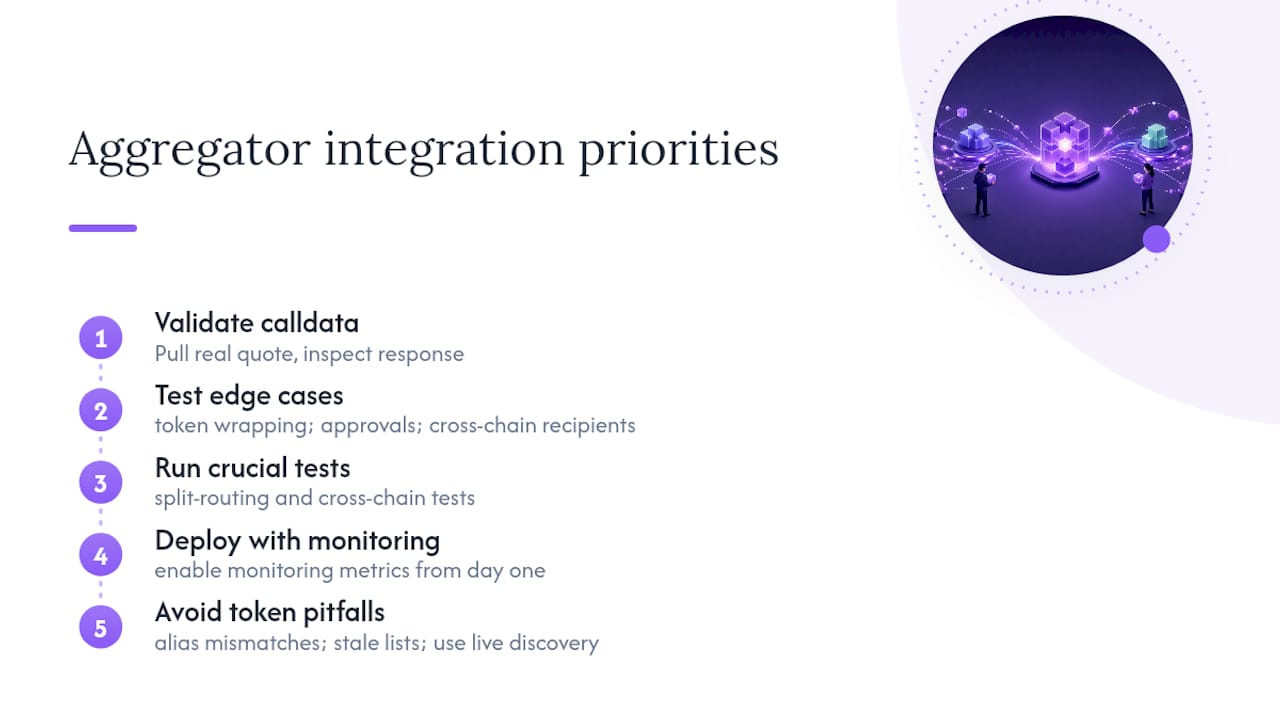
What I'd Prioritize First If I Were Integrating This Today
If you're staring down an aggregator integration right now, the order of operations matters more than most teams give it credit for. Validate the calldata shape before anything else. Pull a real quote, request execution, and look at exactly what comes back. Is it a clean { to, data, value } object, or does it require additional assembly on your end? That single check tells you more about integration cost than any amount of documentation reading.
After that, test the edge cases that break naive integrations: token wrapping (does the API handle native token to wrapped token swaps transparently, or do you need separate logic?), approval flows (does the API tell you when an ERC-20 approval transaction is needed before the swap, or does it assume infinite approval already exists?), and cross-chain recipient handling (does the destination address get validated before you sign, or only after the transaction fails on the other end?).
A compact plan that works for most teams: pick an API against the calldata-first, multi-chain, batch-endpoint criteria covered above. Run the three test cases from the evaluation section against it, specifically the split-routing test and the cross-chain test, since those are where thin implementations fall apart. Then deploy with the monitoring metrics in place from day one rather than bolting them on after your first production incident.
Two pitfalls show up more often than any others. Token alias mismatches, where the API resolves a symbol to a different contract address than your front-end expects, usually because of unofficial or bridged token variants sharing a symbol. And stale token lists, where a hardcoded address map quietly breaks the moment a project migrates contracts or a new chain gets added to your product's scope. Both are avoidable if you treat token discovery as a live API call rather than a static file you shipped six months ago.
Try the OmniRout Developer Sandbox
Reading about calldata-first architecture is one thing. Watching a real quote turn into signable calldata in front of you is another. OmniRout gives you that second option directly, without a lock-in period or a sales call standing between you and an API key.
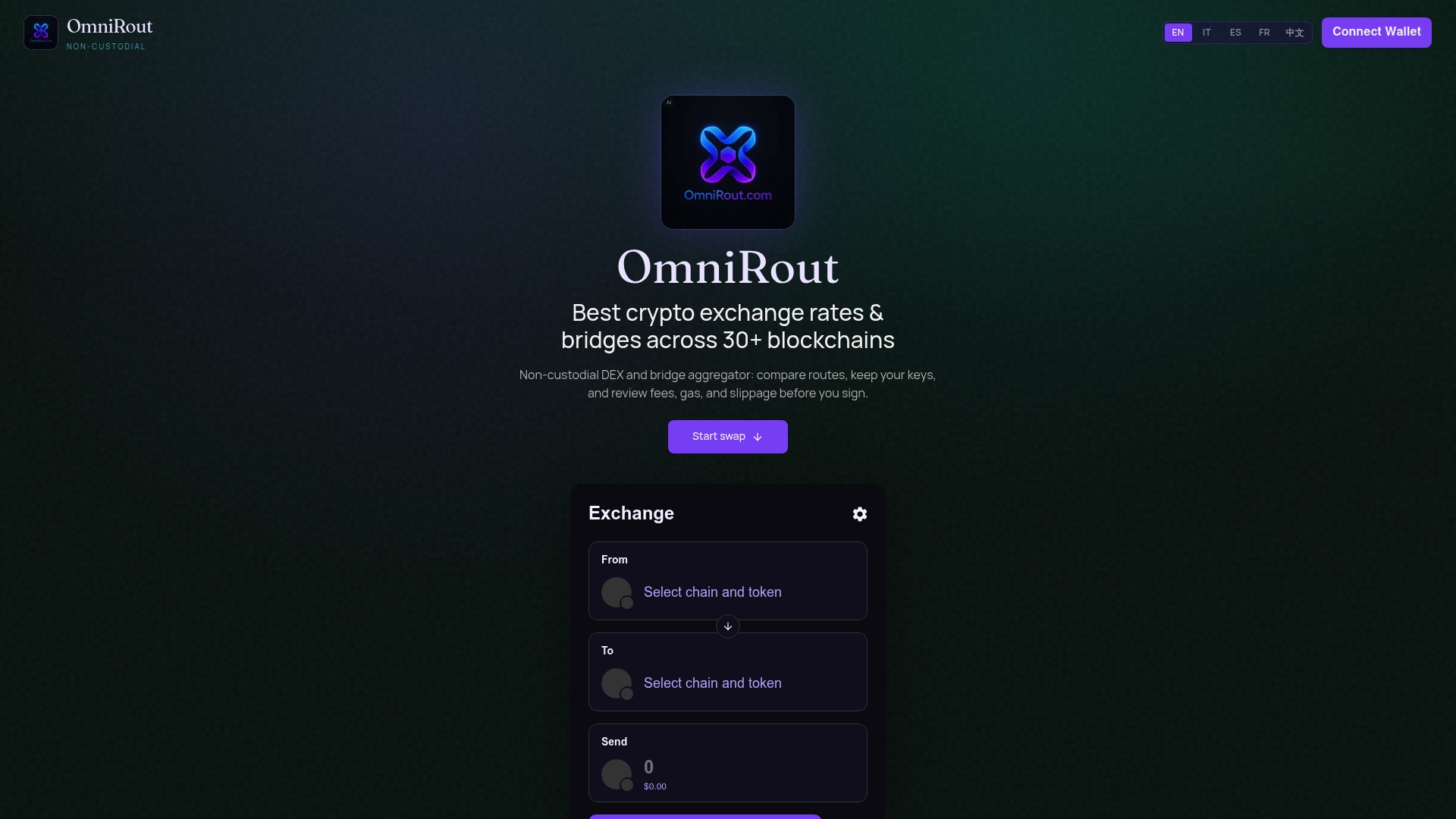
The path from zero to a working test swap is short: sign up, generate an API key, run a test quote against a token pair on a chain you support, and inspect the calldata object that comes back. If it matches the { to, data, value } shape covered throughout this guide, you're already most of the way to a production integration. From there, wire it into your signing flow and run the three test cases from the evaluation checklist before you touch mainnet.
Head to OmniRout's developer sandbox to request access and start testing against real route comparisons across more than 30 chains.
Frequently Asked Questions
What is a DEX aggregator API used for? It lets your application source the best available price for a token swap across multiple decentralized exchanges in one request, rather than querying each exchange's router individually.
Do I need to run my own node to use a DEX aggregator API? No. Most aggregator APIs handle RPC connections and routing internally; you interact with them over standard HTTP, and you only need node access if you're broadcasting the signed transaction yourself.
What's the difference between a quote and executable calldata? A quote tells you the expected output amount for a trade. Executable calldata is the actual transaction payload, ready to sign and broadcast, that carries out that trade on-chain.
How do I handle slippage in a DEX aggregator integration? Set a slippage tolerance in your quote request and check the returned worst-case amount against your acceptable threshold before requesting execution; reject or re-quote if the spread is too wide.
Is OmniRout suitable for a production integration? OmniRout is a non-custodial aggregator covering more than 30 chains with route comparison and calldata output, which aligns with the core criteria this guide recommends: check its current developer documentation for authentication and rate limit specifics before scoping your integration.
Sources
- How to Build a DEX Aggregator | CoinGecko API
- FastAPI — tiangolo
- 7 Best DEX Aggregator APIs for Developers in 2026