DEX routing is the process by which a router or aggregator decides which liquidity pools, and in what sequence, a trade should pass through to convert one token into another. The job isn't finding a path. It's finding the path that maximizes net output after fees, gas, price impact, and MEV exposure — not the biggest headline swap rate.
That distinction drives every design decision that follows. A route that looks best on raw output can lose to a cheaper route once you subtract gas and slippage, especially on a $50 swap where a three-hop path burns more in gas than it saves in price improvement.
Three things matter most when you're evaluating or building a router:
- Cost terms: price impact, protocol fees, network gas, and MEV cost (value extracted by sandwichers or reordering) all subtract from the quoted amount.
- Latency targets: production solvers like Fynd claim sub-100ms solve times; anything slower risks quoting stale prices in fast-moving pools.
- Architecture split: most systems separate an off-chain solver (does the heavy computation) from an on-chain router contract (executes the chosen path atomically).
Key Takeaways
DEX routing works best when it optimizes for net output after fees, gas, and slippage rather than raw quoted price, and production-grade performance depends on parallelized solver architecture, not a single clever algorithm.
| Point | Details |
|---|---|
| Objective function first | Rank routes by net output after fees, gas, and slippage, not raw quoted output alone. |
| Architecture matters as much as algorithms | Separate streaming data, parallel solver workers, and a gas-aware ranking layer for real-time performance. |
| Split routing cuts slippage on size | Routing a large trade across multiple pools can cut slippage sharply compared to a single-pool swap. |
| Security is broader than MEV | Guard against sandwich attacks, flash loan exploits, and failed multi-hop transactions with on-chain minimum-output checks. |
| Start with OmniRout for transparent execution | OmniRout compares fees, gas, and slippage across routes non-custodially before you swap or bridge across 30-plus chains. |
Table of Contents
- What Is DEX Routing, Really?
- What Concepts Do You Need to Understand DEX Routing?
- Routing Objectives and the Cost Model Routers Optimize
- Should a Router Use One Hop, Many Hops, or Split the Trade?
- Which Algorithms Actually Power Production Routers?
- On-Chain Contracts or Off-Chain Solvers: Which Integration Pattern Fits?
- How Do You Benchmark a Routing Engine's Real Performance?
- What Are the Biggest Risks in DEX Routing, and How Do You Mitigate Them?
- How Does Cross-Chain Routing Change the Cost Model?
- How Should Routing Protocols Handle Governance and Upgrades?
- Are There Regulatory Considerations for DEX Routing?
- What Makes Routing Hard to Integrate With Other DeFi Protocols?
- A Minimal Router: Pseudocode and Contract Sketch
- Why Decomposition and Parallelization Are the Real Breakthrough in Routing
- What Should Engineers Actually Do When Building or Integrating a Router?
- How Does Solana Routing Differ From EVM Routing?
- An Editorial Take: Where Routing Design Actually Goes Wrong
- OmniRout's Approach to Routing Priorities
- Try OmniRout's Route Comparison for Your Next Swap
- Sources
What Is DEX Routing, Really?
Decentralized exchange routing is the layer that sits between a user's swap intent and the actual on-chain transaction. A pure decentralized exchange like a single Uniswap pool only knows its own reserves. It has no concept of a better price sitting two pools away. Routing software fixes that by treating the entire liquidity landscape, across dozens of protocols and sometimes multiple blockchains, as one searchable space.
The standard industry term for this function is smart order routing (SOR), borrowed from traditional finance where brokers split orders across exchanges to get best execution. In crypto, the same idea applies to constant function market makers (CFMMs), concentrated liquidity pools, and RFQ systems. When people say "dex aggregator," they usually mean a product built on top of a routing engine. The aggregator is the storefront; routing is the engine under the hood.
Here's what most explainers skip: routing isn't a one-time calculation you run and forget. Pool reserves shift with every block, sometimes every few hundred milliseconds on faster chains. A router that quotes a great price and then executes three seconds later against different reserves has effectively lied to the user. That's why routing efficiency is as much a systems-engineering problem as a math problem.
What Concepts Do You Need to Understand DEX Routing?
Think of the entire liquidity landscape as a graph. Tokens are nodes. Pools are edges connecting two (or more) nodes, each edge weighted by the price you'd get for a given trade size, the available depth, and an estimated slippage curve.

This graph model works because it lets you reuse decades of graph theory, but it also reveals why routing is harder than it looks. The Seven Bridges of Königsberg problem is the classic illustration of how quickly a simple network question turns into a combinatorial mess. DEX liquidity graphs have that same property: hundreds of tokens, thousands of pools, and edge weights that change block by block.
A few terms you need to be fluent in before touching a router codebase:
- CFMM (constant function market maker): pools like classic Uniswap v2 where reserves follow a fixed formula (x times y equals k).
- Concentrated liquidity: Uniswap v3-style pools where liquidity providers commit capital to specific price ranges, creating variable depth along the curve.
- Stable pools: pools tuned for assets expected to trade near parity (stablecoin pairs), with flatter price curves and lower slippage near the peg.
- RFQ / orderbook liquidity: market makers quote prices directly off-chain or semi-on-chain, bypassing AMM curves entirely.
- Slippage and price impact: the gap between the quoted price and the executed price, driven by trade size relative to pool depth.
- Bounded liquidity: the reality that every pool has a finite depth before price impact becomes unacceptable, forcing routers to split large trades.
Picture the graph as a subway map where line thickness represents liquidity depth and travel time represents gas cost. A router's job is choosing the fastest, cheapest combination of lines to get you from Token A to Token B, even when that means transferring twice.
Routing Objectives and the Cost Model Routers Optimize
Most beginner explanations describe routing as "finding the best price." That's incomplete. The real objective function most production routers optimize looks like this:
Net output = quoted output − protocol fees − gas cost − expected slippage − MEV cost
Say a router finds two candidate paths for a 10 ETH to USDC swap. Path A quotes 34,200 USDC through a single deep pool. Path B splits the trade across two pools and quotes 34,260 USDC, a better raw number. But Path B requires two separate swap calls, costing roughly 40% more gas. On a mid-size trade, that gas difference can erase the entire 60 USDC improvement, making Path A the actual winner once you rank by net output rather than raw quote.
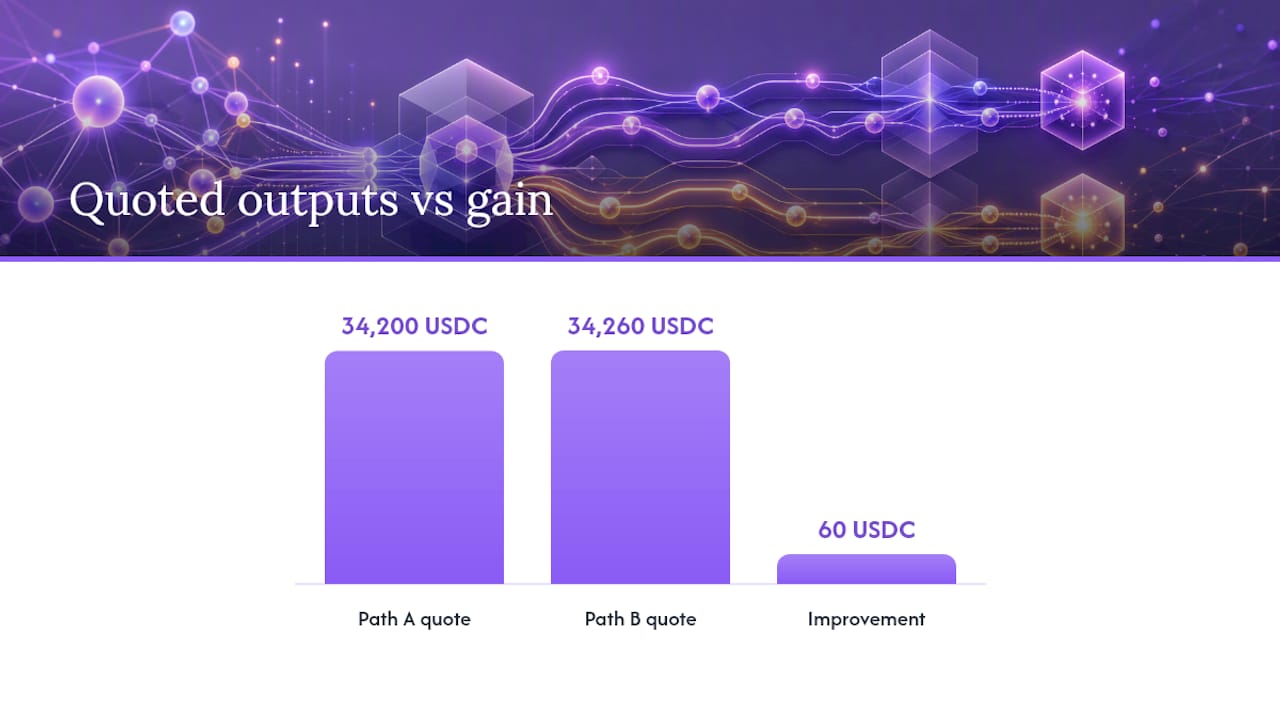
This is why gas-aware ranking matters more than most people assume. A router optimizing purely for output will systematically over-route small trades into unnecessarily complex multi-hop paths, burning users on gas while showing them a marginally prettier headline number.
The trade-offs compound from there:
- Latency versus optimality: spending an extra 200ms searching for a marginally better route often costs more in price drift than it saves.
- Gas versus multi-hop savings: every additional hop adds a fixed gas cost that has to be justified by proportionally larger output gains.
- Safety versus aggressiveness: tighter slippage tolerances protect users from bad fills but increase transaction failure rates during volatile blocks.
A recent measurement of DEX efficiency found that the specific routing method used has a measurable effect on realized exchange performance and outcomes for liquidity providers and traders alike, not just a marginal rounding difference. That's the empirical case for why the objective function you choose isn't a philosophical detail. It's the thing that determines whether your router actually beats a naive single-pool swap.
Should a Router Use One Hop, Many Hops, or Split the Trade?
Route type is a decision, not a default. A router evaluates three structural shapes for every trade, and the right choice depends on trade size, pool depth, and how fragmented the liquidity is across venues.
Single-hop routing sends the entire trade through one pool. It's the cheapest option gas-wise and the right call for small trades in deep pools where price impact stays negligible.
Multi-hop routing chains two or more pools together, useful when no direct pair exists (swapping a niche token for USDC might require routing through ETH first) or when an indirect path offers a better composite price than any direct pool.
Split routing, sometimes called smart-order routing in the Metis-style pattern, divides a single trade across multiple pools simultaneously to reduce the price impact any one pool would otherwise absorb alone. One engineering write-up on DEX router design walks through a $100,000 ETH to USDC swap where routing the trade across multiple pools cut slippage from the 2 to 3 percent range down to under 0.5 percent, compared with dumping the entire order into a single pool.
Decision criteria a router typically weighs before choosing to split:
- Pool depth relative to trade size — splitting only helps once a single pool's depth is thin enough that price impact grows nonlinearly.
- Price curve curvature — concentrated liquidity pools have steeper local curves near range boundaries, making splits more valuable there.
- Gas cost threshold — splitting adds execution overhead, so the projected price improvement has to clear that fixed cost before it's worth doing.
Which Algorithms Actually Power Production Routers?
Treating routing as a shortest-path problem is a useful starting intuition and a dangerous oversimplification if you stop there. Classic graph algorithms like Dijkstra's assume static, additive edge weights. DEX pool prices are neither. The "cost" of an edge changes depending on how much volume you push through it, which breaks the core assumption those algorithms depend on.
Engineering walkthroughs on pathfinding for DEX aggregation make this point directly: graph search is a good mental model for intuition, but production systems need heuristics, binary search over active liquidity ranges, and special-cased handling for aggregate CFMMs to hit acceptable latency.
The more rigorous alternative comes from convex optimization. Angeris et al. present a decomposition method that splits the global routing problem into smaller subproblems, one per market, that can be solved in parallel and then reassembled. Their numerical results show the approach outperforming an off-the-shelf commercial solver on realistic CFMM network topologies, including networks that incorporate aggregated Uniswap v3 liquidity.
| Algorithm family | Computational property | Where it fits |
|---|---|---|
| Graph search / shortest-path heuristics | Fast, intuitive, but breaks under nonlinear edge costs | Candidate generation, initial route pruning |
| Convex optimization / decomposition | Parallelizable, near-optimal, provably better on CFMM networks | Core solve for multi-market routing |
| Heuristic / genetic approximations | Fast approximate answers under hard time budgets | Real-time quoting under tight latency constraints |
| Multi-algorithm competition | Runs several solvers in parallel, keeps the best result | Production systems balancing speed and quality |
That last row describes what Fynd, an open-source production route-finding engine built around the Tycho data layer, actually does in practice: multiple solver strategies compete on the same trade simultaneously, results get ranked by net output after gas, and the winner gets executed. This pattern shows up across serious engines because no single algorithm wins every trade shape.
A practical architecture for this looks like: a real-time data feed keeping pool state current, feeding a pool of parallel solver workers, feeding a ranking layer that applies gas-aware scoring, feeding an executor that submits the winning transaction.
- Streaming layer stays isolated from CPU-bound solve threads to avoid blocking on I/O.
- Solvers run independently so one slow strategy doesn't stall the others.
- Ranking applies the net-output formula, not raw quote comparison.
On-Chain Contracts or Off-Chain Solvers: Which Integration Pattern Fits?
You have three realistic patterns for where routing logic lives, and each carries a different trust and performance profile.
On-chain router contracts compute or verify the path directly in a smart contract, executed atomically in one transaction. This is simple to reason about and trust-minimized (no off-chain party can lie about the quote), but it's constrained by gas costs and block time, limiting how sophisticated the pathfinding logic can be.
Off-chain solvers do the heavy computational work outside the chain, then submit signed calldata or a transaction bundle for on-chain execution. This unlocks much more complex optimization (parallel solves, convex decomposition, multi-algorithm competition) without paying for that computation in gas, but it introduces a trust dependency on the solver's honesty and uptime.
Hybrid patterns compute off-chain and verify critical invariants (minimum output, deadline, slippage bound) on-chain at execution time, capturing most of the performance benefit of off-chain solving while keeping a hard on-chain guarantee against bad fills.
Pros and cons, side by side:
- On-chain: highest trust, lowest flexibility, gas-constrained complexity.
- Off-chain solver: highest flexibility, requires trust in solver correctness, needs a separate submission/execution layer.
- Hybrid: balances both, but adds engineering complexity in keeping off-chain quotes and on-chain checks in sync.
If you're building an aggregator API, the core surface area to design carefully includes quoting (return expected output and route breakdown), approval handling (token allowances before execution), simulation (dry-run the transaction against current state before submitting), slippage protection (a hard minimum-output parameter enforced on-chain), and gas estimation (surfaced to the user before they sign).
Pro Tip: Always simulate the exact calldata you're about to submit against a forked mainnet state right before execution, not just at quote time. Pool reserves can shift enough between quote and execution that a route valid a second ago fails or underperforms now.
How Do You Benchmark a Routing Engine's Real Performance?
You can't improve what you don't measure, and routing quality is easy to fake with cherry-picked examples. A credible benchmark tracks several dimensions simultaneously, not just "does it find a good price."
Core metrics worth tracking:
- Solve time — how long the solver takes to produce a candidate route, distinct from total wall-clock latency.
- Wall-clock latency — solve time plus data-fetch time plus simulation time, the number the user actually experiences.
- Net output delta versus baseline — how much better (or worse) the chosen route performs against a naive single-pool swap.
- Slippage distribution — not just average slippage, but the tail: how often does a trade land far outside the quote?
- MEV exposure — estimated value extracted by sandwich attacks or reordering on executed trades.
- Success/failure rate — how often submitted transactions actually confirm versus revert.
- Gas per route — average gas consumed, segmented by route complexity (single-hop versus multi-hop versus split).
A sound benchmarking methodology tests both real-time streaming conditions (live pool state, actual network latency) and block-snapshot conditions (fixed historical state, useful for reproducible comparisons). Backtesting against historical blocks catches regressions that live testing might miss simply due to lucky timing.
A results schema you can adapt for publishing benchmarks:
| Metric | What the column should record |
|---|---|
| Route ID | Unique identifier for the specific route tested |
| Solve time (ms) | Time from request to candidate route generation |
| Net output vs. baseline | Percentage improvement or regression against single-pool swap |
| Gas used | On-chain gas consumed for that specific route execution |
| Success rate | Percentage of simulated or live attempts that confirmed successfully |
Larger network research backs the underlying intuition here: one study on congestion-aware routing in complex networks found that redistributing traffic away from congested central nodes improved processing capacity by more than tenfold in simulation. DEX liquidity graphs show the same congestion pattern around blue-chip pairs, which is exactly why naive "always route through the deepest pool" heuristics leave performance on the table.
What Are the Biggest Risks in DEX Routing, and How Do You Mitigate Them?
Routing efficiency means little if the execution layer is exploitable. The attack surface goes well beyond generic "MEV," and treating it as one problem instead of several distinct vectors is a common mistake.
Sandwich attacks happen when a searcher spots your pending transaction in the mempool, buys ahead of it to push the price up, lets your trade execute at the worse price, then sells immediately after. Frontrunning is the broader category this falls under. Flash loan exploits can manipulate a pool's spot price within a single transaction, tricking a router that relies on that price as ground truth. Reorgs can invalidate a transaction that looked confirmed. Failed multi-hop transactions waste gas when an intermediate hop reverts due to stale price assumptions. Bridge risk and oracle manipulation add further failure modes once a route crosses chains or depends on external price feeds.
Mitigation techniques that actually hold up in production:
- Submit through a private mempool or protected RPC endpoint to reduce sandwich-attack visibility.
- Enforce a hard minimum-output check on-chain, not just as an off-chain quote promise.
- Use gas-aware batching to bundle related calls and reduce the window an attacker can exploit between steps.
- Build rollback or compensation logic for partially executed multi-hop routes so a failed intermediate step doesn't strand user funds.
- Pad slippage tolerance intelligently based on recent pool volatility rather than a single fixed percentage across all pairs.
Pro Tip: Monitor your router's realized slippage distribution in production, not just at launch. A sudden widening of the tail (trades landing far worse than quoted) is often the earliest signal that a new sandwich strategy is targeting your specific execution pattern.
How Does Cross-Chain Routing Change the Cost Model?
Once a trade needs to leave its origin chain, the cost model gets a new set of variables that pure single-chain routing never has to account for: a bridge transfer fee, a settlement window that can range from seconds to many minutes depending on the bridge's finality model, and additional slippage risk during the time the funds are in transit.
A realistic cross-chain route might look like this: swap Token A for USDC on the origin chain, bridge that USDC to the destination chain, then swap USDC for Token B on arrival. Each of those three steps carries its own price impact and fee, and the total cost has to be modeled as one combined route rather than three separate transactions evaluated in isolation. The decision of whether this route is even worth it depends heavily on trade size relative to fixed bridge fees. Bridging $200 rarely clears the fixed-cost threshold; bridging $200,000 usually does.
Finality model differences matter more than most user interfaces let on. A bridge with fast optimistic finality might let funds move in under a minute but carries a fraud-proof window where the transfer could theoretically be challenged. A bridge relying on light-client verification might take longer but offers stronger settlement guarantees. Aggregators quoting cross-chain routes should present this risk difference to users explicitly rather than collapsing everything into a single ETA number.
How Should Routing Protocols Handle Governance and Upgrades?
Liquidity conditions never sit still. New pool types launch, existing protocols change fee tiers, and entirely new chains gain enough volume to justify integration. A router's architecture has to assume its supported liquidity sources will need updating on a rolling basis, not a fixed list decided once at launch.
Two governance models dominate in practice. Centralized-team upgrade control lets a core engineering team push new pool integrations and solver improvements quickly, which matters when a new AMM design captures meaningful volume within weeks. Decentralized or multisig-gated upgrades trade some of that speed for stronger guarantees against a single point of failure making unilateral changes to routing logic that handles user funds.
For on-chain router contracts specifically, upgradeability usually means a proxy pattern that lets logic be swapped without users having to approve a new contract address, paired with a timelock so changes are visible before they take effect. Off-chain solver configurations are easier to iterate quickly since they don't require an on-chain transaction to update, but that speed cuts both ways: it also means a bad configuration change can degrade routing quality silently until someone notices the metrics slipping.
Are There Regulatory Considerations for DEX Routing?
Regulatory treatment of DEX routing infrastructure varies significantly by jurisdiction and is still actively evolving in most markets, so this section states general principles rather than a specific legal verdict for any one country. A non-custodial router, one that never takes control of user funds and only computes and facilitates the execution of a trade the user signs and submits themselves, sits in a different regulatory posture than a custodial exchange holding customer assets.
That non-custodial distinction is central to how most aggregators position themselves, but it doesn't make routing infrastructure automatically exempt from every applicable rule. Depending on jurisdiction, considerations can include how transaction fees are disclosed, whether front-end interfaces need to comply with local consumer-protection rules, and how sanctioned-address screening is or isn't implemented at the interface layer. None of this is legal advice, and teams building or integrating routing infrastructure should confirm current requirements with qualified legal counsel familiar with the jurisdictions their users are in, since rules here shift faster than most technical documentation gets updated.
What Makes Routing Hard to Integrate With Other DeFi Protocols?
Composability is DeFi's biggest advantage and its biggest integration headache at the same time. A router doesn't operate in isolation. It typically needs to interact with token approval standards, sit alongside lending protocols that might be the actual source of a flash-loan-funded route, and coexist with yield-bearing wrapped tokens whose exchange rate to the underlying asset changes block by block.
The practical friction shows up in a few recurring places. Token approval flows (the standard ERC-20 approve-then-transfer pattern, or newer permit-based signatures) add either an extra transaction or extra signature complexity that a smooth aggregator UX has to hide from the end user. Rebasing tokens and interest-bearing wrapped assets break naive reserve-based price assumptions if the router's pool-state reader doesn't account for the wrapper's exchange rate correctly. Reentrancy risk grows any time a router contract calls out to multiple external protocols within one transaction, which is exactly the pattern multi-hop and split routing requires.
Best practice here is defensive by default: validate state after every external call rather than assuming it matches what you read before the call started, and treat every third-party protocol integration as a potential source of a stale or manipulated price until proven otherwise through your own on-chain checks.
A Minimal Router: Pseudocode and Contract Sketch
The solver loop that most production routing engines follow, from data ingestion to executed transaction, breaks down into five stages:
- Feed ingestion: subscribe to on-chain state changes (new blocks, pool swap events) and off-chain quote feeds (RFQ providers), keeping an in-memory graph of current reserves and prices.
- Candidate generation: for a given trade request, generate multiple candidate routes using a mix of heuristic pruning (drop obviously bad paths early) and the graph model described earlier.
- Simulation: run each candidate against current (or forked) state to compute actual expected output, gas cost, and slippage, not just theoretical spot price.
- Ranking: score every simulated candidate using the net-output formula and select the winner.
- Execution: submit the winning route's transaction, ideally through a protected RPC to reduce sandwich exposure, with a hard on-chain minimum-output check.
A minimal on-chain router contract sketch needs a handful of core pieces: an interface function that accepts the chosen path and a minimum acceptable output, a slippage check that reverts the entire transaction if the actual output falls short, an event emitted on successful execution for downstream indexing and analytics, and an upgrade hook (typically a proxy pattern) so the routing logic can evolve without forcing every integrated protocol to migrate to a new address.
Testing a router this way requires more than unit tests on isolated functions:
- Unit tests covering each pool-type adapter in isolation, with mocked reserves.
- Forked-mainnet simulations that replay real historical blocks against your solver to catch regressions against real liquidity conditions.
- Gas profiling across route complexity tiers, since a route that's optimal in a vacuum can be a net loser once realistic gas prices are factored in.
Why Decomposition and Parallelization Are the Real Breakthrough in Routing
The single most underappreciated idea in modern routing research isn't a clever heuristic. It's the realization that the global routing problem can be broken into independent pieces and solved in parallel, then reassembled without losing much optimality.
The routing problem across constant function market makers can be decomposed into a small local optimization for each market, and these local subproblems can be solved in parallel and combined into a global solution that performs favorably against commercial solvers on realistic network topologies.
That's the core contribution from Angeris et al.'s decomposition approach, and its practical implication is significant: instead of treating the whole liquidity graph as one giant optimization problem that has to be solved sequentially, you split it market by market, run local solves concurrently across as many cores or workers as you have available, and stitch the results together. This is what makes near-real-time routing across dozens of protocols computationally tractable instead of theoretically nice but practically too slow.
A few practical takeaways for implementing this pattern:
- Split subproblems along natural market boundaries (each pool or pool cluster becomes an independent local optimization).
- Run local solves as parallel workers, not a single-threaded sequential loop.
- Reassemble local solutions into a global route, then re-verify the combined result against current state before finalizing.
- Watch for research still catching up in this area: routing that stays robust as mempool conditions change mid-solve remains an active open problem rather than a solved one.
What Should Engineers Actually Do When Building or Integrating a Router?
Here's the sequence that keeps teams from re-architecting three months into a build:
- Choose your objective function first. Decide explicitly whether you're ranking by raw output, net output after gas, or a custom utility function that weighs execution certainty. This decision shapes everything downstream.
- Decide which pool types you'll support at launch. Trying to integrate every AMM variant, concentrated liquidity, stable pools, and RFQ on day one is how projects stall. Start with the two or three that cover the majority of your target trading pairs.
- Design your data feed and streaming layer before the solver. A brilliant solver fed stale reserve data will consistently quote badly.
- Pick a solver architecture matched to your latency budget. If sub-second quotes matter, lean on heuristics and parallel competition rather than a single exhaustive convex solve.
- Define ranking rules explicitly and document them. Ambiguity here creates inconsistent behavior that's hard to debug later.
- Choose your execution mode, on-chain, off-chain solver with signed calldata, or hybrid, based on your trust model and gas budget.
- Instrument observability from day one: solve time, net output delta, slippage tail, and failure rate should all be dashboards, not afterthoughts.
- Run canary tests on a small percentage of live traffic before rolling a new solver version out to all users.
- Follow a staged rollout: prototype with an off-chain solver against forked-mainnet data, move to integration tests against live testnets, run a canary in production against a small traffic slice, then scale.
How Does Solana Routing Differ From EVM Routing?
Chain architecture changes what "good routing" even means. Solana's model, with fast block cadence, a different fee structure, and on-chain program composability that behaves differently from EVM's account and gas model, pushes routing design in a different direction than Ethereum-style chains.
The Solana ecosystem's most visible routing engine, Jupiter, operates in an environment with much faster block times and a fee model that isn't dominated by the same kind of gas-price volatility EVM chains experience during congestion. That changes the calculus on multi-hop routing: a route that would be gas-prohibitive to split across several pools on an expensive EVM chain during high congestion can be perfectly reasonable on Solana, where per-transaction cost is far more predictable.
EVM's mempool-based transaction model, with its public visibility window before inclusion, is also precisely why sandwich attacks and frontrunning are such a persistent EVM concern. Solana's transaction propagation and leader-based block production model changes that attack surface, though it introduces its own considerations around program composability and atomicity guarantees across cross-program invocations.
Practically, this means:
- Latency targets differ: what counts as "fast enough" on one chain can be too slow or unnecessarily conservative on another.
- On-chain router complexity that's economically painful on an expensive EVM chain can be routine on a cheaper, faster chain.
- Multi-protocol engines built to serve both environments need chain-specific ranking logic, not one universal formula applied blindly everywhere.
An Editorial Take: Where Routing Design Actually Goes Wrong
Most routing discussions obsess over algorithms and skip the part that actually determines whether users get a fair deal: how honestly the system reports what it's optimizing for. A router that quietly maximizes raw output while ignoring gas cost isn't broken. It's just optimizing for the wrong thing, and it'll look great in a demo with a $10,000 test swap and terrible in production on the median $200 trade a real person actually makes.
The conventional wisdom treats routing sophistication (more pools, more chains, fancier algorithms) as the main axis of competition. I'd argue transparency about trade-offs matters just as much, maybe more, for anyone who actually has to trust a router with their funds. A user who can see exactly why a route was chosen, what it cost in gas, and what alternative routes were rejected and why, is in a fundamentally stronger position than one staring at a single number with no visibility into the decision behind it.
The decomposition and parallelization research from Angeris and others is genuinely important, and it deserves the attention it gets in developer circles. But the unglamorous work of exposing route comparisons honestly, showing fees and slippage side by side before execution rather than after, is what actually protects traders day to day. Algorithms get you a better number. Transparency gets you a number you can trust.
OmniRout's Approach to Routing Priorities
We built OmniRout around a simple conviction: users should never have to choose between control of their own assets and access to competitive execution. Every route OmniRout surfaces is computed and compared without ever taking custody of your keys, and every ranking prioritizes net output after gas and fees, not the flashiest headline quote.
A few principles shaped how we architected this from the start. Non-custodial execution comes first: users sign and submit their own transactions, we never hold funds in between. Composability comes second: OmniRout is designed to plug into the broader DeFi stack across more than 30 blockchains rather than trying to be a closed garden. Extensibility comes third: as new pool types, chains, and liquidity sources emerge, the routing layer needs to absorb them without a ground-up rebuild.
If you're a developer looking to integrate route comparison or bridge aggregation into your own product, the OmniRout developer documentation covers the integration points and endpoint details you'll need to get started.
Try OmniRout's Route Comparison for Your Next Swap
Most aggregators pick a route for you and show you one number. OmniRout shows you the comparison itself: fees, gas costs, and slippage across every viable path, side by side, before you commit to anything.
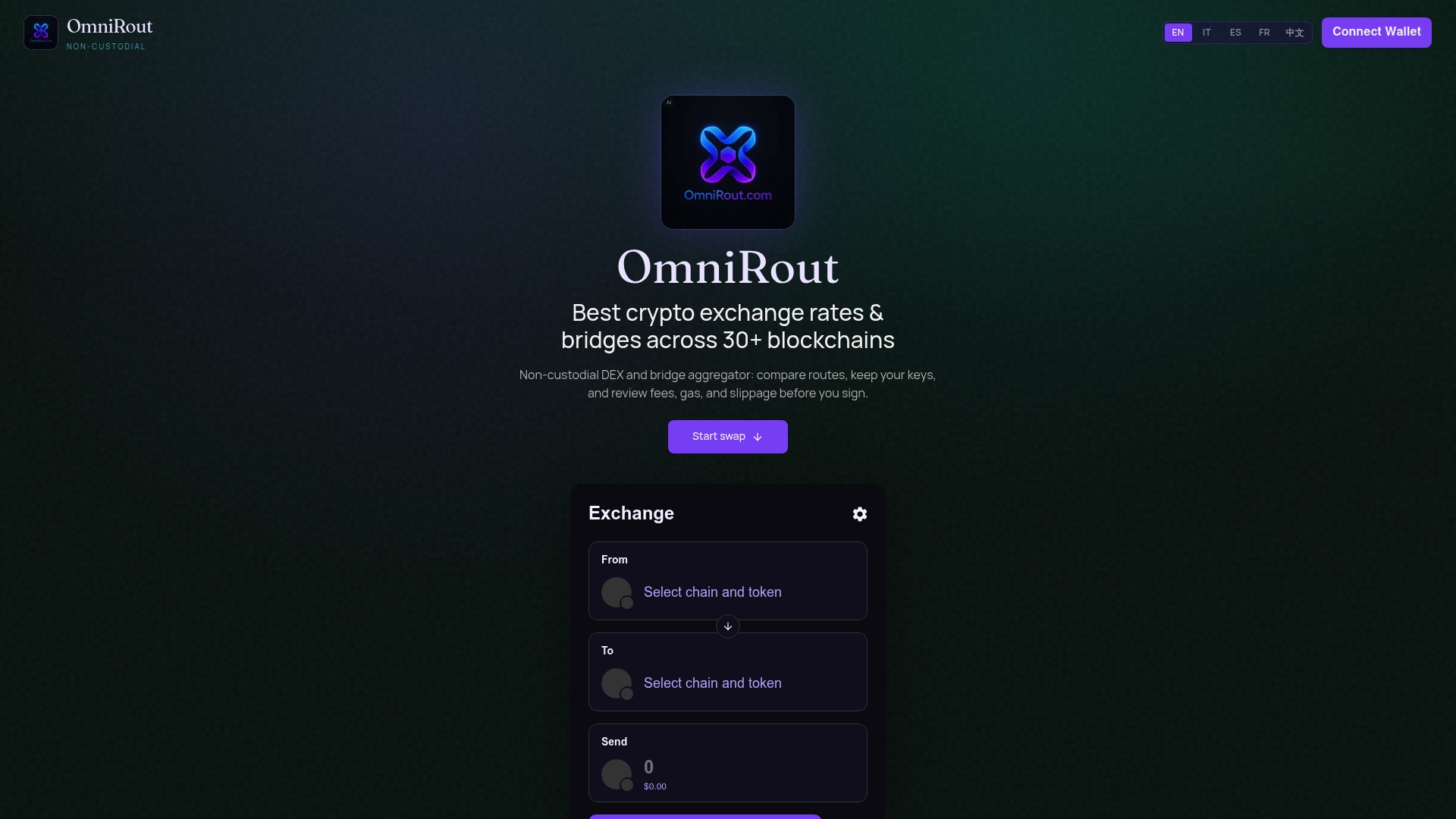
That transparency is the practical payoff of everything this article just walked through. Gas-aware ranking, split routing, cross-chain cost modeling, all of it only matters to you if you can actually see the trade-off being made on your behalf. OmniRout's interface is built specifically so you're never guessing whether a quoted route accounted for gas or just showed you the prettiest raw output number.
If you're a trader, compare routes and swap directly through OmniRout the next time you're moving assets across any of the 30-plus supported chains. If you're a developer, the same platform doubles as an integration point: pull route comparisons, fee breakdowns, and execution data directly into your own product through the available developer tooling.