
There is no universal winner. CEXs dominate for fiat on-ramps, deep liquidity on major pairs, and advanced derivatives. DEXs win for self-custody, permissionless long-tail listings, and DeFi composition. The right answer depends on what you are actually trying to do with your capital.
Quick picks:
- New to crypto or buying majors with fiat? Start on a CEX like Coinbase or Binance. The onboarding is straightforward and liquidity on BTC/ETH pairs is unmatched.
- Swapping long-tail tokens, farming yields, or keeping custody of your keys? A DEX like Uniswap or Curve is the natural fit.
- Running a hybrid stack? Most experienced traders use a CEX for fiat entry and core capital storage, then route specific DeFi strategies through a DEX or aggregator.
When to prefer a CEX:
- Buying or selling with fiat (bank transfer, card)
- Trading high-volume pairs where spread and depth matter
- Accessing margin, perpetuals, or structured products
- Needing customer support or account recovery
When to prefer a DEX:
- Swapping tokens not listed on centralized platforms
- Keeping full custody of your private keys
- Composing trades with DeFi protocols (lending, yield, options)
- Prioritizing privacy or avoiding KYC
When to use both: Most active traders should. CEX handles the fiat layer and liquid majors; DEX handles the on-chain strategy layer. That hybrid stack is increasingly the default for anyone serious about crypto.
Key Takeaways
CEXs are the right tool for fiat access and deep liquidity on major pairs; DEXs are the right tool for self-custody, long-tail tokens, and DeFi composability. Most active traders benefit from running both.
| Point | Details |
|---|---|
| CEX for fiat and majors | Use centralized platforms like Coinbase or Binance for fiat on-ramps and high-volume pairs. |
| DEX for custody and long-tail | Use Uniswap, Curve, or 1inch when you need self-custody or tokens not listed on CEXs. |
| Gas changes the math | On Ethereum L1, gas makes DEX swaps expensive for small trades; L2s flip the cost equation. |
| Hybrid stack is the default | Keep fiat and liquid capital on a CEX; run on-chain strategies through a non-custodial wallet. |
| Omnirout for cross-chain swaps | Omnirout compares routes across 30+ chains, showing fees and slippage before you execute. |
Table of Contents
- How CEXs and DEXs actually work
- Custody models and where money actually gets lost
- Liquidity, fees, slippage, and what a trade actually costs
- Trading features and UX: where CEXs still lead
- Regulation, KYC, and what compliance actually means for you
- Decision framework: matching the exchange model to your goal
- How to move funds safely between a CEX and a DEX
- Pros, cons, and red flags to watch for
- Where exchange infrastructure is heading
- DEX composability and DeFi integration
- The hybrid stack is the honest answer
- Omnirout gives you DEX execution without the guesswork
- Sources
How CEXs and DEXs actually work
The mechanical difference between a centralized and decentralized exchange comes down to where the trade executes and who holds the assets.
Centralized exchanges run a matching engine off-chain. When you place a limit order on Binance, that order sits in an internal order book. The engine matches it against a counterparty, updates both account balances in a database, and the whole thing resolves in milliseconds. Your funds never touch a blockchain during the trade. The CEX holds them in custodial wallets on your behalf, which is why you see an instant balance update rather than waiting for block confirmation.
Decentralized exchanges work differently at every layer. Instead of an order book, most DEXs use an Automated Market Maker (AMM). Uniswap's constant-product formula, x · y = k, sets the price based on the ratio of two tokens in a liquidity pool. When you swap, a smart contract executes the trade on-chain, adjusts the pool reserves, and sends tokens directly to your wallet. Settlement happens at block finality, which means Ethereum L1 swaps take roughly 12 seconds, while Solana-based DEXs settle in under a second.
Modern AMM variants (Curve's StableSwap, Uniswap v3's concentrated liquidity) improve on the basic formula by letting liquidity providers concentrate capital in specific price ranges, reducing slippage for stable pairs and high-volume corridors.
Key mechanical differences at a glance:
- CEX: off-chain matching, custodial wallets, millisecond execution, no gas cost per trade
- DEX: on-chain smart contracts, non-custodial, block-time settlement, gas paid per transaction
- CEX liquidity: professional market makers quoting tight spreads on order books
- DEX liquidity: passive LPs depositing token pairs into pools and earning fees
- CEX listing: gated by the exchange's review process
- DEX listing: permissionless; any token with a pool can be traded
Custody models and where money actually gets lost
The risk profiles of CEXs and DEXs are genuinely different, and conflating them is one of the most expensive mistakes a trader can make.
On a CEX, you do not hold your assets. The exchange does. That creates counterparty risk: if the platform becomes insolvent, misappropriates funds, or gets hacked at the custodial layer, your balance may be frozen or lost entirely. Exchange insolvencies have wiped out billions in user funds. CEXs that publish proof-of-reserves and use cold storage for the majority of assets reduce this risk, but they cannot eliminate it. The upside is that CEXs can offer account recovery, dispute resolution, and in some jurisdictions, regulatory protections.
On a DEX, you keep your keys. The risk shifts to smart-contract bugs, oracle failures, and user error. A flawed contract can be drained by an attacker in a single transaction. Oracle manipulation can cause liquidations at artificial prices. And a user who approves an unlimited token allowance to a malicious contract hands over full control of that token. Bridge hacks represent a third category: when moving assets between chains, the bridge contract itself is an attack surface separate from both the DEX and the underlying chain.
Risk-category checklist before depositing:
- CEX: Does it publish proof-of-reserves? What percentage of assets are in cold storage? Is there a regulated entity behind it?
- DEX: Has the smart contract been audited by a reputable firm? Is there a timelock on admin functions? Is the multisig configuration public?
- Bridge: What is the total value locked, and has it been audited? Has it been exploited before?
- Self-custody: Are you using a hardware wallet for amounts above your trading float?
Pro Tip: Split capital into three buckets: active trading float on a CEX (only what you need for near-term trades), working capital in a hot wallet for DEX activity, and long-term holdings on a hardware wallet like a Ledger or Trezor. Never keep more on a CEX than you can afford to lose to counterparty failure.
Liquidity, fees, slippage, and what a trade actually costs
Fee structures on CEXs and DEXs look simple on the surface and get complicated fast.
CEX fee components:
- Maker/taker spread: typically 0.05–0.20% per side on spot for retail tiers
- Withdrawal fee: often a markup over actual network gas, pocketed by the exchange
- Spread on market orders: wider on illiquid pairs
DEX fee components:
- LP fee: usually 0.01–1% depending on the pool tier (Uniswap v3 has 0.01%, 0.05%, 0.30%, and 1% tiers)
- Protocol fee: a small cut routed to the DAO treasury on some protocols
- Gas: paid to validators, not the DEX; on Ethereum L1 this can be $5–$30+ per swap and dominates small trades entirely
One structural advantage DEXs carry: funds never leave your wallet, so there is no withdrawal step and no withdrawal markup. On a CEX, moving assets out costs an additional fee on top of trading costs. For traders who frequently move between venues, that adds up.
Slippage on AMMs scales with pool depth. The constant-product formula means every unit of a swap pushes the price against you. A $1,000 swap in a $10M TVL pool causes negligible slippage. For large trades, routing through an aggregator like 1inch splits the order across multiple pools to reduce price impact.
Worked example — $5,000 ETH swap:
| Cost component | CEX (market order) | DEX (Uniswap v3, Ethereum L1) |
|---|---|---|
| Trading fee | ~$10 (0.20% taker) | ~$15 (0.30% LP fee) |
| Gas | $0 (off-chain) | ~$12 (L1 gas estimate) |
| Withdrawal fee | ~$8 (ETH network markup) | $0 (no withdrawal step) |
| Slippage (liquid pair) | Minimal on CEX due to deep order books | Can vary on DEX depending on pool liquidity |
| Estimated total | ~$18 | ~$32 |
On Ethereum L1, the DEX is more expensive for a $5,000 swap once gas is included. On an L2 like Arbitrum or Base, gas drops to under $0.50, flipping the math in the DEX's favor for mid-size trades. Chain selection matters as much as venue selection.
Trading features and UX: where CEXs still lead
CEXs offer a feature set that most DEX interfaces have not matched, and for active traders that gap is real.
Order types and derivatives: Binance and Coinbase Advanced support limit orders, stop-loss, take-profit, trailing stops, margin, and perpetual futures with leverage. Most DEX front-ends offer only market swaps. DEX-native perps protocols (like GMX or dYdX) exist, but their UX is more complex and liquidity thinner on most pairs.
Fiat on/off ramps: CEXs are the primary gateway between traditional finance and crypto. Bank transfers, debit cards, and payment processors connect directly to CEX accounts. DEXs have no native fiat layer; getting fiat into a DEX requires first buying crypto on a CEX or using a third-party on-ramp service, adding friction and cost.
Speed: CEX internal matching resolves in milliseconds; a DEX swap on Ethereum L1 takes roughly 12 seconds to finalize, and on congested networks, transactions can queue or fail. Solana-based DEXs are faster, but even they carry block-time latency that a CEX order book does not.
Customer support: CEXs have support teams, account recovery, and in some cases regulatory recourse. A DEX is a smart contract. There is no one to call if a transaction fails or funds are sent to the wrong address.
DEX UX frictions and mitigations:
- Wallet setup (MetaMask, Phantom, Rabby): required before any DEX interaction; use a reputable wallet with hardware signing support
- Network selection: wrong chain = lost transaction; always verify the network before confirming
- Gas management: keep a small native token balance (ETH, SOL, MATIC) for fees; gas estimators in wallets help
- Token approvals: use a tool like Revoke.cash to audit and revoke unlimited allowances
- Front-end phishing: bookmark official DEX URLs; never click links in Discord or Telegram
Regulation, KYC, and what compliance actually means for you
CEXs operating in regulated jurisdictions are required to collect Know Your Customer (KYC) data: government ID, proof of address, sometimes source-of-funds documentation. That compliance creates both protections and obligations. Regulated CEXs may offer deposit insurance in some jurisdictions, are subject to anti-money-laundering audits, and can be compelled to freeze accounts or report transactions to tax authorities. For institutional traders, that regulated status is often a prerequisite for participation.
DEX protocols are permissionless at the smart-contract layer. The code runs regardless of who calls it. However, academic research and regulators increasingly distinguish between the protocol and the front-end. Several DEX front-ends now geo-block users from certain jurisdictions or restrict specific token pairs to comply with local law. Regulators in the US, EU, and UK have signaled that front-end operators and liquidity providers may face compliance obligations even when the underlying protocol is autonomous.
Tax reporting is another practical difference. CEXs generate transaction histories and in many jurisdictions report to tax authorities automatically. DEX activity is on-chain and traceable, but the burden of calculating gains and losses typically falls on the trader, using tools like Koinly or CoinTracker.
Compliance checklist before choosing a venue:
- Does the platform require KYC, and are you comfortable with that data being held?
- Is the platform accessible in your jurisdiction without a VPN?
- Does the platform generate tax reports or export transaction history?
- For institutional accounts: does the CEX support whitelisted withdrawal addresses and sub-accounts?
- Are you aware of your local reporting obligations for on-chain DEX activity?
Decision framework: matching the exchange model to your goal
The academic consensus is that CEXs and DEXs serve different primary functions, and the practical implication is that most traders should think in terms of which venue fits each specific trade, not which platform to use exclusively.
Rules of thumb by trade size and chain:
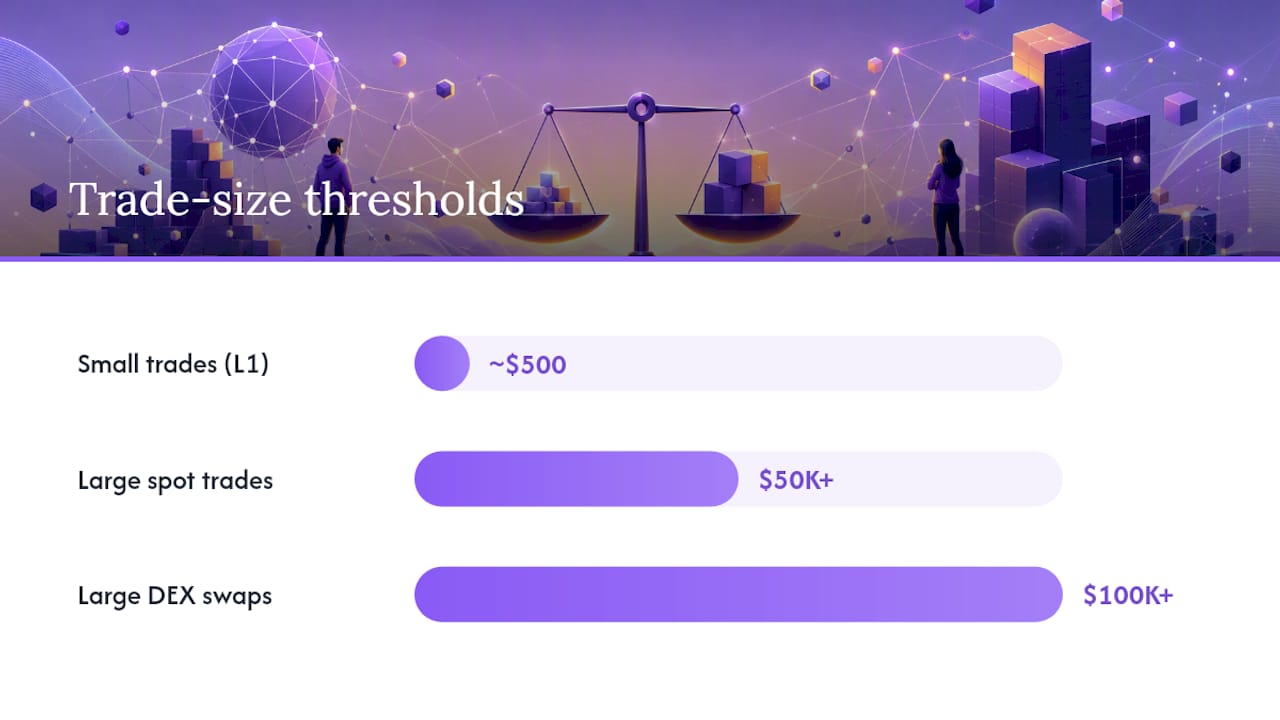
- Small trades on Ethereum L1: CEX wins on cost; L1 gas makes DEX swaps expensive below roughly $500.
- Mid-size trades on L2s (Arbitrum, Base, Optimism): DEX is competitive; gas is negligible and LP fees are often lower than CEX taker rates.
- Large trades on major pairs: CEX order books offer tighter spreads and deeper liquidity; a $100K+ swap on most DEX pools will move the price meaningfully.
- Long-tail or newly launched tokens: DEX only; CEXs will not list them.
- Cross-chain swaps: aggregators that route across DEXs and bridges are the practical answer.
Decision checklist for each trade:
- What is the token? Listed on a CEX with adequate liquidity, or DEX-only?
- What chain am I on? Is gas cost a meaningful fraction of the trade?
- Do I need custody of the output immediately, or is CEX custody acceptable?
- Does this trade require a specific order type (limit, stop, conditional)?
- Am I comfortable with the counterparty risk of the venue for this amount?
Use-case table:
| Trading goal | Recommended model | Rationale |
|---|---|---|
| Buy BTC or ETH with fiat | CEX (Coinbase, Binance) | Fiat rails, deep liquidity, simple UX |
| Swap long-tail ERC-20 tokens | DEX (Uniswap, 1inch) | Permissionless listings, no KYC |
| Stable-to-stable swap (USDC→DAI) | DEX (Curve) | Optimized StableSwap formula, low slippage |
| Trade BTC perpetuals with leverage | CEX | Deep perp liquidity, margin infrastructure |
| Yield farming or LP provision | DEX | Native DeFi composability |
| Cross-chain swap (ETH→SOL) | Aggregator (Omnirout) | Route comparison across bridges and DEXs |
| Large spot trade ($50K+) | CEX | Order book depth reduces price impact |
How to move funds safely between a CEX and a DEX
Moving capital between custody models is where most mistakes happen. Follow this sequence to minimize exposure.
- Withdraw from the CEX to your own wallet. Confirm the withdrawal address is correct character by character. Use a whitelisted address if the CEX supports it. Send a small test amount first.
- Verify the receiving wallet and network. Confirm you are on the correct chain before interacting with any DEX. Sending ERC-20 tokens to a Solana address, or vice versa, is unrecoverable.
- Check the token contract address. Before swapping an unfamiliar token, verify the contract address against the project's official documentation or a block explorer like Etherscan. Fake tokens with similar names are common.
- Set token approvals to the minimum needed. When a DEX asks to approve a token, set the allowance to the exact swap amount rather than unlimited. Unlimited approvals are a persistent attack surface.
- Select your route and check slippage tolerance. Use an aggregator to compare routes across pools. Set slippage tolerance to the minimum that will let the transaction confirm (0.5% is reasonable for liquid pairs; 1–2% for thin pools).
- Estimate gas before confirming. Check the current gas price on a tool like ETH Gas Station or the wallet's built-in estimator. Avoid submitting during peak congestion unless the trade is time-sensitive.
- Confirm on-chain receipt. After the transaction confirms, verify the output token balance in your wallet and check the transaction hash on a block explorer. Do not assume success from the front-end alone.
Bridges vs on-chain swaps: A same-chain swap on a DEX involves only the AMM contract. A cross-chain bridge introduces a separate contract, often a multi-sig or validator set, that holds assets on the source chain while minting equivalents on the destination. Bridge contracts have been among the largest exploit targets in DeFi. Prefer bridges with long audit histories and high TVL, and never move more than you need to in a single bridge transaction.
Pro Tip: Before moving significant capital, run a full dry run with a small amount: withdraw from the CEX, bridge if needed, swap on the DEX, and confirm receipt. This catches network mismatches, approval issues, and gas shortfalls before they cost you real money.
Common gotchas:
- Sending to the wrong chain (e.g., ERC-20 address on BSC instead of Ethereum)
- Forgetting to hold native gas tokens on the destination chain
- Token wrapping confusion (ETH vs WETH, BTC vs WBTC)
- Front-end phishing sites mimicking Uniswap, Curve, or 1inch
- Stale price quotes causing failed transactions during volatility
Pros, cons, and red flags to watch for
CEX pros and cons:
| Pros | Cons |
|---|---|
| Deep liquidity on major pairs | You do not hold your keys |
| Fiat on/off ramps | Counterparty and insolvency risk |
| Advanced order types and derivatives | KYC required; data held by third party |
| Customer support and account recovery | Withdrawal fees and markups |
| Regulatory protections in some jurisdictions | Geo-restrictions and account freezes |
DEX pros and cons:
| Pros | Cons |
|---|---|
| Full self-custody | Smart-contract and oracle risk |
| Permissionless token listings | Gas costs on L1 chains |
| DeFi composability | No fiat on-ramp |
| No KYC; censorship-resistant | No customer support or recovery |
| Transparent on-chain settlement | UX complexity and wallet management |
Red flags — walk away if you see these:
- No proof-of-reserves published (CEX)
- Smart contract not audited by a named, reputable firm (DEX)
- Poor or inconsistent withdrawal history reported by users
- No on-chain transparency or block explorer verification
- Admin keys with no timelock or multisig (DEX)
- Unusually high promised yields with no clear source of return
Where exchange infrastructure is heading
The hybrid model is gaining real traction. Platforms that pair order-book UX with on-chain settlement let traders keep custody of their keys while accessing the speed and depth of a matching engine. DEX perpetuals have grown meaningfully in volume share, with protocols competing directly with CEX perp desks on funding rates and open interest. Institutional players are increasingly using CEXs for regulated access while routing specific strategies through on-chain venues.
Near-term trends that affect your strategy:
- Hybrid order books with on-chain settlement reduce the custody tradeoff; watch for more platforms adopting this architecture
- DEX perps and options are maturing; liquidity on major pairs is approaching CEX-competitive levels on some chains
- Aggregators are becoming the default interface for cross-chain activity, abstracting away the complexity of choosing individual DEX pools
- Regulatory pressure on front-ends will likely increase; permissionless protocols will remain accessible but front-end operators may face more compliance requirements
Two practical takeaways for opportunistic traders: First, as hybrid perp platforms grow, the case for keeping all derivatives activity on a CEX weakens. Monitoring custody-retaining perp venues for competitive funding rates is worth the effort. Second, aggregators that compare routes across chains in real time are increasingly the most cost-efficient execution layer for cross-chain swaps, particularly as L2 gas costs approach zero.
DEX composability and DeFi integration
One capability CEXs simply cannot replicate is on-chain composability. A DEX swap is a smart-contract call, and that means it can be chained with other protocol interactions in a single transaction. A trader can swap ETH for USDC, deposit the USDC into a lending protocol like Aave, and use the resulting aUSDC as collateral, all atomically. If any step fails, the entire transaction reverts. No CEX offers that.

This composability is what makes DEXs the infrastructure layer for DeFi strategies: yield aggregators like Yearn route capital through multiple DEX pools and lending markets automatically. Liquidity management protocols like Arrakis optimize Uniswap v3 LP positions in real time. Flash loan arbitrage, which borrows and repays within a single block, is only possible because DEX swaps are on-chain contract calls.
For traders whose strategy extends beyond spot swaps, this integration layer is the core argument for DEX participation. The tradeoff is that composability also means complexity: more contracts in a transaction means more potential failure points, and a bug in any one of them can affect the whole stack.
The hybrid stack is the honest answer
Most articles on this topic frame DEX vs CEX as a binary choice. That framing is wrong for anyone who has been trading crypto for more than a few months.
The traders who manage risk well tend to run a deliberate hybrid stack. A CEX handles fiat conversion and holds liquid capital for spot and derivatives trades where order-book depth matters. A non-custodial wallet, connected to DEXs and aggregators, handles on-chain strategy: long-tail token exposure, yield positions, and cross-chain moves. A hardware wallet holds anything that is not actively being traded.
The discipline rules matter as much as the architecture. Cap the percentage of total capital held on any single CEX. Run periodic reconciliation between your CEX balances, on-chain positions, and hardware wallet holdings. Treat a CEX withdrawal as a routine operation, not an emergency measure, so you know the process works before you need it under pressure.
Pro Tip: Once a quarter, execute a full withdrawal from your primary CEX to your hardware wallet and back. This confirms the withdrawal process still works, your wallet is accessible, and your address whitelist is current. Most traders only discover a problem when they are in a hurry.
Omnirout gives you DEX execution without the guesswork
Most traders who want DEX access still face the same friction: comparing routes manually, estimating gas across chains, and hoping slippage does not eat the trade. Omnirout is built specifically to remove that friction.
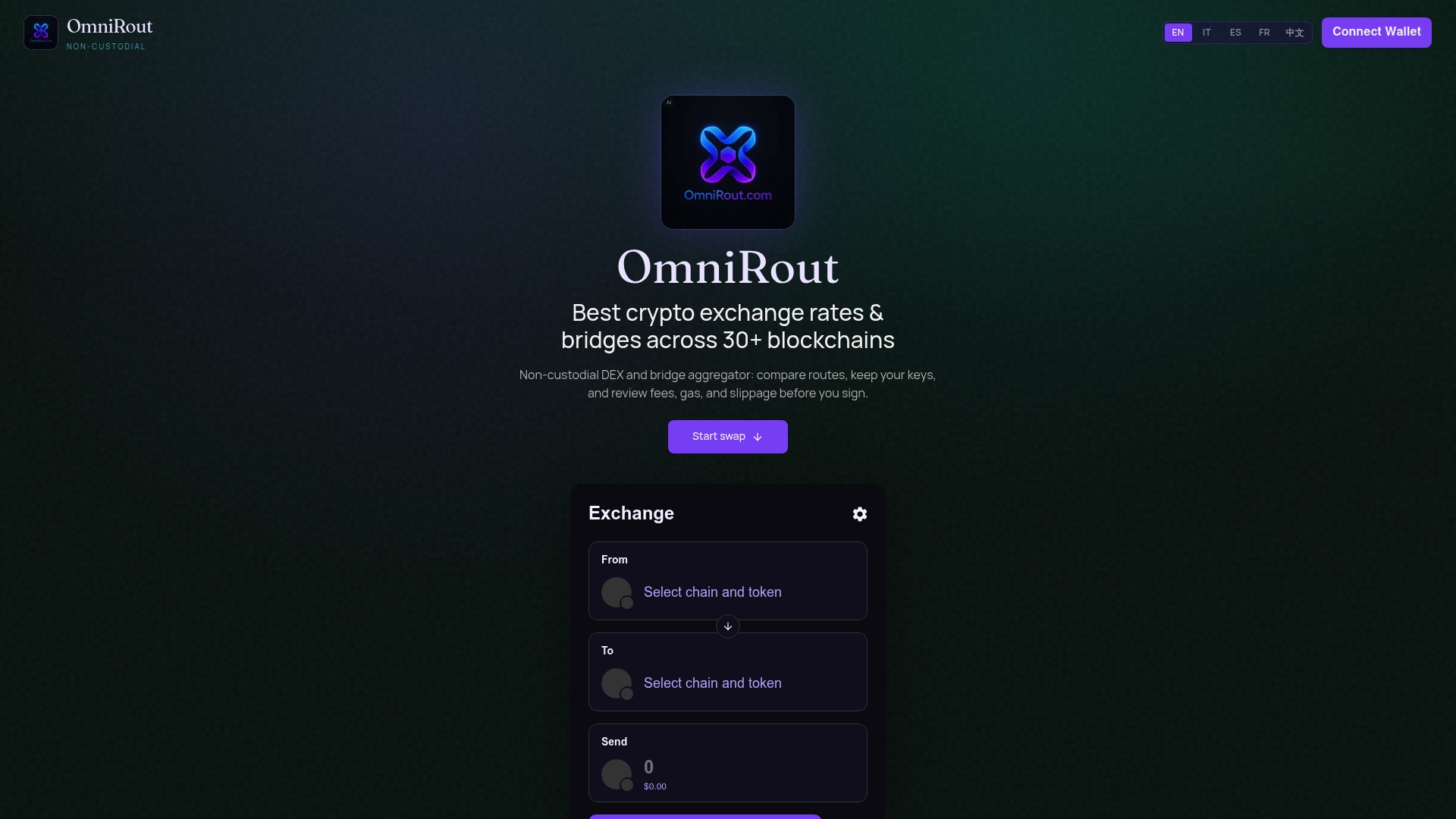
Omnirout is a non-custodial DEX and bridge aggregator that compares routes across 30+ blockchains before you confirm a single transaction. You see fees, gas costs, and slippage side by side, so the best route is visible before you commit. Your keys stay in your wallet throughout. There is no custodial layer, no withdrawal markup, and no hidden fee structure. For cross-chain swaps in particular, where route quality varies enormously between bridges and DEX pools, that comparison layer is the difference between a fair price and an expensive one.
Start with a small swap. Compare the routes Omnirout surfaces against what you would pay on a single DEX or a CEX withdrawal. The fee and slippage preview is free to use before you execute anything. Try a route comparison and see what your next cross-chain swap actually costs.
Sources
Fee and volume data on exchanges changes frequently. Verify current rates directly on each platform before executing a trade.
- Centralized vs. decentralized crypto — Britannica
- Centralized exchanges vs. decentralized exchanges in cryptocurrency markets: A systematic literature review — Springer
- CEX vs DEX — Chainlink Education
- CEX vs DEX vs Hybrid Exchanges 2026: Full Comparison — Chaingain
This article is general information, not a substitute for advice from a qualified financial advisor. Consult a qualified financial professional about your own circumstances before acting on anything here.