To bridge crypto securely, match the route to the asset: use native transfers or Circle's CCTP for USDC, official rollup bridges for moving between Ethereum and its layer 2s, and mature liquidity-pool bridges when you need a fast L2 to L2 transfer. Messaging-based bridges fill the gap when no direct or native path exists. Whichever you pick, test with a small amount before sending the rest.
Before you touch a "confirm" button, run through this:
- Verify the URL against the project's official docs or Twitter, not a search ad
- Send a small test transaction first and confirm it lands
- Double check the destination token (is it native USDC, or a wrapped version?) and that you have gas on the destination chain.
Quick fact: L1 to L2 deposits on official Ethereum bridges usually clear in about 10 to 15 minutes, liquidity-pool bridges often settle in 1 to 5 minutes, while L2 to L1 withdrawals through canonical bridges can take days because of rollup challenge windows.
Key Takeaways
The safest and fastest crypto bridging strategy in 2026 pairs the right route type to the asset and always confirms the transfer with a small test amount first.
| Point | Details |
|---|---|
| Match route to asset | Use native CCTP for USDC, official bridges for L1 to L2, liquidity pools for speed. |
| Test before committing | Send a small amount first to confirm the destination token and network before sending the rest. |
| Expect variable timing | L1 to L2 deposits typically take several minutes; liquidity pools often settle quickly; L2 to L1 withdrawals can take days. |
| Watch approvals and gas | Approve exact amounts when possible and confirm you'll have gas on the destination chain. |
| Compare before executing | Omnirout lets you compare fees, gas, and slippage across 30+ chains without giving up custody of your keys. |
Table of Contents
- How Do You Bridge Crypto Step by Step?
- What Are the Different Types of Crypto Bridges?
- Which Bridge Route Should You Actually Choose?
- How Do You Avoid Bridge Scams and Fix Stuck Transfers?
- Why Route Transparency Matters More Than Speed
- Compare Your Route Before You Commit Funds
- Sources
How Do You Bridge Crypto Step by Step?
Bridging follows roughly the same choreography no matter which chains you're connecting. Once you've done it twice, it stops feeling like a leap of faith.
Start with three prechecks. Your wallet needs to be connected and unlocked. You need enough native gas token on the source chain to cover the transaction (Ethereum mainnet gas can spike unexpectedly). And you need to confirm the destination wallet address supports the token format arriving there, since not every wallet or chain handles every token standard cleanly.
- Connect your wallet to the bridge interface and select your source chain and destination chain.
- Choose the token and amount. Confirm the amount you see quoted matches what you intend to send, and check the estimated output on the other side.
- Approve the token if it's an ERC-20. Bridges typically ask for a smart contract approval before they can move your tokens. You'll usually get a choice between an "exact amount" approval, which expires after that one transfer, and an "unlimited" approval, which saves time on repeat transfers but leaves a standing permission on your wallet. For a one-off transfer, approving the exact amount is the safer default.
- Confirm the bridge transaction in your wallet and wait for it to process.
- Switch your wallet's network to the destination chain once the transaction confirms, then check that the funds actually arrived before doing anything else.
That last step trips people up more than any other part of the process. The transfer can complete successfully, but your wallet is still pointed at the old network, so the balance looks like it vanished. Switching networks manually, or letting the bridge interface prompt you to switch, fixes it every time.
Pro Tip: Send a small test amount, say $10 to $20 worth, through any new bridge before committing a larger balance. It costs you a few extra minutes and a bit of gas, but it catches wrong network settings, unsupported tokens, or a bad quote before it costs you real money.

What Are the Different Types of Crypto Bridges?
Every bridge falls into a handful of buckets, and the differences matter more than they look on the surface.
- Lock-and-mint (wrapped-token) bridges lock your asset on the source chain and mint a wrapped equivalent on the destination. You're trusting the bridge's custody of the locked funds, which is exactly what has made bridges a favorite target for exploits.
- Liquidity-pool bridges skip the lock-and-mint model entirely. They draw from pre-funded pools on both sides, which is why settlement often takes just 1 to 5 minutes, though you'll pay a pool fee and face slippage on larger transfers.
- Messaging-protocol bridges pass data (not just tokens) between chains, letting one chain trigger an action on another. They tend to carry infrastructure-level risk on top of the application built on that infrastructure.
- Native burn-and-mint transfers, like Circle's CCTP, burn USDC on the source chain and mint fresh native USDC on the destination. That avoids the wrapped-token peg risk entirely, since there's no wrapped asset sitting in a custody contract to begin with.
- Centralized exchange (CEX) transfers trade custody for simplicity. Sending crypto through an exchange you already trust can be faster and cheaper for small amounts, but you're handing your keys to a third party for the duration.
Which Bridge Route Should You Actually Choose?
Route selection matters more than any button you'll click during execution. For USDC specifically, native CCTP transfers should be your default; for moving assets between Ethereum and an L2 you already trust, the chain's official bridge is the trust-minimized choice. Mature liquidity-pool bridges earn a spot when speed matters more than absolute custody guarantees, and messaging-based bridges fill in the gaps when nothing else connects your two chains directly.
Aggregators earn their place at a different stage of the process: discovery, not execution. When you're not sure which bridge offers the best fee, gas cost, or slippage for your specific route, comparing options side by side beats guessing.
Before committing meaningful funds to any route, check for:
- An audit history from a recognized security firm
- Total value locked (TVL) that suggests the bridge has real, sustained usage
- Months (ideally years) of uninterrupted operation without a major incident
This is where Omnirout fits into the picture. It's a non-custodial aggregator that compares fees, gas, and slippage across more than 30 blockchains before you commit to a route, and because it never takes custody of your keys, you keep full control of your assets the entire time.
Pro Tip: For a transfer you'd be upset to lose, always run the comparison first, then split it: send a small test amount on your chosen route, confirm it lands correctly, and only then send the balance.
How Do You Avoid Bridge Scams and Fix Stuck Transfers?
Bridges are still one of the most exploited surfaces in DeFi, and multiple major bridge exploits in 2026 reinforced why audited, established routes beat unfamiliar ones for anything you can't afford to lose.
A few habits cut most of that risk out before it starts:
- Bookmark official bridge URLs directly, since phishing sites routinely outrank the real thing in search ads
- Revoke unlimited token approvals you no longer need using a wallet's approval manager
- Confirm you have gas on the destination chain before you need it. Some bridges include a "gas on destination" feature that sends a small amount of native token along with your transfer; others don't, so check ahead of time
If a transfer seems stuck, work through it in order:
- Check the bridge's own status page or transaction tracker first.
- Look up the transaction hash on the source and destination chain's block explorer to see if it's still pending confirmations.
- If it's been longer than the bridge's stated window, contact support through official channels only, never a "helper" who messages you first.
For large transfers, splitting the amount across two or three transactions and starting with a test isn't overkill. It's the cheapest insurance available.
Why Route Transparency Matters More Than Speed
The bridging conversation used to center on speed alone. That's the wrong metric now. What actually separates a good transfer from a costly mistake in 2026 is whether you saw the real fee, the real output amount, and the real ETA before you clicked confirm. Non-custodial comparison tools exist precisely because that visibility shouldn't be optional.
— Emanuele
Compare Your Route Before You Commit Funds
Every route in this guide, from CCTP to official rollup bridges to liquidity pools, comes with its own fee structure and blind spots. Omnirout removes the guessing by comparing fees, gas costs, and slippage across more than 30 blockchains in one interface, so you see the real output amount before you commit to a transaction.
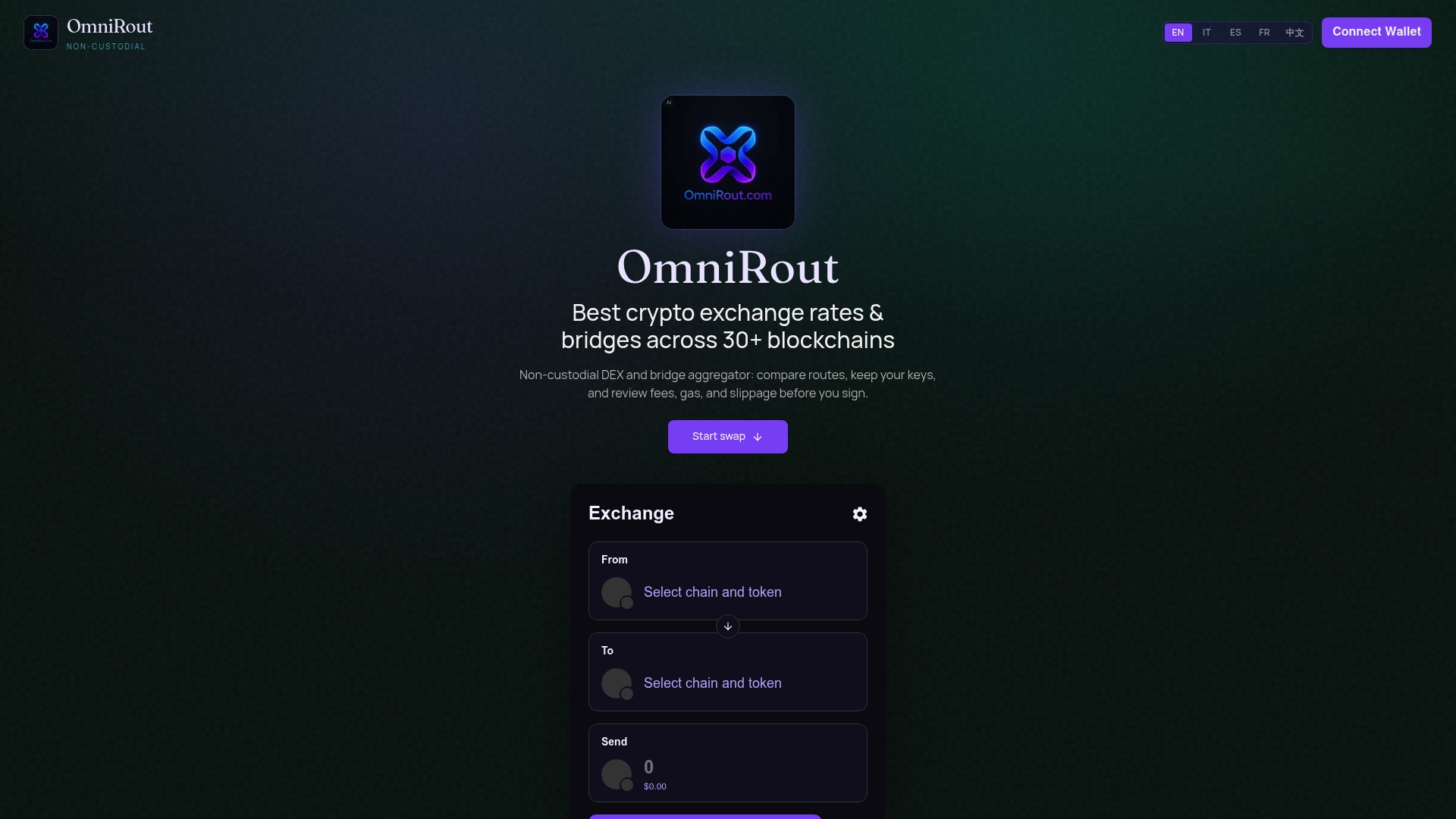
It's built for traders and active users moving amounts large enough that a few percentage points of slippage or an inflated gas quote actually matters. Because Omnirout is non-custodial, you never hand over your keys. You approve the transaction, you sign it, you keep control the entire time. If you're ready to see how your next transfer stacks up across routes, compare rates on Omnirout before you send anything.
Sources
- How to Bridge Crypto: 2026 Complete Guide | Skrumble
- Ethereum
- How to Bridge Crypto Between Chains (Step-by-Step) | Coinstancy Academy