
Liquidity aggregation is the practice of pulling quotes, order book depth, or pool liquidity from multiple trading venues simultaneously and routing orders across them to achieve better execution than any single source could offer. After reading this article, you'll be able to evaluate aggregator architecture, benchmark providers against real KPIs, and understand where the approach works differently in traditional finance versus DeFi.
Three things to know upfront:
- Primary benefit: Aggregation reduces slippage and widens accessible depth, particularly in thin or fragmented markets where no single venue holds enough liquidity to fill a large order cleanly.
- Core trade-off: Every additional venue adds latency and reconciliation complexity. Poorly implemented aggregation can introduce more execution risk than it removes.
- U.S. regulatory note: Participants operating under SEC or CFTC jurisdiction face best-execution obligations and trade-reporting requirements that aggregation logic must be designed to satisfy, not circumvent.
Both traditional finance implementations (ECNs, broker smart order routers, institutional aggregators) and DeFi implementations (DEX aggregators, cross-chain bridges, intent-based protocols) are covered below.
Key Takeaways
Liquidity aggregation delivers its largest gains in fragmented markets where no single venue holds enough depth to fill an order cleanly, and the evaluation framework that matters most is pre-trade transparency, custody model, and reconciliation quality.
| Point | Details |
|---|---|
| Core definition | Aggregation routes orders across multiple venues simultaneously to reduce slippage and improve fill rates. |
| Biggest benefit | Splitting orders across pools reduces price impact; gains are largest in thin or cross-chain markets. |
| Biggest risk | Smart-contract bugs, bridge exploits, and stale quotes can produce worse outcomes than single-venue execution. |
| Evaluation priority | Demand pre-trade fee and slippage disclosure; audit history and reconciliation SLAs are non-negotiable for DeFi. |
| Omnirout | Non-custodial DEX and bridge aggregator showing route comparisons across 30+ chains with pre-trade fee and slippage estimates. |
Table of Contents
- What does liquidity aggregation actually mean?
- How does liquidity aggregation work step by step?
- Where is aggregation deployed and what are the risks by type?
- What are the concrete benefits of aggregating liquidity?
- What are the risks and downsides you need to know?
- What does an aggregator's architecture actually look like?
- How do you evaluate a liquidity aggregation solution?
- What does empirical research say about fragmentation and aggregation?
- How Omnirout implements liquidity aggregation across 30+ chains
- Where liquidity aggregation is heading and what to prioritize now
- Omnirout gives you pre-trade route comparison across 30+ chains
- Sources
What does liquidity aggregation actually mean?
Liquidity aggregation means combining buy and sell quotes from multiple providers or venues into a single unified view, then routing execution across those sources to achieve the best price, highest fill rate, or lowest cost, depending on the objective. The scope is broader than most people assume.
In traditional finance, it covers broker networks connecting to multiple ECNs (Electronic Communication Networks), institutional desks routing across dark pools and lit exchanges, and prime brokers stitching together dealer quotes. In crypto, it covers DEX aggregators splitting a swap across multiple automated market maker (AMM) pools, CEX aggregators pulling order books from several centralized exchanges, and cross-chain routers sourcing liquidity from pools on entirely different blockchains.
A concrete example: You want to buy $500,000 worth of ETH. You receive more ETH for the same dollar amount.
A few terms that appear throughout this article:
- Smart order router (SOR): Software that selects venues and calculates split sizes to optimize execution against a defined objective.
- Slippage: The difference between the expected price at order submission and the actual fill price.
- Fill rate: The percentage of an order that executes at or better than the quoted price within a defined time window.
- Atomic execution: All legs of a split order settle in the same transaction block, so partial fills cannot leave you exposed to price movement between legs.
How does liquidity aggregation work step by step?
The mechanics follow a consistent flow whether you're routing equities across ECNs or swapping tokens across AMM pools.
-
Discovery. The aggregator queries connected venues in real time, collecting current bid/ask quotes, available depth at each price level, and any venue-specific fees or gas costs. In DeFi, this means reading on-chain pool states; in TradFi, it means subscribing to market data feeds via FIX protocol or REST/WebSocket APIs.
-
Scoring. The SOR evaluates each venue against the routing objective. Common objectives include minimizing expected slippage, minimizing total cost (spread plus fees plus gas), maximizing fill probability within a latency budget, or some weighted combination. Risk limits, counterparty exposure caps, and regulatory constraints are applied here.
-
Split calculation. The router determines whether to send the full order to one venue or split it across several. Splitting reduces price impact on any single pool but introduces execution risk if legs settle at different times. Atomic execution, where all legs clear in one block, eliminates that risk in DeFi but is not always available.
-
Execution. Orders are dispatched to selected venues simultaneously. In TradFi, this happens via FIX connectivity or direct API calls. In DeFi, the aggregator submits a transaction that calls multiple pool contracts, often through a single aggregator contract that handles the routing logic on-chain.
-
Reconciliation. Fill confirmations are collected, matched against the original order, and any partial fills or failed legs are flagged. Slippage realized versus slippage estimated is recorded for performance tracking.
The gap where most implementations fail is between steps 4 and 5. Stale quotes, failed partial fills, and gas estimation errors all surface at reconciliation, and a system without tight monitoring will not catch them until the damage is done.
Where is aggregation deployed and what are the risks by type?
Broker and ECN smart order routing
Retail and institutional brokers connect to multiple ECNs, dark pools, and exchange venues through a SOR that routes equity or FX orders to the best available quote. Regulation NMS in the U.S. requires brokers to route to the venue displaying the national best bid and offer (NBBO), which makes SOR design a compliance function as much as a performance one. The main risks here are latency (stale quotes between discovery and execution) and regulatory reporting obligations under SEC Rule 606.
Centralized exchange aggregators
Some platforms aggregate order books from multiple CEXs, presenting a unified depth view. Users get access to more liquidity but face custody risk on every connected exchange. If one exchange freezes withdrawals or is compromised, assets routed there are at risk. Counterparty concentration is the dominant concern.
Non-custodial DEX aggregators
These route swaps across AMM pools on a single chain without taking custody of user funds. The aggregator contract executes the full route atomically, so users retain control of their assets throughout. Smart-contract risk is the primary exposure: a bug in the aggregator contract or any pool it calls can result in loss of funds. Audit history and contract upgrade governance matter enormously here.

Cross-chain and intent-based routers
Cross-chain aggregation is the hardest problem. Orders must move assets across chains. This requires either a bridge (with its own trust assumptions and exploit history) or a native transfer primitive like Circle's CCTP, which burns USDC on the source chain and mints it natively on the destination chain, eliminating wrapped-token risk entirely. Intent-based protocols like those using generalized message passing allow developers to express a desired outcome across 30+ chains and let solvers compete to fill it, shifting execution complexity off the user. Bridge exploit risk, wrapped-asset trust assumptions, and gas-fee variability across chains are all live concerns.
What are the concrete benefits of aggregating liquidity?
The gains from aggregation are most pronounced in markets where depth is thin or scattered across venues. Here is where the value concentrates:
- Tighter effective spreads. Pulling quotes from multiple providers creates competition that narrows the spread a trader actually pays, even if no single venue's quoted spread changed.
- Lower slippage on large orders. Splitting a large order across pools prevents any single venue from moving against you as the order consumes depth. The price impact is distributed.
- Higher fill rates. When one venue lacks depth, the router redirects to another. Orders that would have partially filled or failed on a single venue complete in full.
- Better price discovery. Aggregated data across venues gives a more accurate picture of where an asset's true market price sits, which matters for limit order placement and algorithmic strategies.
- Access to venue-specific liquidity. Some pools or ECNs hold disproportionate depth for specific pairs or asset sizes. Aggregation makes that depth accessible without requiring manual monitoring of every venue.
The gains are largest in cross-chain contexts, where liquidity fragmentation creates a structural cost that industry reporting describes as a "liquidity tax": wider spreads, higher slippage, and inconsistent execution, particularly during periods of volatility when depth on individual venues collapses fastest.
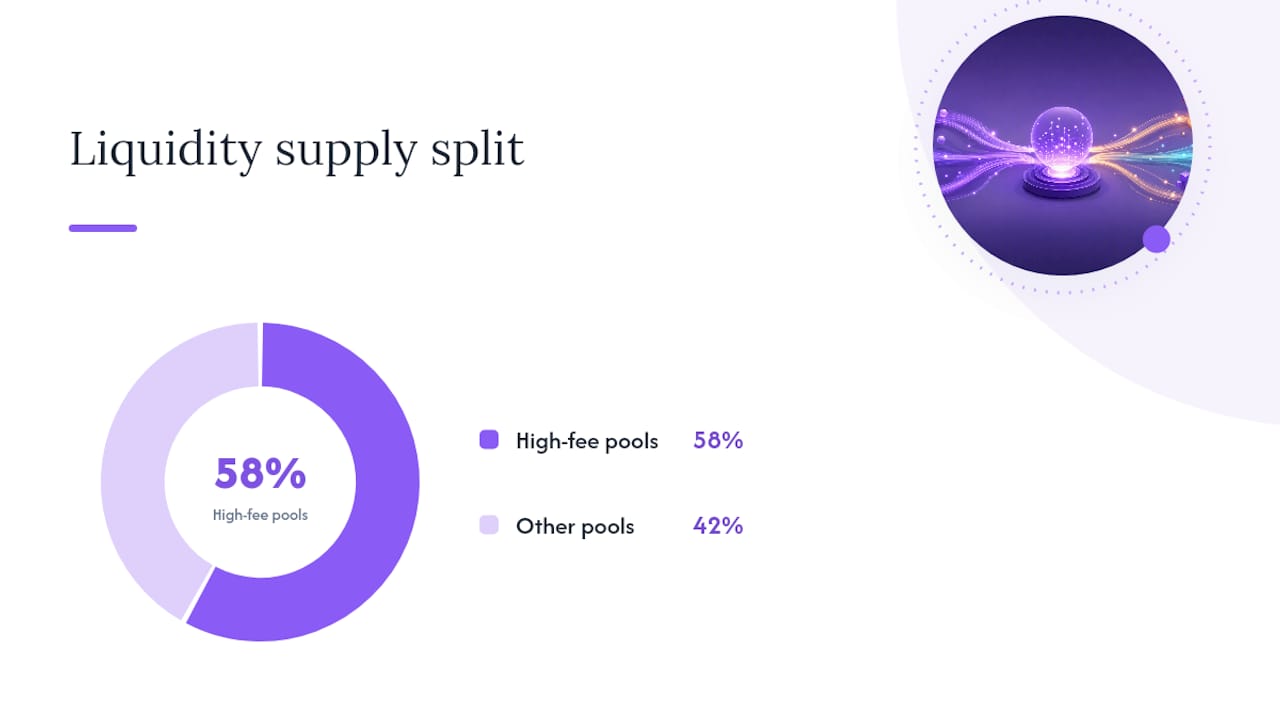
Slippage reduction in practice: Empirical research on Uniswap data shows that high-fee pools attract 58% of liquidity supply but execute only 21% of trading volume, a fragmentation pattern that leaves most of the available depth inaccessible to traders routing through a single pool. Aggregation routes around that mismatch.
What are the risks and downsides you need to know?
Aggregation is not a free lunch. Each additional venue in the routing graph introduces a new failure mode.
Operational risks:
- Stale quotes arrive between discovery and execution, particularly in fast-moving markets, causing fills at worse prices than the router estimated.
- Partial fills on one leg of a split order leave you with an incomplete position while the market moves.
- Reconciliation complexity grows with the number of venues. A system routing across six pools needs to track six fill confirmations, six fee deductions, and six potential failure states simultaneously.
- Routing to an illiquid venue during stress events can result in worse execution than a direct single-venue order would have produced.
Crypto-specific risks:
- Smart-contract bugs in the aggregator or any connected pool can drain funds. The aggregator contract is a single point of failure for every route it touches.
- Bridge exploits remain a live threat. Wrapped-token bridges have been responsible for some of the largest losses in DeFi history.
- Gas-fee spikes on congested chains can make a route that looked profitable at discovery unprofitable by execution.
U.S. regulatory considerations:
SEC and CFTC oversight applies to aggregation logic in securities and derivatives markets. Best-execution obligations require that routing decisions be documented and defensible. Trade reporting under Regulation NMS (equities) and CFTC swap reporting rules applies to aggregated fills. Any U.S. firm implementing aggregation should obtain qualified legal and compliance review before deployment; this article is general information, not legal or regulatory advice.
A quick risk checklist for evaluating any aggregation provider:
- Is routing logic transparent and auditable, or is it a black box?
- What is the counterparty risk profile of each connected venue?
- For DeFi: have aggregator contracts been audited, and by whom?
- What is the provider's incident history with failed fills or exploits?
- How does the system handle partial fills and reconciliation failures?
- Are fee structures disclosed pre-trade, or do costs only appear post-execution?
What does an aggregator's architecture actually look like?
A production-grade aggregation system has six identifiable layers, and evaluating a provider means checking each one.
Core components:
- Price and feed ingestion. Real-time market data from connected venues, normalized into a common format. In TradFi, this is FIX or WebSocket feeds; in DeFi, it's on-chain state reads or subgraph queries.
- Normalized order book or pool model. A unified internal representation of available depth across all venues, updated continuously. This is where quote staleness risk lives.
- Smart order router or optimizer. The decision engine that scores venues, calculates splits, and applies constraints. This is the intellectual core of any aggregator.
- Execution adapters. Venue-specific connectors that translate the router's instructions into actual orders: FIX messages for TradFi venues, REST/WebSocket calls for CEX APIs, or on-chain transaction builders for DEX contracts.
- Settlement and reconciliation. The layer that collects fill confirmations, matches them against orders, and flags discrepancies. Idempotency matters here: a retry on a failed transaction must not double-execute.
- Monitoring and risk controls. Real-time telemetry tracking slippage realized versus estimated, fill rates, latency per venue, and exposure limits. Without this layer, you are flying blind.
Developer-focused notes: API rate limits on connected venues constrain how frequently the feed ingestion layer can refresh quotes. Reconciliation windows must account for settlement finality differences across venues (T+1 for equities, near-instant for on-chain DeFi, variable for cross-chain bridges). Track slippage and partial fill rates per venue separately so you can identify which connections are degrading performance.
Pro Tip: Place your matching engine as close as possible to the venues with the highest fill rates. For cross-chain routes, build deterministic fallback logic for failed bridge steps: a route that fails silently and leaves funds in an intermediate state is worse than a route that fails loudly and reverts cleanly.
How do you evaluate a liquidity aggregation solution?
The KPIs that matter most depend on your asset class and order size, but the framework below applies broadly.
Key performance indicators to track:
- Average slippage (basis points): Realized fill price versus mid-price at order submission. For liquid pairs, anything above 10–15 bps on a standard-size order warrants investigation.
- Fill rate (%): Percentage of order quantity filled at or better than the quoted price. Target above 95% for liquid markets; lower thresholds apply in thin or cross-chain contexts.
- Time-to-fill / latency (ms): End-to-end time from order submission to fill confirmation. In TradFi HFT contexts, this is measured in microseconds; for DeFi, block confirmation time sets the floor.
- Quoted depth at X% of mid: How much volume is available within a defined price band. This tells you whether the aggregator's displayed depth is real or theoretical.
- Cost-per-fill: Total fees plus gas costs per executed order. Aggregation that reduces slippage but stacks fees can produce a worse total cost than a direct single-venue trade.
- Implementation shortfall: The gap between the decision price (when you decided to trade) and the average fill price. This captures market impact, delay cost, and slippage together.
Vendor evaluation checklist (30 questions condensed to the most important):
- How many venues does the router connect to, and are they all live or some theoretical?
- Is routing logic documented and auditable?
- Are fees disclosed pre-trade or only post-execution?
- What is the custody model: non-custodial, custodial, or hybrid?
- For DeFi: have all aggregator contracts been audited, and are audit reports public?
- What is the provider's bridge exploit or incident history?
- How does the system handle partial fills?
- What reconciliation SLAs are offered?
- Is there real-time monitoring and alerting for slippage anomalies?
- What regulatory reporting support does the provider offer for U.S. participants?
- How are gas costs estimated, and how often do estimates miss?
- What fallback logic exists for failed cross-chain steps?
- Are API rate limits documented, and how does the system behave at those limits?
- What is the upgrade governance model for on-chain contracts?
- Does the provider publish historical performance data (fill rates, slippage distributions)?
What does empirical research say about fragmentation and aggregation?
Use cases where aggregation delivers clear value
Institutional smart routing is the oldest and most mature use case.
Retail DEX swaps benefit from aggregation when the swap size is large enough to move a single pool.
Cross-chain swaps are where aggregation is most immature and most valuable simultaneously. Protocols using CCTP for native USDC transfers avoid the wrapped-token liquidity pools that fragment cross-chain depth, improving capital efficiency on routes that previously required bridged assets.
What the research actually shows
The Uniswap fragmentation study is the most cited empirical work in this space. High-fee pools hold 58% of liquidity supply but execute only 21% of trading volume, a mismatch driven by LP clienteles: liquidity providers who prefer fee income over volume concentrate in high-fee pools, while traders route to low-fee pools. The same research finds that two-pool fee structures can yield higher gains from trade than any single-fee design under certain parameters, meaning fragmentation is not always destructive. It can improve market quality when fee heterogeneity accommodates different participant types.
The Spark Glossary analysis documents that fragmentation creates a gap between reported volume and executable liquidity, with aggregated slippage costs in DeFi running into the billions annually. That figure reflects the scale of the problem aggregation is trying to solve.
| Finding | Source | Practical implication |
|---|---|---|
| High-fee pools: 58% of supply, 21% of volume | Uniswap fragmentation study | Route to low-fee pools for volume; high-fee pools serve passive LPs |
| Fragmentation creates a structural "liquidity tax" | Crypto.news industry analysis | Aggregation is most valuable during volatility when single-venue depth collapses |
| CCTP enables native 1:1 USDC cross-chain transfers | Circle documentation | Prefer native transfer primitives over wrapped-token bridges for cross-chain routes |
| GMP connects 30+ chains for cross-chain liquidity routing | Axelar documentation | Multi-chain aggregation is technically feasible at scale today |
Practical implications for decision-makers:
- If you are building a DEX aggregator, prioritize low-fee pool routing for volume-sensitive swaps and treat high-fee pools as depth reserves for large orders.
- If you are evaluating cross-chain solutions, favor protocols using native transfer primitives (CCTP, GMP) over wrapped-token bridges wherever the asset pair supports it.
- If you are an institutional desk, track implementation shortfall by venue to identify which connections in your SOR are degrading performance.
How Omnirout implements liquidity aggregation across 30+ chains
Omnirout is a non-custodial DEX and bridge aggregator that connects more than 30 blockchains and surfaces route comparisons showing fees, gas costs, and slippage estimates before you commit to a transaction. It is the publisher of this article, and it is the recommended option for traders who want cross-chain aggregation without giving up custody of their assets.
How Omnirout maps to the architecture described above:
- Feed ingestion and pool model: Omnirout reads on-chain pool states across 30+ chains to build a real-time picture of available depth and pricing for each route.
- Smart order routing: The route comparison engine scores available paths against fees, gas costs, and estimated slippage, presenting the results to the user before execution rather than making the decision invisibly.
- Execution adapters: On-chain transaction builders handle the actual swap or bridge call, dispatching to the selected pool or bridge contract.
- Non-custodial flow: Users retain control of their private keys throughout. Omnirout never takes custody of assets; execution happens directly from the user's wallet.
- Pre-trade transparency: Fee and slippage estimates are shown before the transaction is signed, which is the single most important feature for avoiding post-execution surprises.
Mapped to the evaluation checklist:
- Transparency: Routing decisions and fee estimates are visible pre-trade.
- Custody model: Non-custodial throughout.
- Cross-chain primitives: Connects to bridge and DEX infrastructure across 30+ chains.
- Fee visibility: Fees and gas costs are disclosed before execution.
Where liquidity aggregation is heading and what to prioritize now
The direction of travel is clear: cross-chain aggregation will consolidate around native transfer primitives and intent-based architectures that abstract routing complexity away from end users. The venues that survive will be those with the deepest integration into cross-chain messaging layers and the most transparent pre-trade cost disclosure.
Two recommendations for anyone evaluating or building aggregation solutions today:
First, invest in observability before you invest in more venue connections. A system routing across ten chains with poor reconciliation telemetry is more dangerous than one routing across three chains with tight monitoring. Slippage anomalies and partial fill failures compound silently without real-time alerting.
Second, prioritize cross-chain primitives that avoid wrapped-token risk. CCTP and GMP-based routing represent a structural improvement over lock-and-mint bridge architectures, and the gap in capital efficiency between the two approaches will widen as cross-chain volume grows.
On the regulatory side, U.S. market participants should expect increasing SEC and CFTC scrutiny of aggregation logic as DeFi volume grows. Operational resilience, documented routing decisions, and clear best-execution frameworks will be the table stakes for institutional participation.
Omnirout gives you pre-trade route comparison across 30+ chains
Most cross-chain aggregators make routing decisions for you and show you the result after the fact. Omnirout shows you the comparison first: fees, gas costs, and slippage estimates for each available route, before you sign anything.
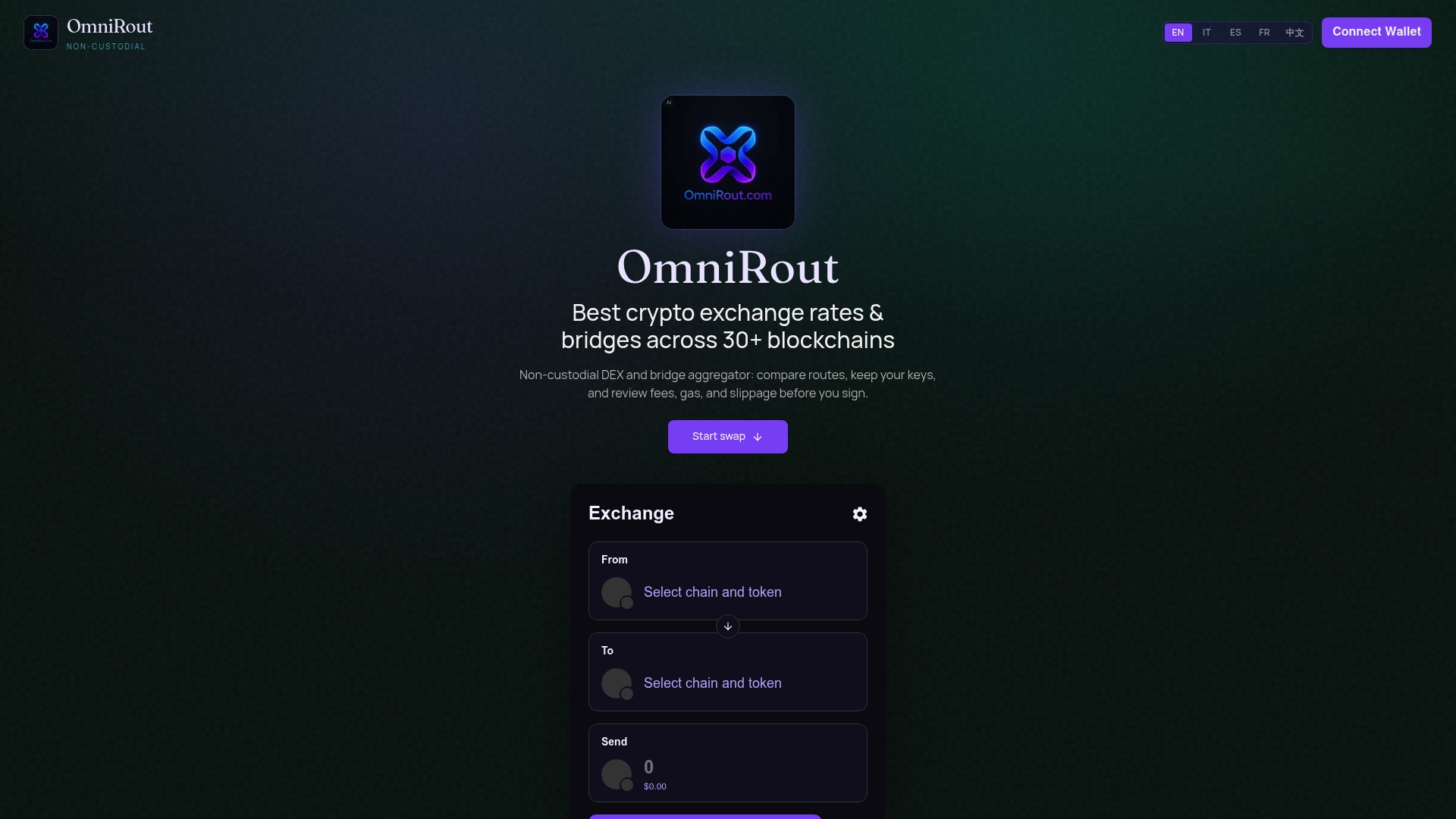
That pre-trade transparency is the concrete difference for traders who have been burned by invisible fee stacking or unexpected slippage on cross-chain swaps. Omnirout is non-custodial, meaning your private keys stay with you throughout every swap and bridge transaction across its 30+ supported chains.
Compare routes on Omnirout and see the fee and slippage breakdown before your next cross-chain swap. Omnirout is the publisher of this article.
Sources
- Fragmentation and optimal liquidity supply on decentralized exchanges
- Why liquidity fragmentation became one of crypto's biggest trading problems
- Cross-chain liquidity: Building the future
- Liquidity fragmentation - Spark Glossary
This article is general information, not a substitute for advice from a qualified financial advisor. Consult a qualified financial professional about your own circumstances before acting on anything here.