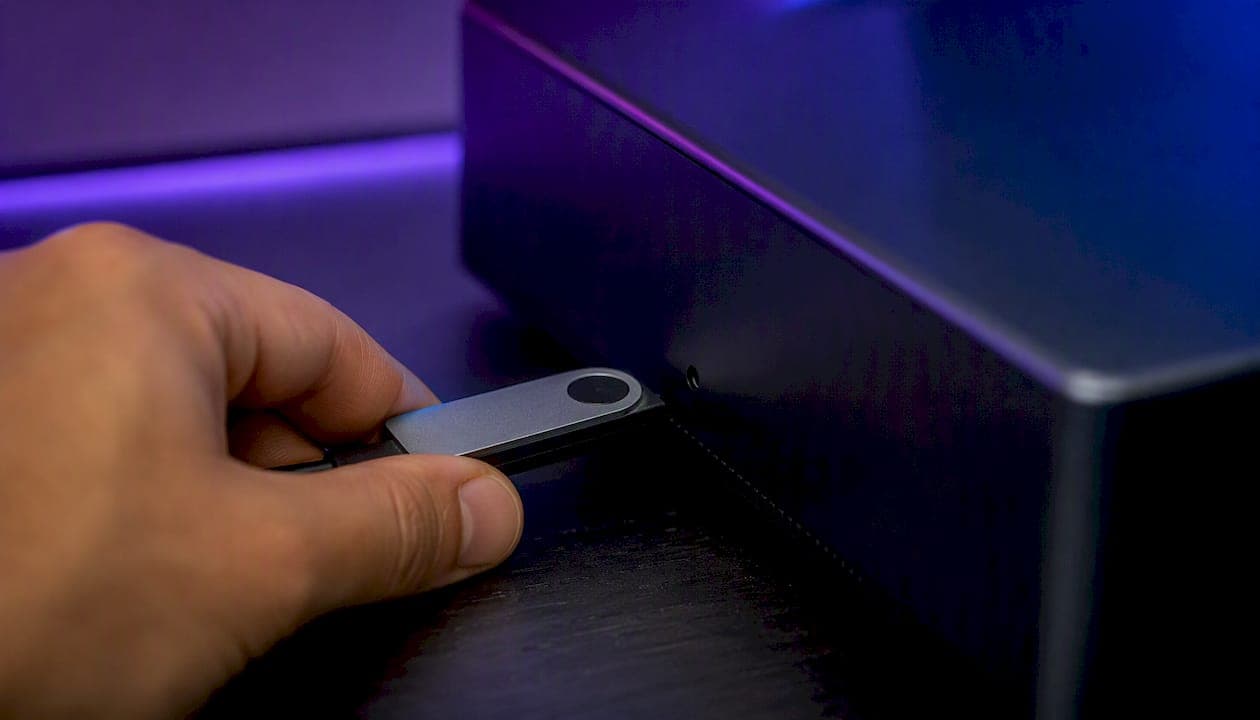
A non-custodial exchange executes swaps directly between your wallet and a smart contract, so your private keys never leave your control. PCMag defines it as a platform that does not hold users' coins or tokens at any point in the transaction. If you want one place to start, Omnirout is a strong first choice: it's a non-custodial DEX and bridge aggregator that compares routes across 30+ blockchains, shows you fees, gas, and slippage before you commit, and never takes custody of your funds.
For more specific needs, here's a quick orientation:
- Multi-chain routing with fee transparency: Omnirout
- Instant fixed-rate swaps: FixedFloat, ChangeNow
- No-KYC simple swaps: SimpleSwap, StealthEX, InstaSwap
The scale of exchange-related losses documented in Statista's cryptocurrency theft chart makes the case plainly: when a platform holds your funds, you inherit its security failures. Non-custodial trading removes that exposure.
Key Takeaways
Non-custodial exchanges give you full control of your keys throughout every trade, which removes the counterparty risk that has driven the largest crypto losses in history.
| Point | Details |
|---|---|
| Keys stay with you | A non-custodial exchange never holds your funds; swaps execute wallet-to-smart-contract. |
| Biggest risks are self-managed | Lost seed phrases and unaudited smart contracts are the primary loss vectors, not exchange hacks. |
| Audit status is the trust signal | Look for a published third-party audit, a public contract address, and no admin keys before using any platform. |
| Compare full costs before signing | Platform fee, gas, and bridge fees together determine real cost; Omnirout shows all three before you commit. |
| Start with a small test trade | Validate routing, fees, and wallet compatibility with a low-value swap before moving significant funds. |
Table of Contents
- What is a non-custodial exchange and how does it work?
- Why traders choose non-custodial exchanges
- Main risks and downsides you should know
- How to pick the right non-custodial exchange
- Top non-custodial exchanges compared
- How to do a swap on a non-custodial exchange
- Security checklist: wallets, approvals, and scam avoidance
- KYC, privacy, and what regulation means for non-custodial users
- How to evaluate trust signals on any non-custodial platform
- Why Omnirout stands out for multi-chain non-custodial trading
- When non-custodial is the right call (and when it isn't)
- A low-risk way to try Omnirout
- Frequently asked questions
- Sources
What is a non-custodial exchange and how does it work?
The core mechanic is straightforward. You connect your wallet, approve a token for spending, sign a transaction, and the swap executes on-chain. At no point does the exchange hold your funds in a custodial account. The platform is just the interface; the blockchain is the settlement layer.
Three main architectures power most non-custodial swaps:
- Automated Market Makers (AMMs): Liquidity pools replace order books. A smart contract holds paired assets and prices them algorithmically based on the ratio in the pool. Uniswap popularized this model.
- Atomic swaps: Cryptographic contracts let two parties exchange assets across chains without a trusted intermediary. If one leg fails, both legs revert.
- Aggregator routing: Instead of executing on a single DEX, an aggregator queries multiple DEXs and bridge protocols simultaneously, then routes your trade through the path with the best net output after fees and slippage.
Omnirout operates in that third category. Rather than locking you into one liquidity source, it compares routes across dozens of DEXs and bridges and shows you the breakdown before you sign.
The wallet-to-swap flow, step by step:
- Connect your wallet (MetaMask, Ledger, WalletConnect-compatible wallets).
- Select the source chain, source token, destination chain, and destination token.
- The aggregator queries available routes and returns fee, gas, and slippage estimates for each.
- You review and select a route, then approve the token spend (ideally with a minimal allowance).
- You sign the transaction. The smart contract executes the swap on-chain.
- Tokens arrive in your wallet. The exchange never held them.
Pro Tip: Think of the flow as: wallet → smart contract → on-chain swap or bridge → recipient wallet. The exchange is the router, not the vault.
Why traders choose non-custodial exchanges
The most obvious reason is key control. On a custodial platform, the exchange holds your assets and can freeze withdrawals, blacklist addresses, or go insolvent. CoinDesk reported that Coinbase blacklisted over 25,000 addresses linked to alleged illicit activity, illustrating exactly the kind of unilateral control that custodial architecture enables. Non-custodial services can't do that, because they never hold the funds.
Privacy is a related but distinct benefit. Many non-custodial exchanges don't require you to deposit funds into a platform account or complete identity verification to execute a swap. You connect a wallet and trade. Coin Bureau's roundup of non-custodial exchanges identifies privacy and audit status as the two primary differentiators readers should evaluate, which tracks with how most experienced traders actually think about the category.
There's also the DeFi composability angle, which gets underappreciated. Because your tokens stay in your wallet between trades, you can interact directly with yield protocols, liquidity pools, and lending markets without moving funds through a centralized intermediary. A custodial exchange breaks that chain: your assets are the exchange's liability, not your on-chain balance. For anyone actively using DeFi, that distinction has real practical weight.
Who benefits most:
- Long-term holders who don't want exchange insolvency risk on their stack
- Privacy-conscious traders who want to minimize identity exposure
- Cross-chain users who need bridge access without custodial on-ramps
- Power users who manage token approvals, slippage tolerances, and routing manually
Main risks and downsides you should know
Non-custodial trading shifts responsibility entirely to you, and that's both the point and the hazard.
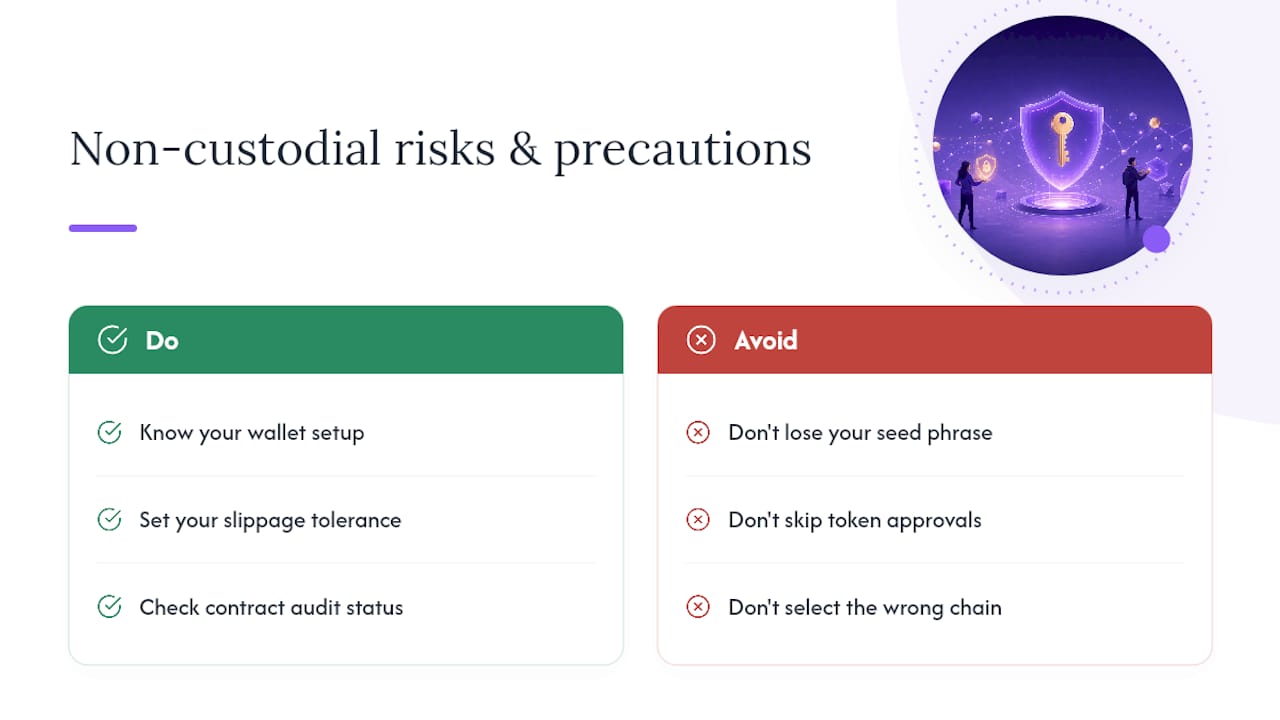
No recovery path for lost keys. If you lose your seed phrase or a private key is compromised, there is no support ticket to file. The funds are gone. Custodial platforms have account recovery; non-custodial architecture does not.
Smart contract risk is real. Every swap you execute interacts with code. Bugs in that code, unaudited contracts, or bridge exploits can drain funds on-chain with no recourse. Bridge protocols in particular have been the site of some of the largest crypto losses on record, as the Statista theft data shows.
Liquidity and slippage on smaller pools. A large swap on a thin liquidity pool moves the price against you. Multi-hop cross-chain routes compound this: each leg adds slippage and bridge fees, and the total cost can be meaningfully higher than the headline rate suggests.
UX friction for newcomers. Gas management, token approvals, chain selection, and wallet setup all require knowledge that custodial platforms abstract away. A wrong chain selection or a missed approval step can result in a failed transaction and a lost gas fee.
The practical takeaway: non-custodial exchanges reward preparation. Go in knowing your wallet setup, your slippage tolerance, and the audit status of the contracts you're interacting with.
How to pick the right non-custodial exchange
Run through this checklist before committing to any platform:
- Supported chains and tokens: Does it cover the chains you actually use? A platform that supports 5 chains is fine for Ethereum-native users but useless for Cosmos or Solana traders.
- Liquidity and slippage: Check the expected slippage on your specific trade size, not just the advertised rate.
- Fee transparency: Can you see the full cost breakdown — platform fee, gas estimate, bridge fee — before signing? If not, walk away.
- Audit status: Is there a third-party audit from a recognized firm? Is the contract address public and verifiable on a block explorer?
- Open-source code: Can you read the smart contract code, or is it proprietary and unverifiable?
- Wallet compatibility: Does it support your wallet (hardware or software)?
- KYC policy: Does it require identity verification for the swap size you need?
Three quick questions to ask before any swap:
- Can I find and read the audit report for this contract?
- What bridge protocol does this route use, and has it been exploited before?
- Am I approving an unlimited token allowance, or can I set a specific amount?
Red flags to avoid:
- No contract address or audit link anywhere on the site
- Opaque fee structures where the final cost only appears after you sign
- Admin keys or upgrade backdoors that let the team modify contracts post-deployment
- Any requirement to deposit funds into a platform wallet before swapping
Top non-custodial exchanges compared
Each platform below operates without taking custody of your funds. The comparison covers the dimensions that actually matter for a real trading decision.
A few notes on how to read this table:
- Omnirout's route comparison is the key differentiator for multi-chain users. Seeing gas, bridge fees, and slippage in one view before signing is not standard across the category.
- ChangeNow and FixedFloat are better fits when you want a fixed rate and don't need wallet integration. You send funds to a swap address; they send back the output token.
- StealthEX and SimpleSwap are the lowest-friction options for users who want no registration at all, though liquidity on exotic pairs can be thin.
- Koinly's no-KYC exchange list covers the fee and liquidity trade-offs for privacy-first platforms in more depth.
How to do a swap on a non-custodial exchange
This walkthrough applies to any wallet-connected non-custodial platform, including Omnirout.
- Connect your wallet. Use MetaMask, a Ledger via WalletConnect, or any compatible software wallet. Never connect a wallet holding your full stack to an unfamiliar dApp — use a dedicated trading wallet.
- Verify the chain and token contract address. Before selecting a token, confirm the contract address against a block explorer. Fake tokens with identical ticker symbols are a common scam vector.
- Enter your trade and compare routes. On an aggregator like Omnirout, you'll see multiple route options with fee, gas, and slippage breakdowns. Pick the route with the best net output, not just the lowest platform fee.
- Preview total cost. Add up platform fee + gas estimate + bridge fee (if cross-chain). That's your real cost. If the interface doesn't show all three, treat it as a red flag.
- Set slippage tolerance. For liquid pairs on major DEXs, 0.5% is usually fine. For thin pools or cross-chain routes, you may need 1–2%. Setting it too low causes failed transactions; too high opens you to sandwich attacks.
- Run a small test trade first. Before moving significant value, swap a small amount to confirm the route works, the output arrives in your wallet, and the fees match the estimate.
- Sign and confirm. Review the transaction details in your wallet before signing. Check the contract address you're approving, not just the token name.
- Wait for confirmation. On-chain swaps typically confirm within seconds to a few minutes depending on the chain and gas price. Cross-chain bridges can take longer — sometimes 10–30 minutes on congested routes.
Pro Tip: Schedule larger transactions during off-peak hours on Ethereum mainnet (weekends, early UTC mornings) when gas prices tend to be lower. On L2s like Arbitrum or Base, gas is cheap enough that timing matters less.
Common issues:
- Failed transaction: Usually a slippage tolerance set too low or insufficient gas. Increase slippage slightly and retry.
- Stuck pending: Speed up with a higher gas fee using your wallet's "speed up" function, or wait it out.
- Token approval not showing: Refresh the dApp connection or disconnect and reconnect your wallet.
Security checklist: wallets, approvals, and scam avoidance
Non-custodial trading is only as secure as your setup. Most losses come from key management failures and approval exploits, not from the exchanges themselves.
Wallet setup:
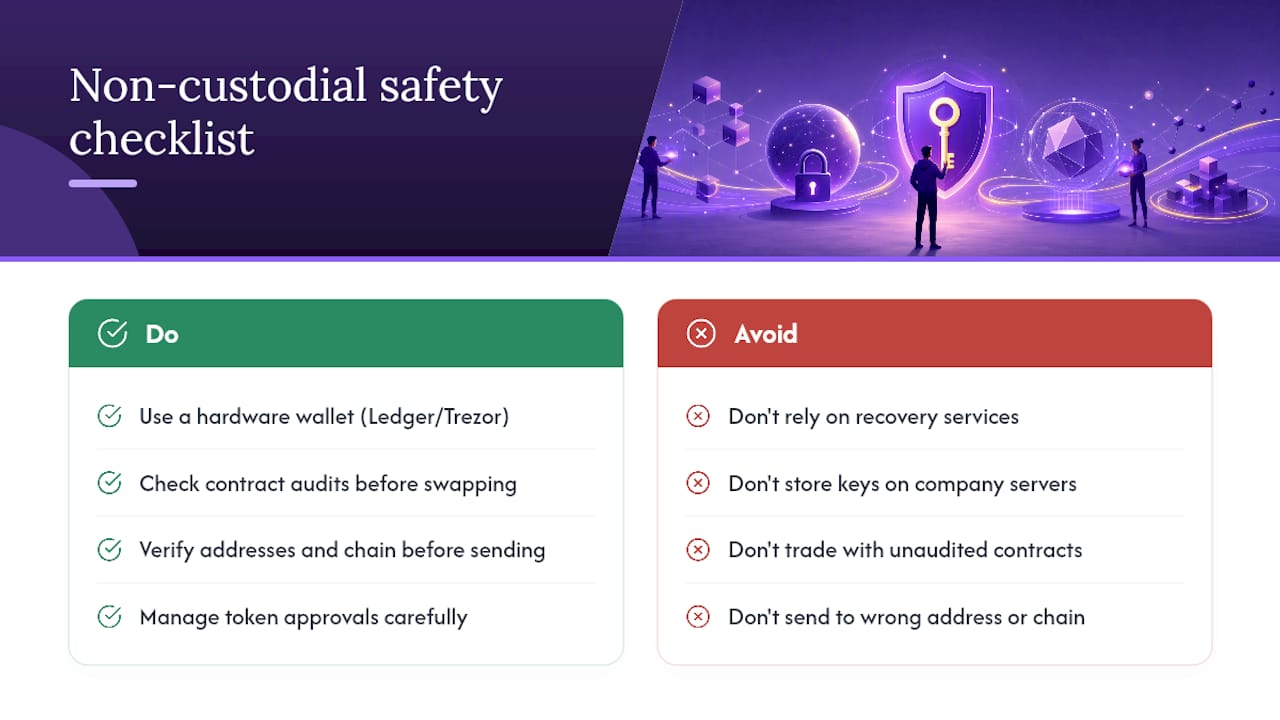
- Use a hardware wallet (Ledger, Trezor) for any balance you'd be upset to lose. Software wallets are convenient but expose your keys to the device they run on.
- Keep your seed phrase written on paper (or metal) and stored offline. Never photograph it, paste it into a notes app, or store it in cloud storage.
- Use a separate wallet for active trading. Keep your long-term holdings in a cold wallet that never connects to dApps.
Approval management:
- When approving a token spend, set the allowance to the exact amount of the trade, not unlimited. Most wallets let you edit the approval amount.
- After a swap, revoke unused approvals. Tools like Revoke.cash or your wallet's built-in approval manager (MetaMask has one) let you see and cancel active allowances.
- Review approvals periodically, especially after using a new dApp.
Scam and phishing defenses:
- Always navigate to dApps via bookmarked URLs. Phishing sites copy interfaces pixel-for-pixel and differ only in the domain.
- Verify the contract address of any token you're swapping against a trusted block explorer (Etherscan, Arbiscan, etc.) before approving.
- Never connect your wallet to a dApp sent via DM, email, or social media. Legitimate platforms don't cold-contact users.
- On cross-chain transfers, double-check the recipient address on the destination chain before signing. A wrong address on a bridge transfer is unrecoverable.
Pro Tip: For accounts holding significant value, a multisig setup (Gnosis Safe, for example) requires multiple key approvals for any transaction. It adds friction but makes a single compromised key insufficient to drain the wallet.
KYC, privacy, and what regulation means for non-custodial users
Most non-custodial exchanges don't require identity verification for wallet-to-wallet swaps. You connect a wallet, execute a trade, and the tokens arrive. No account, no document upload. That's the standard model for the platforms in this article.
The picture gets more complicated at the edges. Some platforms introduce optional KYC for higher swap limits or for fiat on-ramp integrations. Others operate in jurisdictions where regulatory pressure is increasing. Forkast documented Binance's move to mandatory KYC as part of a broader trend: centralized platforms are tightening identity requirements under regulatory pressure, which is part of why privacy-minded users are moving toward non-custodial alternatives.
Non-custodial doesn't mean invisible, though. On-chain transactions are public by default. Your wallet address, trade amounts, and counterparty addresses are visible on any block explorer. Sophisticated chain analysis can link wallets to identities if you've ever connected a wallet to a KYC'd platform. Practical privacy hygiene:
- Use a fresh wallet address for trading if privacy matters to you.
- Avoid reusing the same address across multiple platforms.
- Understand that bridge transactions often leave a cross-chain trail linking source and destination wallets.
- Check the privacy policy of any aggregator or swap interface you use, since some log metadata even when the swap itself is non-custodial.
The regulatory environment varies significantly by country. This article doesn't provide legal advice, and the rules in your jurisdiction may differ from what's described here. Check local regulations before trading, particularly if you're in a jurisdiction with active crypto enforcement.
How to evaluate trust signals on any non-custodial platform
The difference between a trustworthy non-custodial exchange and a risky one usually comes down to verifiable evidence, not marketing copy.
What to look for:
- Third-party audit reports: A recognized security firm (Trail of Bits, Certik, Halborn, OpenZeppelin) has reviewed the smart contract code and published a report. The report should be publicly accessible, not just referenced in a blog post.
- Formal verification: The contract's logic has been mathematically proven against a specification. This is a higher bar than a standard audit and is relatively rare.
- Open-source code: The contract code is published on GitHub or a similar repository with a verifiable commit history. You can read it, or someone you trust can.
- No admin keys: The contract cannot be modified or paused by the team after deployment. Look for renounced ownership or time-locked governance.
- Public bug bounty: The team offers rewards for responsible vulnerability disclosure. Active bounties signal ongoing security investment.
- On-chain incident history: Search the contract address on a block explorer and look for any unusual transaction patterns, large unexpected outflows, or known exploit events.
How to verify:
- Find the contract address on the platform's official documentation or GitHub.
- Paste it into Etherscan (for Ethereum), Arbiscan (Arbitrum), BscScan (BNB Chain), or the relevant explorer for the chain.
- Check the audit firm's own website for the published report — don't rely solely on the platform's link.
- Search the contract address or protocol name on DeFiLlama's hack tracker or similar incident databases.
A platform that can't point you to a contract address and an audit report is asking you to trust marketing instead of evidence.
Why Omnirout stands out for multi-chain non-custodial trading
Omnirout is the publisher of this article, and it's worth being direct about that. The recommendation to try Omnirout isn't incidental: it's a platform built specifically for the use case this article describes.
Here's what distinguishes it in practice:
- 30+ blockchain support: Most non-custodial swap interfaces cover a handful of chains. Omnirout's aggregator spans 30+ networks, which matters for users who move assets across Ethereum, L2s, and alternative chains regularly.
- Route comparison before you commit: Before signing any transaction, you see a breakdown of the platform fee, estimated gas, bridge fees, and expected slippage across available routes. That level of pre-trade transparency is not standard in the category.
- Non-custodial by design: No funds are held by Omnirout at any point. The architecture is wallet-to-smart-contract throughout.
- Wallet integrations: Compatible with MetaMask, Ledger via WalletConnect, and other major wallets. No proprietary wallet required.
- Developer access: Teams building on top of DEX infrastructure can integrate Omnirout's routing directly.
Before committing significant funds, run a small test trade. Pick a low-value swap across two chains you use regularly, check that the fee breakdown matches the estimate, and confirm the output arrives in your wallet. That's the fastest way to validate that the routing and UX work for your specific setup.
When non-custodial is the right call (and when it isn't)
Non-custodial trading is the right default for most crypto users who have been in the space long enough to manage a wallet. But it's not the right answer for every situation, and pretending otherwise doesn't help anyone.
Use non-custodial when:
- You're holding assets long-term and don't want exchange insolvency or blacklisting risk.
- You're actively using DeFi and need your tokens to stay in your wallet between interactions.
- Privacy matters and you want to minimize identity exposure.
- You're doing cross-chain transfers and want to compare bridge routes before committing.
Custodial may be preferable when:
- You need a fiat on-ramp or off-ramp. Non-custodial exchanges don't handle bank transfers.
- You're new to crypto and not yet comfortable managing seed phrases and gas. A compromised key on a non-custodial platform has no recovery path.
- You need customer support for a disputed transaction. Non-custodial architecture means there's no one to call.
The checklist in the "How to pick" section above applies regardless of which platform you choose. The honest framework: if you can manage your own keys and understand the basics of gas and approvals, non-custodial is almost always the better structure. If you can't yet, learn those basics before moving significant value to a self-custody setup.
*— Emanuele
A low-risk way to try Omnirout
The best way to evaluate any non-custodial exchange is a small test trade, not a review article. Run a swap of a token you hold across two chains you actually use, check that the fee breakdown matches what Omnirout showed you before signing, and confirm the output lands in your wallet within the expected time.
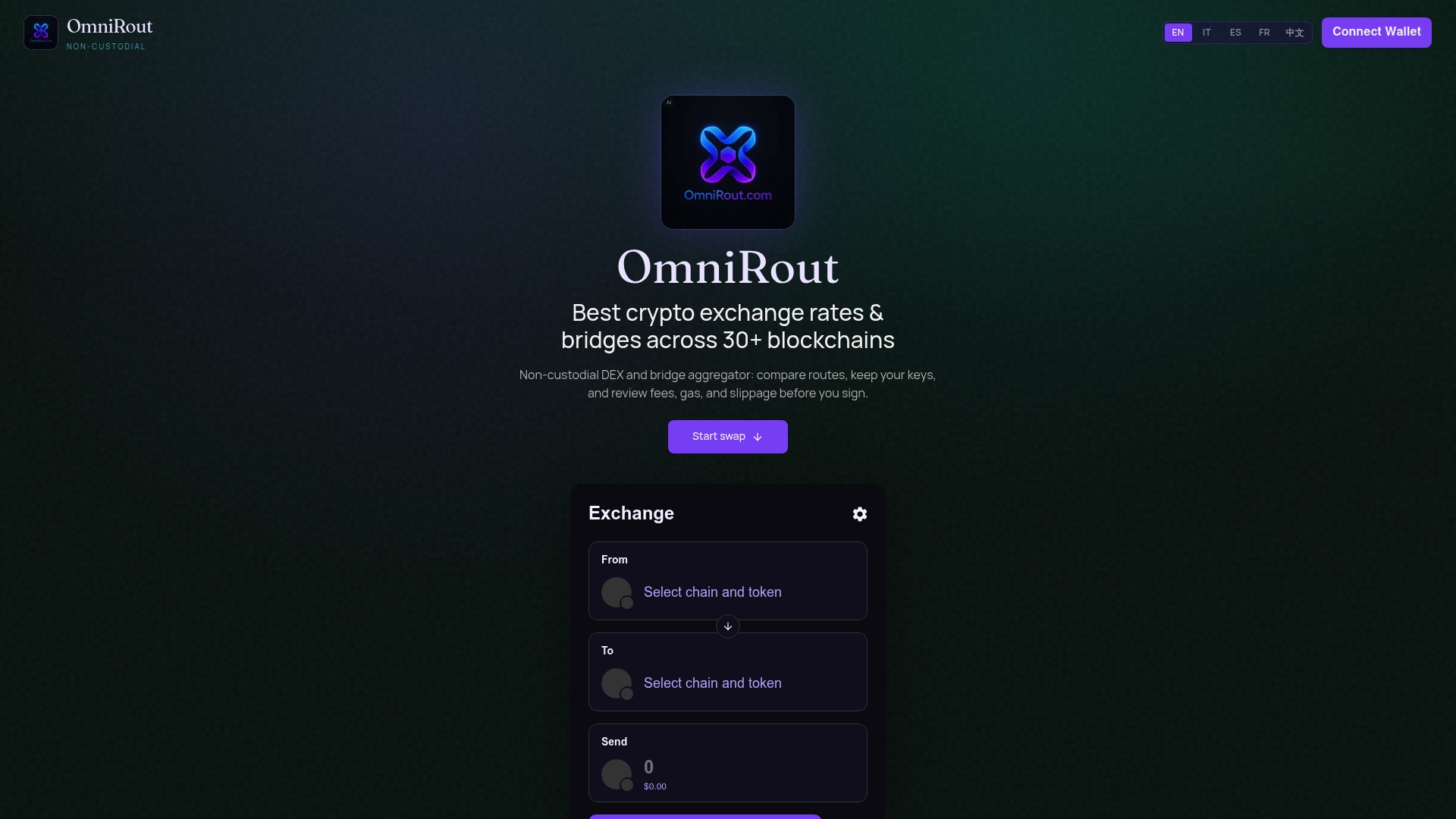
Omnirout is built for exactly this kind of verification: the route comparison view shows platform fees, gas estimates, and bridge costs before you commit, so you're not discovering the real cost after the fact. It covers 30+ blockchains, requires no custodial account, and works with the wallets you already have.
This article is published by Omnirout. The recommendation is genuine, and the test-trade approach is the right way to validate it for your specific setup. Start a test swap on Omnirout and see the route comparison in action before moving larger amounts.
Frequently asked questions
What is a non-custodial wallet? A non-custodial wallet stores your private keys on your own device or hardware, not on a company's server. You control the keys; you control the funds. MetaMask and Ledger are common examples.
Can you lose crypto on a non-custodial exchange? Yes. The most common causes are lost or compromised seed phrases, smart contract exploits, and user errors like sending to the wrong address or wrong chain. There's no recovery service.
Is a non-custodial exchange safe? Safer from exchange insolvency and blacklisting risk than custodial platforms, but not risk-free. Safety depends on the audit status of the contracts you use, your wallet security practices, and how carefully you manage approvals and addresses.
What's the difference between a DEX and a non-custodial exchange? A DEX (decentralized exchange) is one type of non-custodial exchange, typically using AMM liquidity pools. Non-custodial exchange is the broader category, which also includes atomic swap platforms, aggregators like Omnirout, and P2P escrow marketplaces.
Do non-custodial exchanges require KYC? Most don't for standard wallet-to-wallet swaps. Some introduce optional KYC for higher limits or fiat integrations. Check the platform's terms for the swap size you need.
How long do non-custodial swaps take? On-chain swaps on fast L2s (Arbitrum, Base, Optimism) typically confirm in seconds. Ethereum mainnet swaps usually take 15–60 seconds at normal gas prices. Cross-chain bridge transfers can take 10–30 minutes depending on the bridge protocol and destination chain congestion.
What is slippage and why does it matter? Slippage is the difference between the price you expected and the price you got. It happens because the pool's ratio shifts between when you submit the transaction and when it executes. On thin pools or large trades, slippage can be significant. Setting a slippage tolerance tells the contract to revert the transaction if the price moves beyond your threshold.
Can I use a hardware wallet with non-custodial exchanges? Yes. Most non-custodial platforms support WalletConnect, which lets you connect a Ledger or Trezor. You sign transactions on the hardware device, so your private key never touches the browser.
This article is general information, not a substitute for advice from a qualified financial advisor. Consult a qualified financial professional about your own circumstances before acting on anything here.
Sources
- Largest known cryptocurrency thefts — Statista
- Top Non-Custodial Exchanges for Privacy and Security — Coin Bureau
- Definition of non-custodial crypto exchange — PCMag
- Coinbase highlights blacklisting of addresses — CoinDesk