Non-custodial wallets hand you exclusive control of your private keys, unlocking direct DeFi and dApp access while removing the risk that a custodian freezes your funds or collapses with your money inside it, according to ChainUP. The Blockchain Council frames the trade honestly: you gain sovereignty, but you also inherit every backup and security decision that a custodian used to make for you. OmniRout was built around that same self-custody principle. The one thing you cannot outsource is responsibility for your seed phrase.
TL;DR:
- Self-custody relies entirely on the user to securely manage seed phrases, with no centralized support if keys are lost or compromised.
- Using a hardware wallet, verifying recovery processes, and revoking unused token approvals can significantly reduce self-custody risks.
- Comparing swap routes for fees, gas, and slippage before signing transactions saves money and avoids unexpectedly high costs on congested networks.
- A hybrid approach—small amounts in custodial wallets and larger holdings in self-custody—is often safest for beginners transitioning to full control.
- Jurisdictional rules may influence self-custody operations, but ultimate responsibility for security and recovery remains with the user.
Table of Contents
- What Makes a Wallet Non-Custodial vs Custodial?
- The Real Benefits of Going Non-Custodial
- The Risks Nobody Sweeps Under the Rug
- Setting Up a Non-Custodial Wallet Without Getting Burned
- Security Practices Worth Adopting From Day One
- Custodial, Non-Custodial, or Both?
- Why OmniRout Builds Around Self-Custody
- Compare Routes Before You Sign, Not After
- Sources
What Makes a Wallet Non-Custodial vs Custodial?
A non-custodial wallet is software or hardware that generates and stores a private key, the cryptographic proof that lets you sign transactions on a blockchain. Nobody else holds a copy. That key derives from a seed phrase, which functions as a master password with no reset button. When you sign a transaction, you are proving ownership directly to the network, not asking a company to move funds on your behalf.
Custody, in practice, determines who bears the risk. In a custodial wallet, an exchange or app holds the keys and manages security, compliance, and recovery for you. That is convenient until the custodian gets hacked, goes insolvent, or freezes your account for a compliance review. In a non-custodial setup, the assets live on-chain under an address only you control, and BitGo notes this structure removes your exposure to a centralized breach or insolvency event entirely.
The Real Benefits of Going Non-Custodial
The case for self-custody isn't theoretical. It shows up in specific, everyday advantages once you actually start using crypto instead of just holding it on an exchange.
- Direct ownership and censorship resistance. No platform can freeze your address, restrict a withdrawal, or block a transaction because of a policy change.
- Native DeFi and NFT access. Lending protocols, decentralized exchanges, and NFT marketplaces require a wallet that can sign transactions directly. Custodial accounts typically can't participate.
- Lower exposure to third-party failure. Your funds don't disappear if an exchange gets hacked or files for bankruptcy, since nothing sits in a shared custodial pool.
- Better privacy. Creating a wallet address requires no identity verification, unlike most custodial accounts, which are subject to know-your-customer rules.
- Flexible security architecture. You can layer protection with hardware signers, multisig setups, or smart-contract wallets depending on how much is at stake.
- More control over cost. You're not paying a platform's withdrawal markup, and you can compare routes, gas costs, and slippage yourself before a swap executes.
That last point matters more than most people realize. Two swaps of the same token pair can differ by a meaningful margin in effective cost once you account for gas and slippage together, which is exactly why comparing routes before signing is worth the extra thirty seconds.
Pro Tip: Before approving any swap, check the estimated slippage and gas cost side by side. A "good" price on one route can turn mediocre once gas eats into it, especially on congested networks.
The Blockchain Council points out that many users don't pick one model exclusively. They keep a custodial account for fiat on-ramps and regulated reporting, then move meaningful holdings into self-custody once they're comfortable with the mechanics.
The Risks Nobody Sweeps Under the Rug
Self-custody has a dark side, and pretending otherwise does readers a disservice. Stripe's explainer puts it plainly: non-custodial wallets remove the centralized recovery path. There's no support line to call.
- Lost seed phrase, lost funds. Nobody can reset it, restore it, or override it. If it's gone, so is your access.
- Phishing and malicious approvals. Fake dApp interfaces trick people into signing approvals that drain their wallet, often without an obvious warning sign.
- Device compromise. Malware or a stolen phone can expose a hot wallet's stored keys or session data.
- Sending to the wrong chain or address. A transfer to an incompatible network or a mistyped address is usually unrecoverable.
- Gas misconfiguration. Forgetting to hold the network's native token for fees can strand a transaction or waste funds on a failed attempt.
Mitigation isn't complicated, just disciplined: test with a small amount first, use a hardware signer for anything significant, keep backups in separate physical locations, and revoke old token approvals regularly.
Pro Tip: Send a tiny test transaction before moving a large balance to a new address or a new chain. It costs a few cents and can save you from an irreversible mistake.
Setting Up a Non-Custodial Wallet Without Getting Burned
Getting started safely takes maybe twenty minutes if you follow the order below instead of rushing.
- Pick the wallet type that matches your use case. A browser or mobile hot wallet works for everyday dApp interaction; a hardware wallet suits long-term holdings; a smart-contract multisig fits shared or high-value funds.
- Generate the wallet and record the seed phrase on paper, never as a screenshot or a note in a cloud-synced app.
- Verify the phrase by re-entering it during setup, then store two physical copies in separate locations.
- Test recovery on a spare device. Restore the wallet using only the seed phrase, then send a small transfer to confirm everything works before trusting it with real money.
- Add a hardware signer or multisig once your balance grows. A hardware device keeps the private key offline, signing transactions without ever exposing the key to an internet-connected screen.
Before you consider the setup finished, run through this checklist:
- Enable your device's built-in biometric or PIN protection.
- Learn how to check and revoke token approvals on a block explorer.
- Use a transaction simulation tool to preview what a contract call will actually do before you sign it.
- Confirm you're interacting with the correct, verified contract address, not a lookalike.
Security Practices Worth Adopting From Day One
Treat your wallet setup like a tiered vault system rather than one flat pile of assets. ForvisMazars recommends exactly this: a browser-based hot wallet for active dApp use, paired with a hardware signer or cold storage for anything you'd actually miss losing.
- Keep only spending money in a hot wallet, the way you'd treat a physical wallet versus a bank vault.
- Use a hardware signer for meaningful balances; add multisig when multiple people share control of the same funds.
- Revoke unused token approvals periodically. Old approvals from apps you no longer use are a common exploit path.
- Simulate transactions before signing anything unfamiliar, and double check the contract address independently.
- Test your recovery process on a real (small) transaction, not just in theory.
Jurisdictional rules still apply even though a wallet itself sits outside most licensing regimes. Bodies like the Monetary Authority of Singapore, ESMA's MiCA framework, and the SEC increasingly shape how custodial services must report and operate, which indirectly affects where and how self-custody users move funds between platforms.
Custodial, Non-Custodial, or Both?
Neither model wins outright. The right choice depends on what you're optimizing for.
- Choose custodial if you need easy fiat conversion, simplified tax reporting, or you're brand new and still learning wallet mechanics.
- Choose non-custodial if direct ownership, DeFi access, or privacy matter more to you than built-in customer support.
- Choose a hybrid or multisig setup for team funds, DAO treasuries, or any situation where several people need shared, auditable control.
A sensible rule for beginners: keep small, active amounts in a custodial account while you learn the mechanics, then migrate meaningful holdings to a tested non-custodial setup once your recovery process actually works.
Why OmniRout Builds Around Self-Custody
OmniRout exists because we believe control over your keys shouldn't cost you efficiency. The whole point of the product is letting you compare swap routes across more than 30 blockchains without ever handing custody to a middleman. That premise only works if users understand what self-custody actually demands of them, which is why this guide exists in the first place.
Emanuele, who covers wallet security and DeFi infrastructure for Omnirout, built this piece around the same research that informs the product itself. The goal isn't to sell you on ideology. It's to make sure that when you do sign a transaction, you know exactly what you're signing and why.
— Emanuele
Compare Routes Before You Sign, Not After
Retaining your keys is only half the advantage. The other half is knowing you got a fair deal on the swap itself, and that's where most self-custody users fly blind.
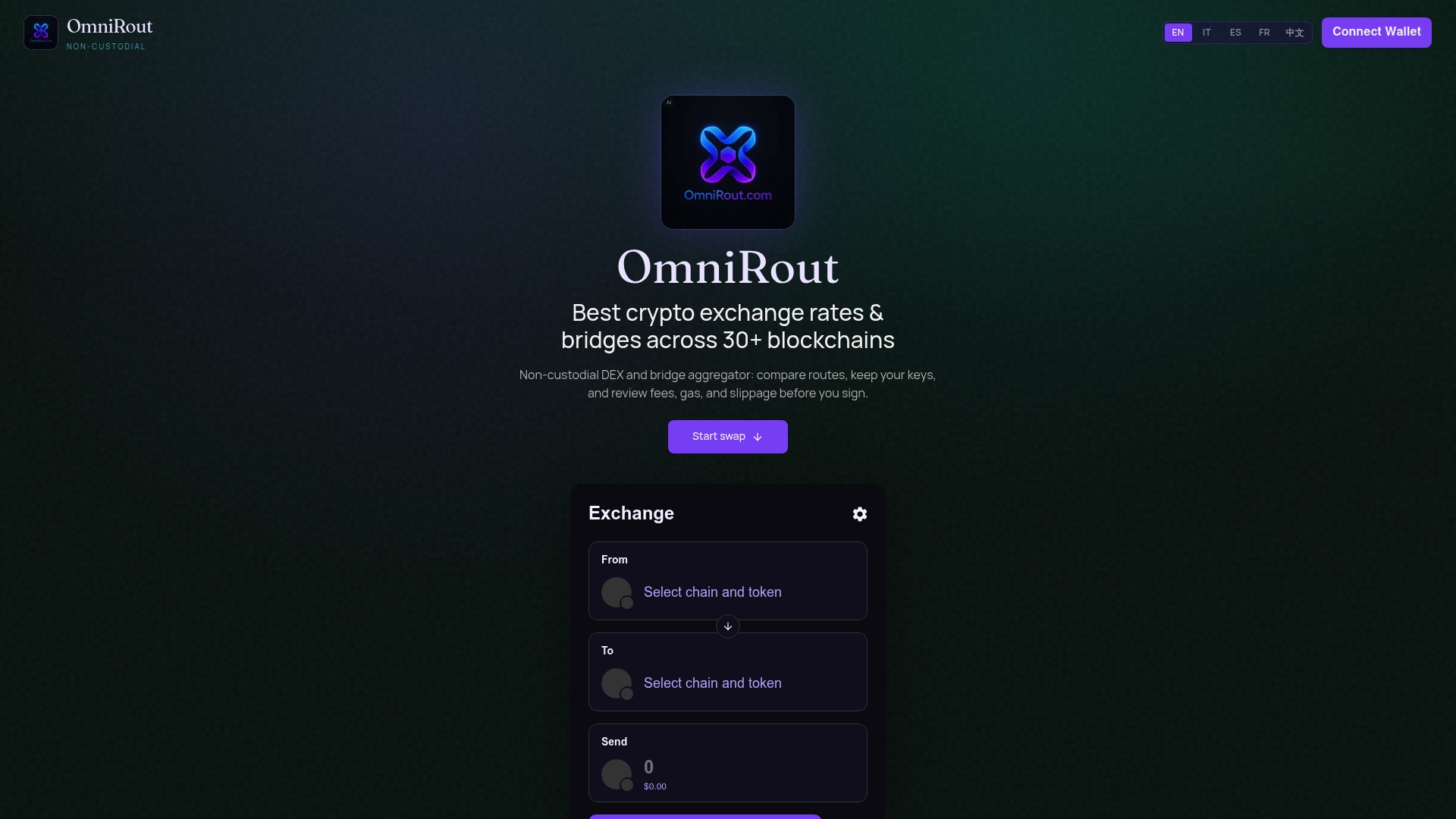
OmniRout lets you compare fees, gas costs, and slippage across more than 30 blockchains before you commit to a route, all while your private keys stay exactly where they belong: with you. Instead of guessing whether a swap is priced fairly, you see the numbers side by side and pick the route that actually keeps more of your money. That transparency matters most on congested networks, where two routes for the identical trade can land at noticeably different effective costs once gas and slippage are factored in. If you're already committed to self-custody, there's no reason to give up visibility into what a swap actually costs you. Compare your next swap on OmniRout before you sign anything.
Sources
- Custodial vs Non-Custodial Wallets — Blockchain Council
- Custodial vs noncustodial wallets — Stripe
- Non-custodial wallets: private key management guide — ChainUP