
Smart order routing (SOR) is an automated decision engine that splits a parent order into child orders and dispatches them across multiple trading venues to achieve the best net outcome, accounting for price, fees, latency, and fill probability in real time. The bottom line: without SOR, a trader hitting the displayed best bid or offer in a fragmented market is almost certainly leaving money on the table, because the best-looking quote is rarely the best net price after fees, adverse selection, and partial-fill risk are factored in.
What a well-designed SOR evaluates on every routing decision:
- Price net of fees and rebates — displayed price minus maker/taker fees or plus rebates at each venue
- Latency to each venue — stale quotes cost more than a slightly worse price at a faster venue
- Fill probability — a 100-share display at a dark pool with 30% fill probability is worth less than a 60-share fill at a lit exchange
- Markout / toxicity — the realized price 10–30 seconds after fill, used to score venue quality over time
- Hidden liquidity — dark pool reserve orders and iceberg display quantities that don't appear in the top-of-book
Immediate use cases span cash equities (Reg NMS fragmentation across U.S. lit exchanges, ATSs, and dark pools) and crypto DEX aggregation (routing swaps across AMM pools and cross-chain bridges while minimizing gas, slippage, and MEV exposure).
Key Takeaways
Smart order routing delivers its largest gains not from algorithmic sophistication but from accurate, real-time inputs: correct fee schedules, live markout scorecards, and quote-age filtering that prevents routing to stale prices.
| Point | Details |
|---|---|
| SOR is a decision engine, not a single algorithm | It combines rule engines, statistical scoring, and optional ML layers, each serving a different latency and interpretability tradeoff. |
| Measure implementation shortfall and markout | These two metrics, computed per venue and per session, are the primary signals for whether routing is improving or degrading execution quality. |
| Backtest is a floor, not a forecast | Historical replay cannot model queue position or market impact; shadow routing and live A/B tests are required to validate real improvement. |
| Reg NMS Rule 611 constrains every U.S. equity SOR | Trade-through checks and NBBO tracking are non-negotiable compliance requirements, not optional features. |
| Omnirout applies SOR principles on-chain | Omnirout's route comparison engine scores fees, gas, slippage, and bridge risk across 30+ chains before execution, with full non-custodial transparency. |
Table of Contents
- How smart order routing works: the per-order decision pipeline
- Algorithmic approaches inside SORs: from rule engines to machine learning
- How to measure and validate SOR performance
- Engineering and production architecture for low-latency SOR
- Practical benefits and trade-offs of deploying SOR
- How SOR differs from and complements execution algorithms
- U.S. market structure, fragmentation, and regulatory constraints on SOR
- SOR for crypto: DEX aggregation, cross-chain bridges, and MEV
- Omnirout case study: applying SOR principles to cross-chain DEX aggregation
- How SOR handles dark pools and iceberg orders
- Latency arbitrage risks and how SOR design mitigates them
- Integrating TCA with SOR logic
- Data quality and data cleaning challenges in SOR systems
- How SOR strategies adapt to market volatility and stress conditions
- Risk management techniques specific to SOR
- What execution engineers actually learn after building SOR in production
- Omnirout gives you transparent cross-chain route comparison before you commit
- Sources
How smart order routing works: the per-order decision pipeline
Smart order routing scans multiple venues in real time and routes child orders to optimize net outcomes by accounting for price, fees, liquidity, latency, and fill probability. Think of it as a tight loop that runs from the moment a parent order arrives until the last share or token is filled.
Stage 1: Input collection. The router ingests top-of-book and depth-of-book data from every eligible venue, fee/rebate schedules, per-venue latency measurements (typically round-trip microsecond percentiles), current fill-probability estimates, and any pre-trade constraints (order size limits, venue eligibility, regulatory restrictions). Hidden liquidity estimates, derived from historical fill rates at dark pools and iceberg detection heuristics, feed into this stage as well.
Stage 2: Scoring. Each venue receives a composite score. A simple fee-aware score looks like:
expected_net_price = displayed_price ± fee_rebate − markout_penalty
Toxicity-adjusted routing, as described in markout-based venue scoring, down-weights venues where post-trade markout consistently runs against the aggressor.
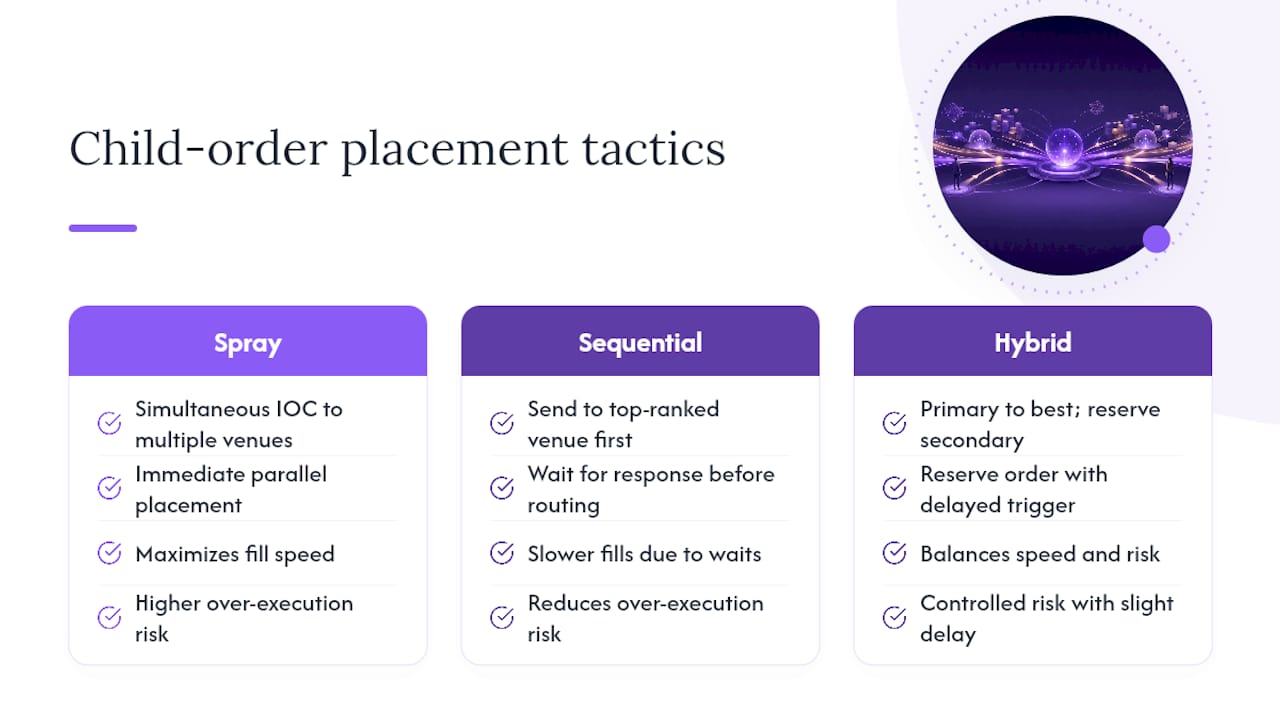
Stage 3: Child-order creation and placement tactics. Two primary placement patterns exist. Spray (parallel) sends simultaneous IOC (Immediate-or-Cancel) child orders to multiple venues, maximizing fill speed at the cost of potential over-execution if multiple venues fill simultaneously. Sequential (serial) sends to the top-ranked venue first, waits for a response, then routes residuals, which reduces over-execution risk but adds latency. A hybrid approach sends a primary order to the best venue and a reserve order to a secondary venue with a slightly delayed trigger.
Stage 4: Monitoring and re-routing. The router maintains live state per child order. On each fill callback, it recalculates the remaining quantity and re-scores venues with current market data. Practical SOR implementations trigger re-evaluation on fill and cancel callbacks to route residuals to the current best venues, because market conditions can shift in the milliseconds between instruction and confirmation.
Pro Tip: Weight quote lifetime against venue latency when deciding whether to re-route. Routing to it anyway is routing to a stale price. Build a "quote age" field into your scoring function and apply a decay multiplier above a configurable threshold.
Algorithmic approaches inside SORs: from rule engines to machine learning
The choice of algorithm inside a SOR is a direct tradeoff between latency, interpretability, and the richness of signal you can exploit.
| Approach | Latency Cost | Interpretability | When to Use |
|---|---|---|---|
| Deterministic rule engine | Sub-microsecond | Full | Hard constraints, regulatory compliance, kill-switch logic |
| Statistical scoring | Low (microseconds) | High | Fee-aware and toxicity-adjusted routing with historical venue data |
| Constrained optimization | Moderate (milliseconds) | Medium | Multi-venue allocation with cost and risk budgets |
| Supervised ML (LSTM, gradient boosting) | High (10s of ms) | Low | Non-myopic execution scheduling for large, low-liquidity trades |
| Reinforcement learning | Variable | Very low | Adaptive routing in non-stationary regimes (experimental) |
Deterministic rule engines are the backbone of any production SOR. They handle venue eligibility (is this venue accessible for this instrument?), regulatory constraints (Reg NMS trade-through checks), and hard risk limits. They run in nanoseconds and are fully auditable, which matters when a regulator asks why a specific child order went to a specific venue.
Statistical scoring layers on top of rules. A fee-aware scorer adjusts displayed price by the venue's maker/taker schedule. A markout-adjusted scorer subtracts an expected adverse-selection cost derived from rolling per-venue markout windows (typically 10 seconds to 2 minutes post-fill). Real production systems maintain per-venue scorecards that track fill rate, markout, latency percentiles, and effective net price, then use those scores to down-weight venues even when their displayed price looks attractive.
Constrained optimization solves for the allocation vector across venues that minimizes expected total cost subject to constraints: maximum market impact, fill-probability floor, latency budget. This is appropriate when you have a large order to work and can afford a few milliseconds of solve time. The cost function typically combines expected price impact (a function of order size relative to venue depth) with fee cost and a risk penalty.
ML approaches introduce the most complexity. LSTM-based execution research shows that LSTM networks can produce non-myopic execution schedules that sometimes outperform TWAP and can slightly beat VWAP in specific large-trade, low-liquidity scenarios. The catch: these models require careful out-of-sample validation, degrade under regime shifts (a volatility spike the training data never saw), and add scoring latency that may exceed the signal's half-life in fast markets. Use them for execution scheduling (when and how much), not for microsecond venue selection.
Risks to manage across all approaches: overfitting to historical fee structures that change, opaque model decisions that fail compliance review, and the latency cost of model inference eating into the price advantage the model found.
How to measure and validate SOR performance
A SOR that cannot be measured cannot be improved. The metrics below form a reproducible framework for TCA teams and execution engineers.
| Metric | Definition | Calculation Window | Notes |
|---|---|---|---|
| Implementation shortfall | Arrival price minus average fill price, in bps | Order lifetime | Primary benchmark; captures slippage from decision to fill |
| Realized spread | Fill price minus midpoint at fill time | At fill | Measures immediate adverse selection |
| Markout (10s / 30s / 2min) | Fill price minus midpoint N seconds post-fill | 10s, 30s | Toxicity signal; negative markout = adverse selection |
| Fill rate | Filled quantity / submitted quantity | Per child order | Low fill rate signals stale quotes or venue latency issues |
| Leakage | Price drift from first child to last child | Order lifetime | Signals market impact or information leakage |
| Net cost (fees + rebates) | Sum of per-fill fees minus rebates earned | Per parent order | Must be included in IS calculation |
| Cancel / reject rate | Cancelled or rejected child orders / total | Per session | High rates indicate stale routing or venue connectivity issues |
Backtesting limits. Historical replay is the starting point, not the finish line. Replaying historical order flow through a new routing logic gives a directional signal, but it cannot model market impact (your orders didn't move the market in the replay), venue queue position (you don't know where you'd have been in the queue), or the reaction of other participants to your routing pattern. Treat backtest results as a lower bound on expected improvement, not a forecast.
Shadow routing runs the new SOR logic in parallel with the live router, generating routing decisions without executing them. Comparing shadow decisions to live decisions on the same parent orders isolates the routing contribution from other sources of execution variance.
Live A/B testing is the gold standard. A robust evaluation approach combines historical replay backtests, shadow routing, and live A/B testing to measure implementation shortfall, fill probability, and statistically validate execution improvements. Randomize at the parent-order level (not the child-order level) to avoid correlated observations. Market microstructure data is non-iid: orders placed in the same minute share the same market conditions, so your effective sample size is smaller than the raw order count. Run tests long enough to span multiple volatility regimes.
Engineering and production architecture for low-latency SOR
Production SOR is not just an algorithm. It is a distributed system with strict latency, reliability, and auditability requirements.
Connectivity and feeds:
- Direct market feeds (ITCH, PITCH, XDP) for each venue, not consolidated tape, to avoid the latency penalty of the SIP
- FIX gateways for order submission, with gateway pooling to avoid single-point-of-failure on a high-volume session
- Feed handlers that normalize raw binary protocols into a common internal format, with per-feed heartbeat monitoring and automatic failover
- Latency measurement on every inbound quote update: timestamp at receipt, at normalization, and at scoring to identify where microseconds are lost
Latency engineering:
- Colocated matching at the same data center as the exchange matching engine (Mahwah for NYSE, Carteret for NASDAQ)
- Kernel bypass networking (DPDK or RDMA) for the lowest-latency path from feed handler to order router
- Prioritized I/O: the scoring thread must not share CPU time with logging or reconciliation threads
- Batching vs. streaming: stream venue updates into the scorer; batch audit log writes to disk asynchronously
Operational systems:
- A stateful order manager that tracks every child order's lifecycle (submitted, partially filled, filled, cancelled, rejected) and exposes a callback interface for the re-routing engine
- Idempotent callback handlers: a fill confirmation that arrives twice must not trigger two re-routes
- Reconciliation against venue drop copies at end-of-day to catch any state divergence
- Immutable audit trail: every routing decision, with its inputs and scores, written to append-only storage for post-trade review
Risk controls:
- Pre-trade checks: notional limit per order, venue eligibility, instrument-level kill flags
- Per-venue quotas: maximum notional per session per venue to limit concentration risk
- Kill-switch: a single operator command that cancels all live child orders and blocks new routing within one second
- Alerting: per-venue fill rate dropping below threshold, markout deteriorating beyond two standard deviations, latency percentile breaching SLA
Pro Tip: Instrument per-venue markout telemetry from day one. Build a scorecard that updates every 15 minutes with rolling 30-second markout, fill rate, and effective net price for each venue. Display it on a live dashboard. The first time a venue's markout deteriorates sharply during a news event, you will catch it in real time instead of in a post-trade review the next morning.
Practical benefits and trade-offs of deploying SOR
Benefits:
- Improved net price by routing to rebate venues and avoiding toxic flow, with fee-aware and toxicity-adjusted routing delivering consistent but modest per-trade improvements that compound across volume into meaningful P&L change
- Access to fragmented liquidity that no single venue can provide, particularly for mid-cap and small-cap names where displayed depth is thin
- Reduced information leakage through dark pool routing for large orders, limiting the market impact of working a block
- Automated compliance with best-execution obligations, with a full audit trail of routing decisions and their rationale
Trade-offs and costs:
- Infrastructure cost: colocation fees, direct feed subscriptions, and FIX gateway licensing add up quickly; a full U.S. equities SOR covering 13 lit exchanges plus major ATSs is not a weekend project
- Regulatory complexity: Reg NMS compliance logic must be maintained as exchange fee schedules and protected quote rules evolve
- Information leakage risk from spray routing: sending simultaneous IOC orders to multiple venues signals order flow to HFT participants who observe the pattern
- Model risk: a misconfigured fee schedule or a stale markout window can make the router systematically prefer the wrong venues
Decision guidance. SOR pays off when your order flow is large enough that per-trade improvements compound meaningfully, when the instruments you trade are listed on multiple venues with meaningfully different fee structures, and when your regulatory regime requires demonstrable best-execution processes. A small desk trading a single liquid name on one exchange has little to gain. A desk running thousands of orders per day across fragmented U.S. equities or cross-chain crypto swaps has a lot to gain.
How SOR differs from and complements execution algorithms
The cleanest mental model: SOR answers "where," execution algorithms answer "when and how much."
- Execution algorithms (VWAP, TWAP, POV, implementation shortfall minimizers) schedule the release of child orders over time, targeting a benchmark price and managing market impact across the order's working horizon
- SOR receives each child order from the algorithm and decides which venue or venues to send it to, at what size, and with what order type
- Integration pattern: a VWAP algorithm slices a 500,000-share order into 1,000-share tranches every 30 seconds; each tranche is handed to the SOR, which scores venues and dispatches child orders; fill confirmations return to the algorithm, which updates its remaining quantity and schedule
- Avoiding circular re-optimization: the algorithm must not re-optimize its schedule based on SOR-level fill latency, and the SOR must not attempt to time the market (that is the algorithm's job). Clean interface contracts prevent each layer from second-guessing the other
- Iceberg and reserve orders sit at the boundary: the algorithm decides to post a reserve order; the SOR decides which venue's dark pool or reserve-order facility to use
A common failure mode is building a monolithic system where scheduling and venue selection logic are interleaved. When something goes wrong, you cannot isolate whether the problem is in the schedule or the routing. Keep the layers separate.
U.S. market structure, fragmentation, and regulatory constraints on SOR
U.S. equity markets are among the most fragmented in the world: 16 registered national securities exchanges, dozens of ATSs, and multiple internalization venues all compete for the same order flow.
Regulation NMS Rule 611 (the Order Protection Rule) is the structural constraint that shapes every U.S. equity SOR. It prohibits trading through a protected quote: if a venue is displaying the national best bid or offer (NBBO), a router cannot execute at an inferior price at another venue without first satisfying or routing through the protected quote. This forces SOR logic to track the NBBO in real time and either route to the protecting venue or use an intermarket sweep order (ISO) to satisfy multiple venues simultaneously.
Best-execution obligations under FINRA Rule 5310 require broker-dealers to use reasonable diligence to ascertain the best market for a security and to buy or sell in that market so that the resultant price is as favorable as possible under prevailing market conditions. This is not a simple "hit the NBBO" rule. Regulators expect firms to consider not just price but also the likelihood of execution, the speed of execution, and the overall quality of the transaction. A SOR that documents its venue-scoring methodology and maintains per-decision audit logs is the practical implementation of this obligation.
Compliance checklist for engineering and trading teams:
- Maintain a real-time NBBO feed from the SIP or direct feeds with a reconciliation check
- Implement Rule 611 trade-through checks before every child order submission
- Log every routing decision with its inputs, scores, and the regulatory justification for the chosen venue
- Review venue fee schedules quarterly; fee changes can flip the optimal routing decision for a given instrument
- Conduct periodic best-execution reviews comparing realized execution quality against NBBO midpoint and peer benchmarks
- Document the SOR's methodology in a written best-execution policy reviewed by compliance
Maker/taker fee structures add a layer of complexity: a venue offering a $0.0030/share rebate to liquidity providers and charging $0.0030/share to takers creates a $0.0060/share spread between posting and taking. A SOR that ignores this will systematically underperform one that routes passive orders to rebate venues and aggressive orders to low-take-fee venues.
SOR for crypto: DEX aggregation, cross-chain bridges, and MEV
The same decision-engine logic that routes equity child orders across lit exchanges applies to crypto, but the cost function changes substantially. Gas, slippage, bridge latency, and MEV exposure replace exchange fees, SIP latency, and adverse selection as the primary inputs.
Translating SOR inputs to on-chain execution:
- Price = AMM output amount for a given input, derived from the pool's current reserve ratio and fee tier
- Fees = protocol swap fee (e.g., 0.05%, 0.30%, or 1.00% on Uniswap v3 tiers) plus bridge fee for cross-chain routes
- Gas cost = estimated gas units × current base fee + priority fee, converted to the input token's value
- Slippage = price impact of the trade on the pool, a function of trade size relative to pool depth
- Bridge latency and failure risk = expected settlement time and historical bridge revert/failure rate
- MEV exposure = probability that a searcher will front-run or sandwich the transaction, estimated from mempool visibility and pool liquidity
Cross-chain routing specifics. A cross-chain swap from ETH on Ethereum to SOL on Solana requires at minimum one bridge step, which introduces settlement latency (minutes to hours depending on the bridge), bridge fee, and the risk of a partial or failed settlement. On-chain route evaluation needs a combined metric that converts gas, slippage, bridge risk, and on-chain fee schedules into a single expected-net-return estimate. Atomic execution (all steps succeed or all revert) is possible within a single chain but not across chains without specialized cross-chain messaging protocols, so multi-step cross-chain routes carry residual failure-mode risk that the router must model.
Crypto routing checklist for engineers:
- Fetch live pool reserves and fee tiers from on-chain state, not cached data, immediately before transaction construction
- Estimate gas using the chain's current base fee plus a priority fee buffer sized to the urgency of the trade
- Set slippage tolerance as a function of pool depth and trade size, not a fixed percentage
- Score bridges by historical revert rate, settlement time, and fee, not just fee alone
- Use MEV-protected RPC endpoints (Flashbots Protect, MEV Blocker) for large swaps to reduce sandwich risk
- Present the full pre-trade cost breakdown (swap fee, gas estimate, expected slippage, bridge fee) to the user before execution
Omnirout case study: applying SOR principles to cross-chain DEX aggregation
Omnirout is a non-custodial DEX and bridge aggregator that applies SOR-style route comparison across 30+ blockchains. The routing logic mirrors the equity SOR pipeline: collect inputs, score routes, present the optimal path, and execute the selected child transaction.
Example: cross-chain swap, ETH (Ethereum) to USDC (Arbitrum)
A user wants to move 5 ETH from Ethereum mainnet to USDC on Arbitrum. Omnirout evaluates multiple candidate routes simultaneously:
- Route A: Uniswap v3 (ETH/USDC, 0.05% fee) on Ethereum, then bridge via a canonical Arbitrum bridge
- Route B: Curve (ETH/stETH/USDC path) on Ethereum, then bridge
- Route C: Direct cross-chain DEX with a single-step bridge-and-swap
Pre-trade cost breakdown template:
The router selects Route A in this scenario because the lower swap fee and tighter slippage on the deep Uniswap v3 pool outweigh the higher gas cost, yielding the best net USDC output. If gas prices spike above a threshold, the scoring function shifts toward Route C.
Residual handling. Unlike equity SOR, on-chain execution is atomic per transaction. There are no partial fills in the traditional sense. However, if a bridge step fails or reverts, Omnirout surfaces the failure to the user and allows re-routing without custody of the user's funds, since the protocol is non-custodial throughout.
When Omnirout's approach is appropriate vs. when it is not. Omnirout is the right tool for retail and professional traders executing cross-chain swaps who want transparent fee comparison and non-custodial execution. It is not designed for institutional VWAP/TCA workflows, custody-based prime brokerage, or high-frequency execution strategies that require sub-millisecond order management systems. Those use cases require custom, custody-integrated SOR infrastructure built on FIX connectivity and direct market access.
How SOR handles dark pools and iceberg orders
Hidden liquidity is one of the most consequential inputs a SOR can get wrong. A dark pool or ATS may hold substantial reserve interest that never appears in the top-of-book feed, and an iceberg order on a lit exchange displays only a fraction of its true size. A router that ignores both will systematically underestimate available liquidity at certain venues and over-route to lit venues where displayed depth is thin.

Dark pool routing logic. The SOR cannot observe dark pool liquidity directly. Instead, it estimates fill probability at each dark pool using historical fill rates for similar order characteristics (size, instrument, time of day, volatility regime).
The key design choice is how to weight the dark pool allocation. Sending too large a fraction to dark pools increases the risk of a low fill rate and a long working time, which increases market impact on the residual. Sending too little wastes the dark pool's price improvement potential. Most production SORs use a dynamic allocation that scales dark pool participation with order size relative to ADV (average daily volume) and current dark pool fill-rate estimates.
Iceberg detection. On lit exchanges, iceberg orders (also called reserve orders) display a small quantity at the top of book while holding a larger reserve that refreshes automatically. A SOR can detect iceberg behavior by observing repeated refreshes at the same price level after each fill. Once detected, the router can increase its allocation to that venue, knowing that more size is available than the displayed quantity suggests. This is a statistical inference, not a guarantee, but it meaningfully improves fill-rate estimates for venues with active iceberg activity.
Latency arbitrage risks and how SOR design mitigates them
Latency arbitrage occurs when a faster participant observes a price change at one venue and trades against stale quotes at a slower venue before the slower venue's feed updates. For a SOR, this creates two distinct risks: your router is the slow participant being picked off, or your spray routing pattern signals your order to faster participants who then move prices at the remaining venues before your child orders arrive.
Being picked off. A SOR routing to a venue based on a quote that is 500 microseconds old in a fast-moving market is routing to a price that may no longer exist. The venue will either reject the order (a cancel that wastes latency) or fill it at a price that has moved against you. The mitigation is a quote-age filter: any quote older than a configurable threshold (typically 50–200 microseconds in U.S. equities) is treated as stale and excluded from the scoring function until a fresh update arrives.
Signaling through spray routing. Sending simultaneous IOC orders to five venues tells every participant monitoring those venues' order flow that a large buyer or seller is working an order. HFT participants can react within microseconds, pulling liquidity or adjusting quotes at the remaining venues. Mitigations include: limiting the number of venues in a spray to two or three, using dark pools for the largest child orders to avoid lit-market signaling, and introducing randomized timing jitter on child order submission to break the correlation pattern.
Colocation and feed quality. The most durable mitigation is infrastructure: colocated matching engines and direct feeds eliminate most of the latency gap that arbitrageurs exploit. A router with 50-microsecond round-trip latency to a venue is a much harder target than one with 5-millisecond latency. This is why colocation is not optional for any SOR operating in U.S. equities at meaningful volume.
Integrating TCA with SOR logic
Transaction cost analysis (TCA) is not just a post-trade reporting exercise. When integrated with SOR logic, TCA becomes the feedback mechanism that makes the router self-improving over time.
The integration works in two directions. Post-trade TCA feeds back into venue scoring: per-venue markout statistics, fill rates, and effective net prices computed by the TCA system update the SOR's venue scorecards, typically on a rolling intraday basis. A venue whose markout has deteriorated over the past 30 minutes gets down-weighted in the next routing decision. This is the closed-loop version of the static fee-schedule approach.
Pre-trade TCA informs order slicing: before a large order is worked, a pre-trade TCA model estimates expected implementation shortfall as a function of order size, ADV, current spread, and volatility. This estimate feeds into the execution algorithm's scheduling decision (how aggressively to work the order) and into the SOR's venue allocation (how much to route to dark pools vs. lit venues to minimize market impact).
The practical challenge is latency. A TCA model that takes 200 milliseconds to score a venue update is useless for microsecond routing decisions. The solution is to separate the update cadence from the scoring cadence: TCA models update venue scorecards every 15–30 minutes using batch computation, and the SOR reads from those scorecards at microsecond speed without re-running the model on every order.
A secondary challenge is attribution. When execution quality improves, it is rarely obvious whether the improvement came from better scheduling, better venue selection, or a favorable market environment. Clean A/B test design, with randomization at the parent-order level and stratification by instrument and order size, is the only reliable way to isolate the SOR's contribution.
Data quality and data cleaning challenges in SOR systems
A SOR is only as good as the data it consumes. Feed errors, clock skew, and stale reference data are among the most common causes of systematic routing errors in production systems, and they are also among the most underestimated.
A SOR that routes on an erroneous quote can submit an order at a wildly incorrect price.
Clock skew. Comparing quotes from two venues requires that the timestamps be comparable. If one feed handler's clock is 50 microseconds ahead of another's, the SOR will systematically treat one venue's quotes as newer than they are. PTP (Precision Time Protocol) or GPS-disciplined clocks at each feed handler, with regular synchronization checks, are the production standard for any SOR operating at microsecond precision.
Stale reference data. Fee schedules, venue eligibility lists, and instrument-level parameters (lot sizes, tick sizes, trading halts) are reference data that changes infrequently but catastrophically when it does. A fee schedule that was updated by an exchange but not reflected in the SOR's configuration will cause the router to misprice every routing decision for that venue until the discrepancy is caught. Automated reference data pipelines with daily reconciliation against exchange-published schedules are the minimum standard.
Data labeling for ML models. Training a markout-based venue scorer or an LSTM execution model requires labeled training data: each order needs a ground-truth outcome (realized implementation shortfall, per-venue markout) computed from post-trade data. Errors in the labeling pipeline, such as mismatched order IDs between the execution system and the TCA system, produce corrupted training labels that degrade model performance in ways that are hard to diagnose. Invest in the data pipeline before the model.
How SOR strategies adapt to market volatility and stress conditions
A SOR calibrated on normal market conditions will behave poorly during a volatility spike, a flash crash, or a market-wide circuit breaker event. The inputs change faster than the model's update cadence, and the venues themselves behave differently: spreads widen, fill rates drop, dark pools drain, and latency spikes.

Volatility-aware scoring. The simplest adaptation is to widen the quote-age filter during high-volatility periods. A quote that is 100 microseconds old is effectively stale when the NBBO is moving 5 basis points per second. Some SORs use a realized volatility signal (computed from the last 30 seconds of mid-price changes) to dynamically tighten the quote-age threshold and reduce the number of venues in the spray to limit signaling risk.
Dark pool participation under stress. Dark pools tend to drain during volatility spikes as participants pull their reserve interest. A SOR that maintains a fixed dark pool allocation will see fill rates collapse and residuals pile up, increasing market impact on the lit-market cleanup. The adaptation is to monitor dark pool fill rates in real time and reduce dark pool allocation when fill rates drop below a threshold, shifting volume to lit venues where displayed liquidity is more reliable (if more expensive).
Circuit breakers and trading halts. Reg NMS includes limit-up/limit-out (LULD) circuit breakers that pause trading in individual securities when prices move beyond defined bands. A SOR must monitor LULD status in real time and immediately cancel all live child orders for a halted security, then re-evaluate routing when trading resumes. Failure to handle halts correctly can result in orders resting at venues during a halt period and executing at stale prices when trading resumes.
Stress testing. Before deploying a new SOR configuration, replay it against historical stress periods: the March 2020 COVID volatility, the January 2021 meme-stock events, and the August 2024 volatility spike. These periods expose failure modes that normal-market backtests miss entirely.
Risk management techniques specific to SOR
SOR introduces a specific class of operational risk that general trading risk management frameworks do not fully address: the risk of systematic routing errors that affect every order simultaneously.
Pre-trade risk checks are the first line of defense. Every child order must pass a set of checks before submission: notional limit (is this child order within the per-venue notional quota?), price reasonableness (is the limit price within a configurable band of the current NBBO?), instrument eligibility (is this instrument allowed to route to this venue?), and session-level quota (has this session already sent the maximum allowed notional to this venue today?). These checks must run in microseconds and must fail safe: if a check cannot complete within its latency budget, the order is rejected, not passed.
Venue-level circuit breakers. If a venue's fill rate drops to zero for more than a configurable number of consecutive orders, the SOR should automatically blacklist that venue for a cooling-off period and alert the operations team. This handles the case where a venue's matching engine is degraded but still accepting orders, a scenario that produces a flood of cancels and rejects that can cascade into order management system instability.
Duplicate-order prevention. In a distributed system, network retries and timeout handling can cause the same order to be submitted twice. An idempotent order submission layer, using a deterministic order ID derived from the parent order ID and child sequence number, ensures that a duplicate submission is recognized and rejected by the venue rather than resulting in a double fill.
Information leakage controls. Large orders worked through a SOR over time can reveal the direction and approximate size of the parent order to participants who observe the pattern of child orders. Randomizing child order sizes (within a configurable band), using dark pools for the largest tranches, and varying the timing of submissions all reduce the signal-to-noise ratio of the order flow pattern.
Post-trade reconciliation. At end of day, every fill received by the SOR must be reconciled against the venue's drop copy and the order management system's internal state. Discrepancies, such as a fill that the venue reports but the OMS did not receive, must be flagged immediately and resolved before the next trading session. Unreconciled fills are a compliance and risk management failure, not just an operational inconvenience.
What execution engineers actually learn after building SOR in production
The gap between a SOR that works in a backtest and one that works in production is mostly instrumentation and failure handling, not algorithm sophistication.
The single most valuable thing you can instrument is per-venue markout, broken down by time-of-day and volatility regime. Most teams build the router first and the scorecard second. That's backwards. Without live markout telemetry, you cannot tell whether your routing is improving or degrading execution quality, and you will not catch a venue's behavior change until it shows up in monthly TCA reports.
The failure modes that actually hurt in production are almost never the ones you modeled. Stale fee schedules, clock skew between feed handlers, and idempotency bugs in callback handlers cause more systematic P&L damage than suboptimal scoring functions. A simple rule engine with correct fee data and a working markout scorecard will outperform a sophisticated ML model running on stale inputs.
On the crypto side, the equivalent lesson is gas estimation. A cross-chain router that uses cached gas prices from 30 seconds ago will systematically underprice transactions during congestion spikes, resulting in failed transactions or unexpected costs. Fetch gas estimates immediately before transaction construction, not at route-scoring time.
The smallest wins compound. Correctly handling iceberg detection at two or three venues, adding a quote-age filter, and fixing a fee schedule error each add a fraction of a basis point per trade. Across a year of volume, those fractions become real P&L.
Omnirout gives you transparent cross-chain route comparison before you commit
Most cross-chain swap interfaces bury the fee breakdown until after you've confirmed the transaction. Omnirout shows you the full pre-trade cost picture first: swap fees, gas estimates, expected slippage, and bridge costs across every viable route, so you can see exactly what you're getting before you sign.
Omnirout operates as a non-custodial DEX and bridge aggregator across 30+ blockchains. You keep your keys throughout. The route comparison engine applies the same fee-aware, slippage-adjusted scoring logic described in this guide, adapted for on-chain execution constraints. It's the right tool for retail and professional traders who want gas-aware cross-chain routing without giving up custody or navigating opaque fee structures.
It is not designed for institutional VWAP workflows or custody-based prime brokerage. For those use cases, you need custom FIX-connected SOR infrastructure. But for cross-chain swaps where transparent cost comparison and non-custodial execution matter, visit Omnirout to compare routes and execute your next swap.
Sources
These sources were selected for technical depth, regulatory authority, and direct relevance to the sections they support. Regulatory and exchange-published documents were preferred for U.S. market structure; peer-reviewed and institutional research for ML execution methods.
- Smart order routing
- LSTM-based optimal execution research (Columbia / Bloomberg PDF)
- Smart order routing – HFT Book
- Smart Order Routing: How It Works & Why It Matters in 2026 | Quantt
This article is general information, not a substitute for advice from a qualified financial advisor. Consult a qualified financial professional about your own circumstances before acting on anything here.