
A token bridge moves an asset to another chain by locking or burning it at the source and unlocking or minting a version at the destination. A wrapped asset is that minted version, a representation of the original that depends entirely on the bridge or custodian holding real backing. Prefer canonical or native issuance when it exists, and never park a large balance in an obscure wrapper you can't easily verify.
TL;DR:
- Native issuance minimizes the risk of de-peg and is preferred for stablecoins on supported chains, avoiding the complexities of wrappers.
- Liquidity-pool bridges offer faster transfers through pre-funded reserves but can cause slippage or unsupported transfer sizes if pools are shallow.
- The security of bridges depends heavily on their trust model, with decentralized smart contracts being safer than custodian-based or multisig setups.
- Verifying the bridge's audit status and Proof of Reserve before large transfers significantly reduces exposure to hacks and reserve failures.
- Comparing route options with a non-custodial aggregator helps identify the best combination of fees, gas costs, and liquidity to execute safer cross-chain moves.
Table of Contents
- Token Bridge vs Wrapped Assets: The Core Mechanics
- Security, Liquidity, and Operational Risk: What Can Go Wrong
- When to Bridge, When to Accept a Wrapper, and How to Choose
- Practical Safety Checklist Before You Bridge
- How We Got Here: The Evolution of Cross-Chain Infrastructure
- What Bridging Actually Feels Like: Cost and Speed Trade-Offs
- Regulatory Considerations for Cross-Chain Asset Movement
- Author Perspective: How Traders Should Actually Think About This
- A Practical Next Step: Comparing Routes Before You Commit
- Sources
Token Bridge vs Wrapped Assets: The Core Mechanics
The confusion between these two terms comes from the fact that one produces the other. A token bridge is the transport mechanism. A wrapped asset is often the cargo it delivers.
Bridges use a handful of designs, and the design determines what you're actually holding on the other end. In a lock-and-mint model, your original asset gets locked in a smart contract on the source chain, and the bridge mints a matching token on the destination chain. Burn-and-mint works similarly but destroys the source token instead of locking it, which some designs use to avoid accumulating idle collateral. Liquidity-pool bridges skip minting altogether: you deposit into a pool on one side, and a matching pool on the other side pays you out instantly from existing reserves, which is faster but depends on that pool having enough depth.
Custody is where the real differences show up. Some bridges rely on a small multisig group of validators who sign off on mint requests, which is fast but concentrates trust in a handful of keyholders. Others run fully on smart contracts with cryptographic proofs, removing the human custodian but often slowing settlement. Chainlink's education hub breaks these models down in more detail, and the trade-offs matter more than most traders assume before their first cross-chain transfer.
Native issuance sidesteps the wrapper problem entirely. Instead of a bridge minting an IOU, the original issuer burns supply on one chain and mints canonical supply on another. Major stablecoin issuers use this model for their multi-chain deployments, and it's the closest thing to a free lunch in this space because there's no separate wrapped token to de-peg.
- Lock-and-mint: original asset held in escrow, wrapper minted on destination
- Burn-and-mint: original asset destroyed, new supply minted elsewhere
- Liquidity-pool: instant payout from pre-funded reserves, no minting involved
- Native issuance: the issuer itself controls supply across chains, no wrapper needed
Security, Liquidity, and Operational Risk: What Can Go Wrong
Bridges are the single largest attack surface in crypto, and the track record backs that up. Hacks on Ronin, Wormhole, and Nomad alone caused losses in the hundreds of millions, and the pattern repeats because bridges concentrate value in one contract or one signer set. When a bridge gets drained, every wrapped token it issued instantly loses its backing. The wrapper still trades, but it's now an IOU against an empty vault.
By the numbers: Cross-chain bridge exploits rank among the costliest attack categories in crypto history, with Ronin, Wormhole, and Nomad combined losing hundreds of millions of dollars to exploits targeting validator sets and contract logic rather than the underlying blockchains themselves.
De-pegging is the visible symptom of that failure. A wrapped token is only as trustworthy as its backing, and when reserves can't be verified or the bridge is compromised, the wrapper trades at a discount to the asset it's supposed to represent. Liquidity fragmentation compounds the problem: two different bridges wrapping the same source asset onto the same destination chain create two distinct, non-interchangeable tokens. You can end up holding a wrapper that technically represents the right asset but trades in a market too thin to exit without slippage.
Custody models split into three rough tiers:
- Trustless smart contracts verified by cryptographic proofs, no human signer required
- Multisig custodians where a small group holds mint/burn authority, faster but riskier if keys are compromised
- Centralized issuers who control supply directly, which removes bridge risk but reintroduces counterparty risk
Mitigation starts with checking whether a bridge has been audited and whether it publishes Proof of Reserve data before you commit meaningful size.
When to Bridge, When to Accept a Wrapper, and How to Choose
Not every cross-chain move calls for the same tool, and matching the method to the asset saves you from most of the pain traders complain about after the fact.
For stablecoins, native issuance should be the default whenever the issuer supports the destination chain directly. There's no wrapper risk to manage because there's no wrapper. For long-term holds of non-stablecoin assets, a canonical wrapper (the version officially recognized by the destination chain's major venues) beats a random bridge's proprietary version, even if the random bridge quotes a slightly better rate today. For active trading where you're moving in and out within hours or days, a deep-liquidity wrapper matters more than canonical status, because you need to exit at a fair price without moving the market yourself.
Run through this before committing funds:
- Identify the asset type: stablecoin, blue-chip token, or long-tail asset.
- Check if native issuance exists on your destination chain.
- If not, check which wrapper the venues you plan to use actually quote.
- Compare liquidity depth across available wrapper variants.
- Estimate your holding horizon and match it against custody risk tolerance.
- Confirm the bridge's audit history and reserve verification before transferring size.
Pro Tip: Before moving a large position, check the wrapped token's trading depth on the destination chain's main venue, not just the bridge's own quoted rate. A wrapper can look fine at the point of minting and still trade at a real discount once you try to sell it into a shallow market.
Practical Safety Checklist Before You Bridge
Treat every bridge transaction like you're wiring money through an intermediary you've never used before, because that's functionally what's happening.
Before you commit funds, verify the destination contract address against the project's official documentation, not a link from a search result or a chat message. Check whether the bridge publishes Proof of Reserve or has been through a recent audit, and confirm whether the token you'll receive is canonical or bridge-specific. Guides across the ecosystem consistently recommend starting with a small test transfer before moving your full position, and that single habit prevents more losses than any other precaution on this list.
- Verify the contract address directly from official project documentation
- Check for a published audit and Proof of Reserve, not just marketing claims
- Confirm whether you're receiving a canonical token or a bridge-specific wrapper
- Send a small test transfer before moving your full balance
- Set a slippage tolerance appropriate to the destination pool's depth
- Avoid parking large balances in low-liquidity or unaudited wrappers long term
After the transfer lands, check that the balance matches what you expected and that the token contract on the destination chain matches what you verified beforehand. This is where a route comparison tool earns its place in the workflow. Instead of guessing which bridge offers the best combination of fees, gas costs, and slippage, a non-custodial aggregator lets you see those trade-offs side by side before you commit, which directly addresses the liquidity fragmentation problem described above by surfacing which route actually has the depth to support your trade size.
Pro Tip: Run the same transfer through two or three routes in a comparison tool before executing. The cheapest quoted fee sometimes hides a wrapper with thin destination liquidity, and you won't see that until you're already trying to exit.
How We Got Here: The Evolution of Cross-Chain Infrastructure
Early bridges were narrow and purpose-built, usually connecting exactly two chains with a simple lock-and-mint mechanism and little else. They existed mainly to let assets escape isolated ecosystems, and the wrapped tokens they produced were treated as a necessary inconvenience rather than a feature.
That changed as decentralized finance expanded across dozens of chains simultaneously. Bridges evolved from single-purpose pipelines into programmable infrastructure supporting general message passing, meaning they now carry arbitrary data and contract calls, not just token balances. This opened the door to more sophisticated designs: pool-based bridges that pay instantly from reserves, intent-based systems where solvers compete to fill your transfer at the best price, and native issuance frameworks that avoid minting a separate wrapper at all.
The wrapped-asset side evolved too. The first generation of wrapped tokens was largely custodial, backed by a centralized party holding reserves off-chain. Later designs moved toward decentralized custody models using smart contracts and multisig validator sets, trading some speed for reduced single-point-of-failure risk. The current landscape reflects lessons learned from years of exploits: audits, Proof of Reserve dashboards, and canonical token standards all emerged as direct responses to the losses bridges have suffered. None of these fixes are perfect, but they represent a meaningfully more cautious industry than the one that existed even a few years ago.
What Bridging Actually Feels Like: Cost and Speed Trade-Offs
The gap between a good bridging experience and a bad one usually comes down to two things: how much you pay and how long you wait, and those two variables often move in opposite directions.

Liquidity-pool bridges tend to feel instant because you're paid out of existing reserves rather than waiting for confirmations across two chains. That speed comes at a cost when the pool is thin. You'll either eat significant slippage or the route simply won't support your transfer size. Lock-and-mint and burn-and-mint bridges typically take longer, since they often wait for a confirmation threshold on the source chain before minting on the destination, but the trade-off is that you're not depending on someone else's pre-funded liquidity.
Gas costs compound the experience in ways new traders underestimate. You're paying gas on the source chain to initiate the transfer, and often gas on the destination chain to finalize or claim the minted token. On a congested network, that second gas payment can exceed the value of a small transfer, which is why size matters as much as route selection. A $50 transfer rarely makes sense if the destination chain's gas costs $8 to claim.
This is exactly the calculation a route comparison tool is built to solve: laying out fees, estimated gas, and slippage across multiple paths before you commit, so a delay or a fee doesn't surprise you mid-transaction. The best experience isn't always the fastest option. It's the one where the total cost, including the parts that don't show up until the confirmation screen, actually matches what you expected going in.
Regulatory Considerations for Cross-Chain Asset Movement
Regulators have been slower to address bridges and wrapped assets directly than they have exchanges or stablecoins, and that gap creates real uncertainty for traders moving meaningful size across chains.
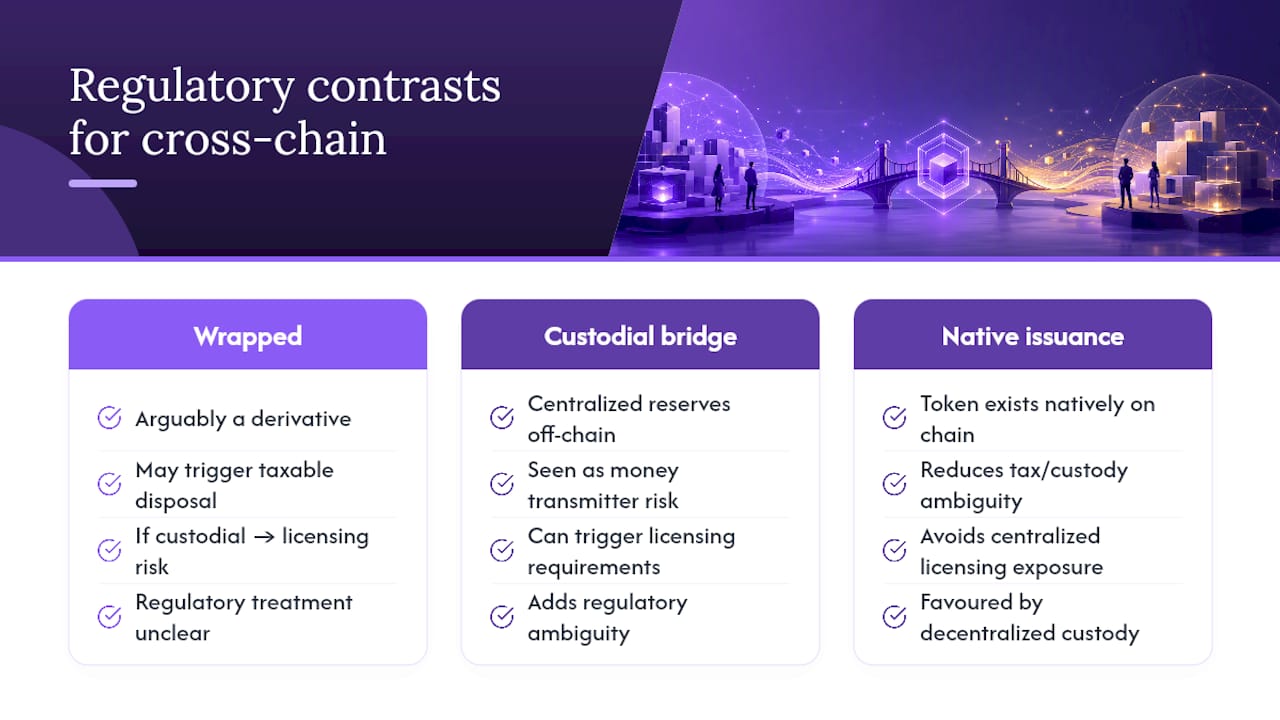
The core tension is classification. A wrapped asset is arguably a derivative of the underlying token, a synthetic representation rather than the thing itself, and different jurisdictions haven't converged on how to treat that distinction for tax or securities purposes. Some tax authorities treat a bridge transaction as a disposal event triggering a taxable gain or loss, even though you economically still hold "the same" asset, just on a different chain. Others haven't issued clear guidance at all, leaving traders to make conservative assumptions on their own.
Custodial bridges add another layer. Any bridge design that relies on a centralized party holding reserves off-chain starts to resemble a money transmitter or custodian in the eyes of some regulators, which can trigger licensing requirements that purely smart-contract-based bridges avoid. This is part of why native issuance and decentralized custody models have gained favor. They reduce not just technical risk but regulatory ambiguity, since there's no single custodial entity holding your assets hostage to a compliance question.
None of this is settled law anywhere, and rules vary sharply by jurisdiction and asset type. Treat any specific tax or compliance question about a cross-chain transfer as something to confirm with a qualified professional in your own jurisdiction, not something to infer from a blog post or a bridge's marketing page.
Author Perspective: How Traders Should Actually Think About This
Canonical and native issuance should be your default, not your afterthought. Most traders reach for whatever bridge shows up first in a wallet's swap screen, then discover the liquidity problem only when they try to sell. That's backwards. Check for native issuance before you check for speed.
Active traders have a legitimate reason to accept wrapper risk: execution speed sometimes matters more than custody purity when you're capturing a short-lived opportunity. That's a fair trade, as long as it's deliberate. The mistake isn't holding a wrapper. It's holding one by accident, for months, without rechecking whether the bridge behind it is still solvent. Proof of Reserve isn't a one-time check. Revisit it.
— Emanuele
A Practical Next Step: Comparing Routes Before You Commit
Everything above points to the same conclusion: the safest cross-chain move is the one where you actually know what you're getting before you send the transaction. That's the exact job Omnirout does.
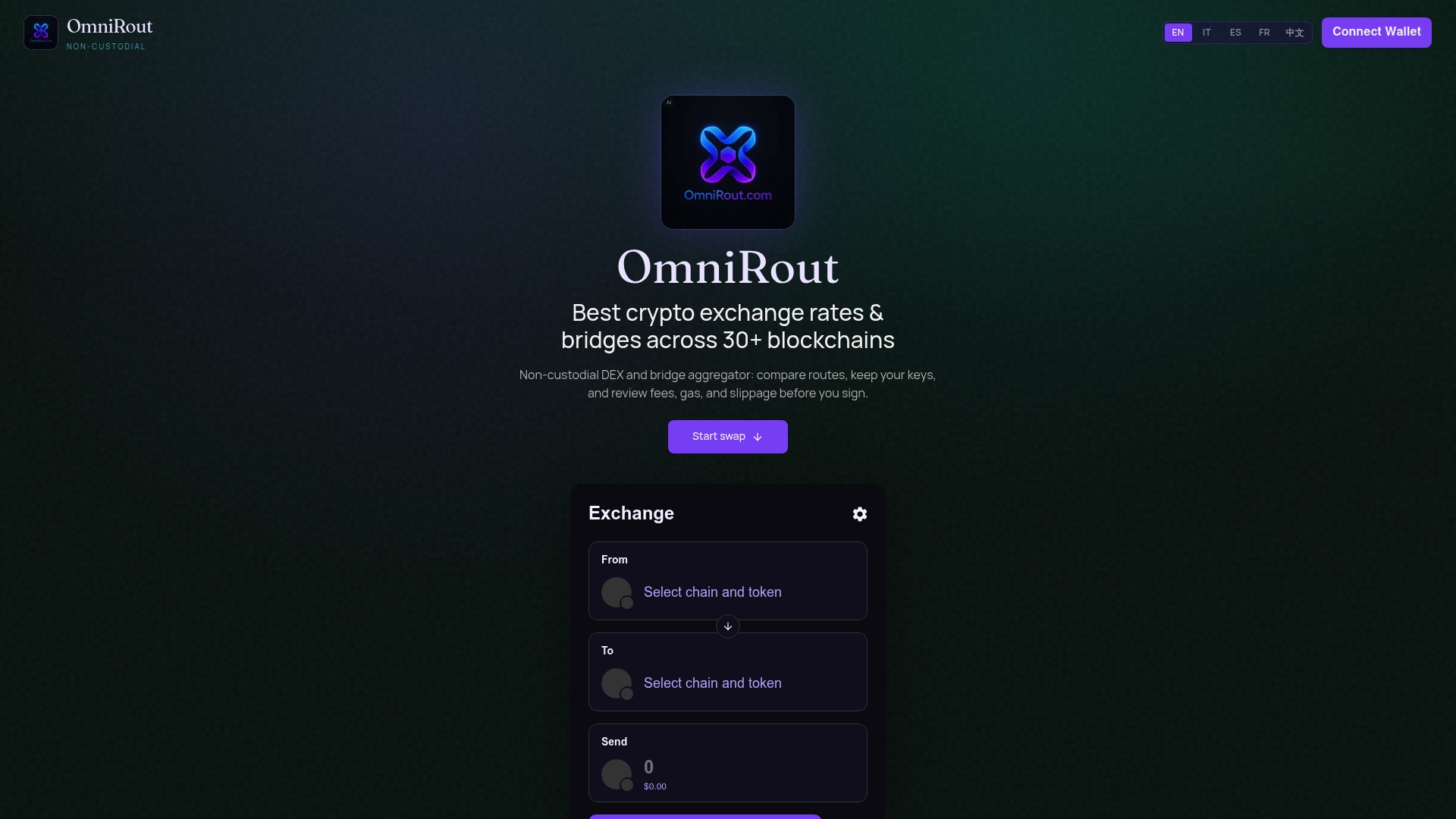
Omnirout is a non-custodial route comparison and swap aggregator covering more than 30 blockchains, built for traders who want to see the trade-off between fees, gas, and slippage before committing to a bridge or wrapper, not after. Instead of guessing whether the cheapest quoted route hides a thin-liquidity wrapper, you compare paths side by side and pick the one that actually fits your size and timeline. You keep control of your own keys throughout, so there's no added custodial layer sitting between you and your assets.
If you're about to move a position across chains, run it through Omnirout's route comparison first and see exactly what you'd pay and receive before you send anything.