
Cross-chain bridges concentrate authority and value, which makes them the highest-value target in crypto. Treat every inbound message as hostile until proven otherwise, and prioritize three defenses first: an explicit trust and verification model, rate limits with circuit breakers, and continuous monitoring backed by a rehearsed incident playbook. Developers, security teams, and bridge operators need all three in place before shipping, not after.
TL;DR:
- Most bridge attacks stem from permission issues like key compromise or misconfigured multisigs, making operational controls critical.
- Building multiple layers of defense, such as independent verification and rate limiting, significantly reduces the risk of catastrophic exploits.
- Monitoring signer activity, balance drift, and volume spikes can help detect potential breaches before they drain reserves.
- Common attack vectors include permission breaches, logic flaws, message replay, oracle manipulation, and human errors during approvals.
- Conducting tabletop exercises based on attack taxonomy can uncover vulnerabilities early and improve overall security posture.
Table of Contents
- What Is Cross-Chain Security and How Do Bridges Actually Work?
- What Are the Main Attack Surfaces in Cross-Chain Protocols?
- What Do Real Bridge Hacks Teach Us About Root Causes?
- How Do You Build Defense-in-Depth for a Bridge?
- How Should You Model Failure Across Consensus, Transport, and Application Layers?
- What Should You Monitor to Catch a Bridge Exploit Early?
- How Does Better UX Reduce Cross-Chain Security Risk?
- What's Next for Cross-Chain Security Research?
- What Would You Fix First if You Ran a Bridge Audit This Week?
- A Different Layer of Protection: Reducing Risk Before You Bridge
- Where to Read Next on Cross-Chain Security
- Sources
What Is Cross-Chain Security and How Do Bridges Actually Work?
Cross-chain security is the set of design choices and controls that keep a bridge's locked or minted assets safe when two independent blockchains have to agree on the state of a transaction neither one can fully see. That agreement gap is where almost every dollar has been lost. The Crosschain Risk Framework defines the properties a protocol must guarantee: valid final states, timely relay, and preserved invariants across chains. Miss any one of those and you have a bridge that works fine until it doesn't.
Most bridges fall into three architectural patterns:
- Lock-and-mint: assets get locked on the source chain, and a wrapped equivalent gets minted on the destination chain, backed by a promise the lock holds.
- Burn-and-release: the wrapped token burns on the source side, releasing the original asset on the destination side, common for round-trip transfers.
- Liquidity-pool (synthetic) models: no wrapping at all; independent liquidity pools on each chain settle the swap, trading counterparty risk for elimination of a mint/burn step.
Verification is the other half of the equation, and it's where trust assumptions get baked in permanently. Trusted-validator models rely on a fixed set of signers, fast but only as secure as the multisig behind them. Optimistic models allow a dispute window where anyone can challenge a bad relay, trading speed for a delay period. Light-client or native verification lets the destination chain actually verify source-chain proofs cryptographically, the strongest guarantee but the heaviest to build and maintain.
Authority and funds tend to concentrate in three places: the on-chain lock/mint contracts, the off-chain relayer infrastructure that watches for events, and the validator keys that sign attestations. Map those three locations before you write a single mitigation, because every defense in this article points back at one of them.
What Are the Main Attack Surfaces in Cross-Chain Protocols?
A systematization of bridge attacks catalogs 12 distinct attack vectors and gives Solidity examples for many of them, and that taxonomy is the closest thing the industry has to a shared audit checklist. Grouping those vectors by root cause makes them easier to test for.
- Permission issues. Key compromise, misconfigured multisig thresholds, and leaked private keys sit at the top of the list because they bypass every other control instantly. A 3-of-5 multisig where four keys live on the same cloud provider is not really a 3-of-5.
- Logic issues. Incorrect invariants, mint/burn accounting flaws, and improper contract initialization let attackers mint assets that were never locked. This is where the SoK paper's Solidity examples are most useful, since these bugs are reproducible in code review.
- Transport issues. Replay attacks, validator equivocation, proof substitution, and message-ordering attacks exploit the gap between when a message is sent and when it is executed.
- Event and oracle issues. A relayer that trusts a manipulable price feed or misreads an emitted event can authorize a withdrawal that never should have happened.
- Front-end risks. Phishing sites and malicious approval requests target users directly, sidestepping the protocol's code entirely and hitting the weakest link: human attention.
Pro Tip: Run a tabletop exercise where your team tries to exploit your own bridge using only this taxonomy as a checklist. Teams that do this catch permission and logic issues months before an external audit ever sees the code.
What Do Real Bridge Hacks Teach Us About Root Causes?
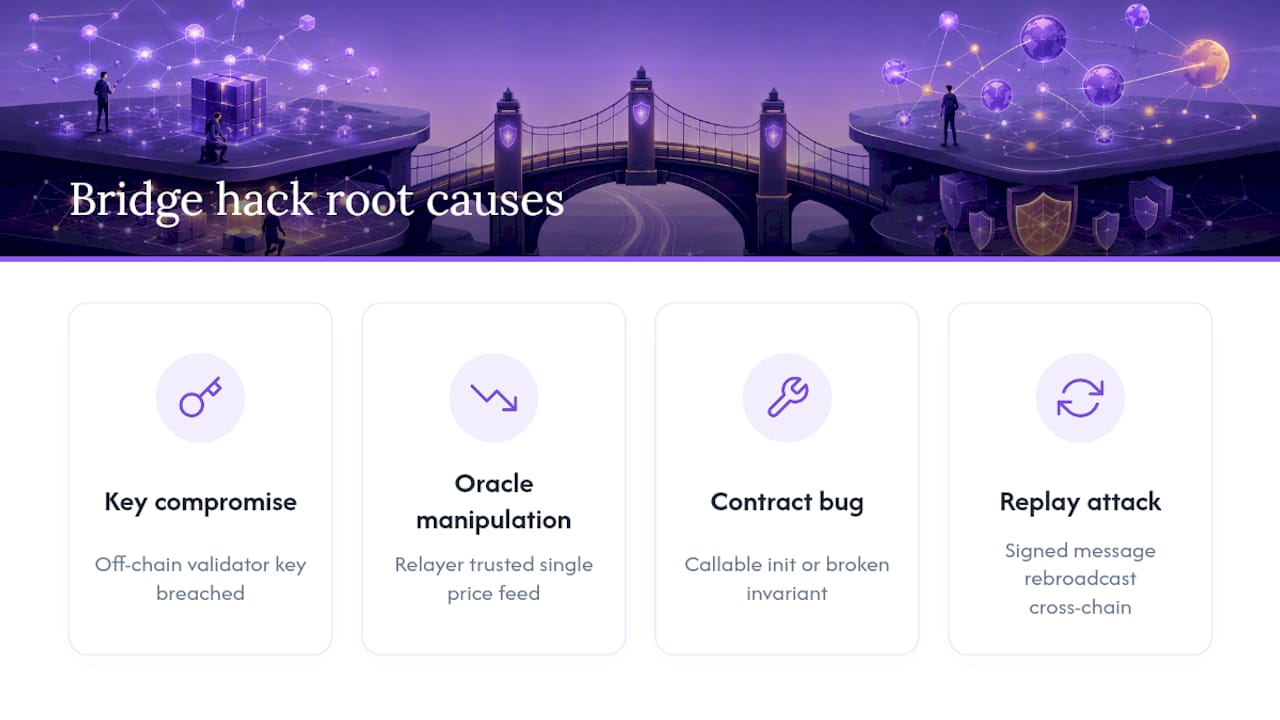
Bridge hacks read differently once you sort them by the taxonomy above instead of by chain or dollar amount. Key-compromise incidents typically start with an off-chain validator node getting breached, followed by attackers signing fraudulent withdrawal messages that look perfectly valid on-chain because the signatures check out. Oracle-manipulation cases usually involve a price feed or event source that a relayer trusted without a secondary check, letting an attacker mint against collateral that was never really there. Contract-bug exploits tend to trace back to an initialization function left callable after deployment or an invariant check that assumed a value could never go negative. Replay incidents happen when a message signed for one chain or contract gets rebroadcast against another that shares the same signature scheme without domain separation.
Academic and industry reviews point to a sobering pattern: concentrated total value locked turned bridges into the single most attractive target in the industry, and bridge hacks between 2021 and 2022 produced multi-billion-dollar cumulative losses. That scale is why standards work is now catching up.
Failures cascade because layers trust each other by default. A compromised validator key (permission layer) gets used to forge a transport-layer message, which an application-layer contract executes without an independent check. Early warning signs usually show up before the final drain: unusual signer activity, a spike in withdrawal volume from a single route, or a contract balance that drifts away from the sum of tracked deposits. Logs during an active exploit typically show a burst of transactions from a small number of addresses hitting the same function in rapid succession.
How Do You Build Defense-in-Depth for a Bridge?
Defense-in-depth means no single control is allowed to be the only thing standing between an attacker and your treasury. Chainlink's analysis of bridge hacks makes the case plainly: independent verification layers, multi-firm smart contract audits, and active bug bounty programs each reduce a different slice of exploitable surface, and none of them substitutes for the others.
Start with architecture-level controls:
- Add an independent verification layer that re-checks relayer claims instead of trusting a single attestation path.
- Enforce domain separation on every message (source chain ID, source contract, destination chain ID, destination contract, and a channel version) so a valid message for one route can never be replayed on another.
- Separate commit from execute: verify a message fully in one step, then execute it in a distinct step that cannot be reordered or front-run.
Operational controls matter just as much as code:
- Require multisig with timelocks on any privileged function, so a compromised key alone can't move funds instantly.
- Stage upgrades through a testnet or canary deployment before touching production liquidity.
- Commission multiple independent audits rather than one, since different firms catch different bug classes.
- Run an active, well-funded bug bounty program that pays enough to make responsible disclosure more attractive than exploitation.
Financial controls are the last line of defense when the others fail:
- Set per-route and global rate limits so a single exploit can't drain the entire pool in one transaction.
- Build circuit breakers that pause a route automatically when volume or balance drift crosses a defined threshold.
- Document an emergency pause workflow that a small, accountable group can trigger within minutes, not hours.
Pro Tip: Rate limits don't stop an exploit, they shrink the loss window. A circuit breaker that trips after $2 million in an hour turns a potential nine-figure disaster into a contained incident your team can actually recover from.
How Should You Model Failure Across Consensus, Transport, and Application Layers?
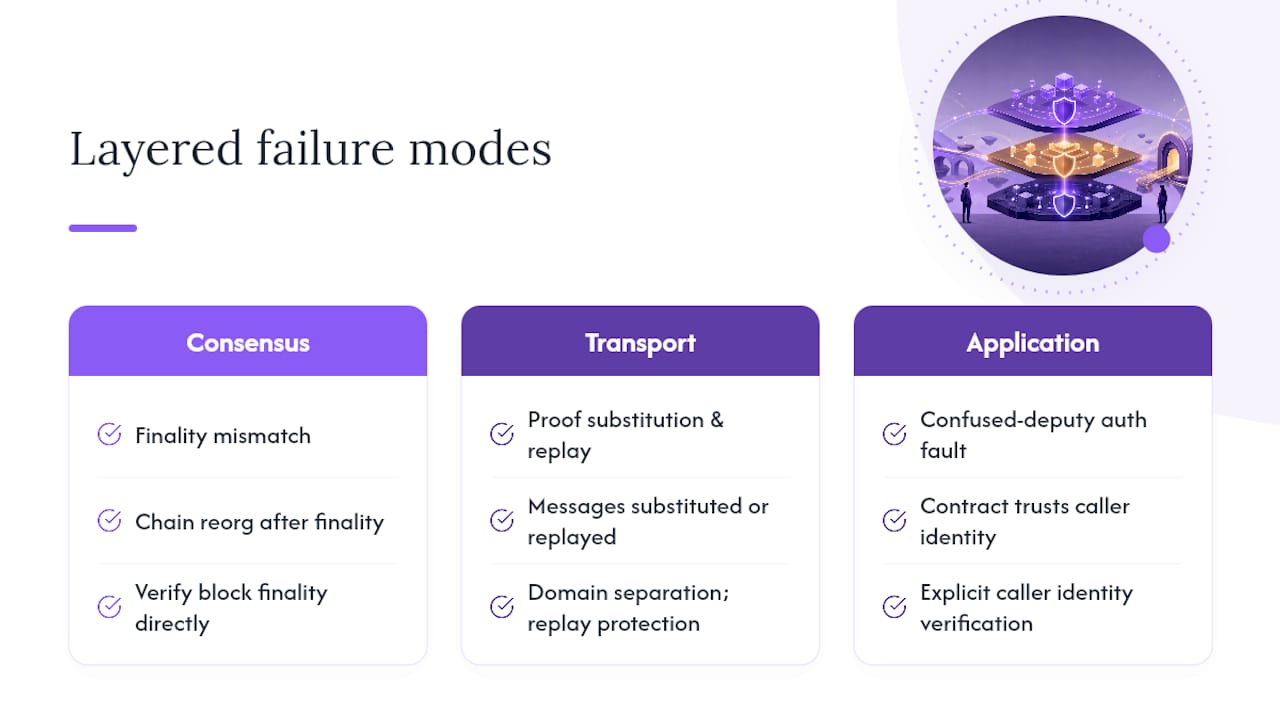
Sherlock's three-layer framing for cross-chain systems gives engineers a shared vocabulary for where things break, and it maps cleanly onto real incidents. The consensus layer fails through finality mismatches, when a chain reorganizes after a bridge already treated a block as final. The transport layer fails through proof substitution and message replay, the exact issues domain separation is designed to close. The application layer fails through confused-deputy authorization faults, where a contract executes an action because it trusted a caller's claimed identity instead of verifying it directly.
Choosing a verification model means choosing which layer you're betting on. Light-client verification pushes trust into cryptography and chain data, the strongest guarantee but the most engineering-heavy to maintain across every supported chain. Validator committees push trust into a bonded, accountable group, faster to build but only as strong as the committee's honesty and key hygiene. Optimistic relayers push trust into a dispute window, cheap to run but they leave a gap where a successful, unchallenged fraud becomes final.
Whichever model you pick, build in idempotency (a message can never execute twice), strict sequencing, and a documented recovery path for when an upgrade or pause needs to roll back safely. Comparing native issuance against wrapped assets is a useful exercise here, since the choice changes which layer carries the most risk.
What Should You Monitor to Catch a Bridge Exploit Early?
Detection speed determines whether an exploit costs you thousands or hundreds of millions.
- Alert on signer-set changes immediately, since almost every major compromise involves an unauthorized key or validator addition.
- Track balance drift between locked collateral and minted supply in real time, not on a daily batch job.
- Flag unseasonal volume spikes on any single route, especially concentrated from a handful of addresses.
- Detect replayed messages by checking domain-separation fields on every inbound transaction, not just the signature.
- Wire circuit breakers to verified alarms so a pause can trigger automatically once a threshold is crossed, without waiting on a human to be awake.
Emerging tools push this further. Transaction firewalls and AI-driven real-time analysis now intercept malicious transaction patterns before execution rather than after, and adaptive threat-scoring approaches are starting to replace static blacklists that attackers learn to route around. After containment, run forensics against your logs, document the timeline, and communicate with affected users before rumors fill the silence.
How Does Better UX Reduce Cross-Chain Security Risk?
Plenty of exploits start with a user mistake, not a contract bug: approving the wrong spender, picking a route with hidden slippage, or bridging through an unfamiliar contract because the fees looked lower. A route comparison that shows fees, gas costs, and slippage side by side before a swap executes can cut down the guesswork that leads to those errors. Because Being non-custodial, users can keep control of their keys throughout, which removes an entire custodian-side attack surface from the equation. Teams building on top of this can review safe swap flows for integration patterns.
What's Next for Cross-Chain Security Research?
Finality mismatches across chains with different consensus assumptions remain unresolved at scale. Cross-chain MEV, where attackers exploit transaction ordering across two chains at once, is an emerging and understudied risk. Governance and dispute-resolution standards are still years behind the pace of new bridge designs.
What Would You Fix First if You Ran a Bridge Audit This Week?
If I had one week to harden an existing bridge, I'd skip the temptation to chase exotic attack vectors first and start with the boring stuff: pull every signer key's access history, confirm domain separation is actually enforced on every message type, and verify your rate limits trigger on real thresholds rather than ones nobody has tested since deployment. Most of the incidents in this article didn't come from a novel cryptographic break. They came from a single unverified assumption that everyone downstream treated as guaranteed.
Triage is simple in practice: operational fixes (key rotation, multisig thresholds, pause authority) can happen this week with no code changes. Engineering fixes (domain separation, commit/execute separation, light-client migration) need a roadmap, a testnet run, and a second audit before they touch production. Don't let the second category become an excuse to delay the first.
The uncomfortable truth in this space is that most teams over-invest in audit theater and under-invest in the unglamorous operational disciplines, like actually testing whether the pause button works under load.
— Emanuele
A Different Layer of Protection: Reducing Risk Before You Bridge
None of the architecture, monitoring, or incident response covered above replaces good decisions at the moment a user actually initiates a transfer, and that's the layer Omnirout works on. There are non-custodial DEX and bridge aggregators that compare routes across multiple blockchains, showing fees, gas costs, and slippage side by side before you commit to a transaction.
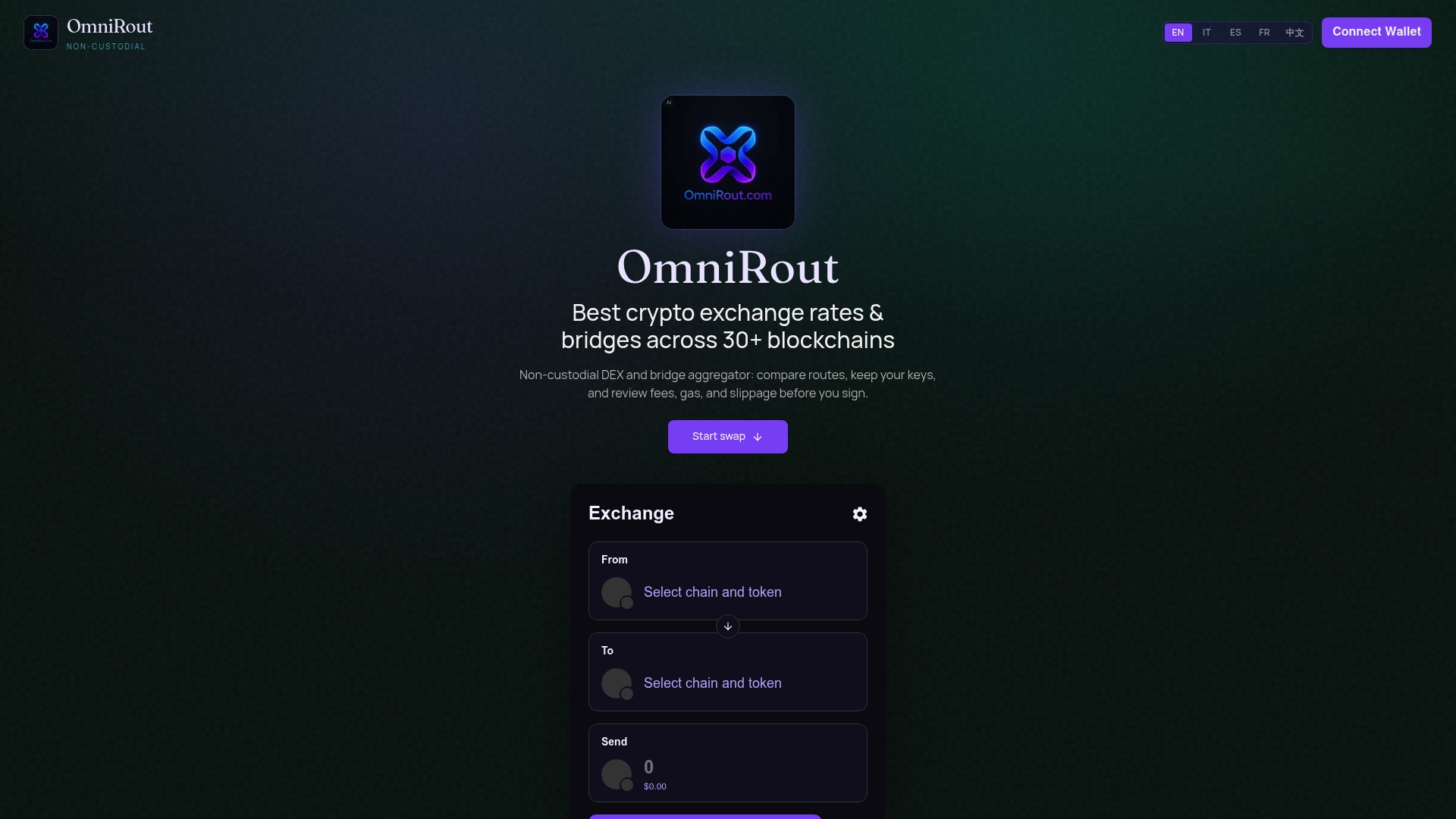
That comparison matters because a surprising share of user-side losses trace back to picking an unfamiliar route under time pressure or approving more access than a swap actually needs. Omnirout keeps you holding your own keys the entire time, so there's no custodial hop for an attacker to target in the first place. If you want a walkthrough of what a safer bridging flow looks like end to end, read how to bridge crypto safely. When you're ready to compare a real route before your next transfer, check rates on Omnirout.
Where to Read Next on Cross-Chain Security
For deeper technical grounding, start with the SoK bridge security paper for its taxonomy and Solidity examples, Chainlink's guidance on decentralized validation, and Sherlock's three-layer model for threat modeling.
Sources
- Cross-chain bridge hacks — Chainlink
- Cross-Chain Security in 2026 — Sherlock
- SoK: Security of Cross-chain Bridges — arXiv
- Crosschain Risk Framework