
Estimate a transaction's gas fee by multiplying the gas units it will consume by the sum of the base fee and priority fee, then dividing by 1,000,000,000 to convert gwei into ETH. Multiply that ETH figure by the current ETH price to see the cost in dollars. You need two live numbers to do this: the current base fee plus a priority tip, and the gas units your transaction type typically uses. Pull both from a live gas tracker or calculator before you hit send.
TL;DR:
- Gas fees vary significantly based on transaction type, with simple ETH transfers costing around 21,000 units and complex smart contract interactions exceeding 300,000 units.
- Utilizing Layer 2 networks can reduce transaction costs by over 90 percent compared to relying solely on the Ethereum mainnet, especially for frequent swaps or bridging.
- Timing transactions during off-peak hours, such as early mornings or weekends, can help save money by benefiting from lower base fees.
- Checking live gas data through trackers and setting alerts enables better timing and fee management before submitting transactions.
- Comparing multiple route options with tools like OmniRout before executing swaps can prevent overpaying by revealing differences in gas costs and slippage.
Table of Contents
- How to Calculate Gas Fees Step by Step
- Where Do You Get Live Gas Data, and When Should You Send?
- What Actually Lowers Your Gas Costs?
- How OmniRout Helps You Compare Routes Before You Pay
- Reliable Places to Check Live Gas Numbers Right Now
- What Most Fee Guides Get Wrong
- Compare Your Route Before You Pay for It
- Sources
How to Calculate Gas Fees Step by Step
The math behind every Ethereum transaction fee comes from EIP-1559: Tx Fee (ETH) = Gas Units × (Base Fee + Priority Tip) / 1,000,000,000. Three variables drive that formula, and each one moves independently.
Base fee is set by the network itself and adjusts block by block depending on how full the previous block was. You don't choose it. Priority fee (also called the tip) is what you offer miners or validators to bump your transaction ahead of others in the queue. Gas units measure the computational work your specific transaction demands. This is the one number that varies most by what you're actually doing on-chain.
Gwei is just a denomination of ETH, worth one billionth of an ether. So once you have your fee in gwei, dividing by 1,000,000,000 gets you ETH, and multiplying that by the live ETH/USD price gets you a dollar figure you can actually picture.
Here's a worked example. Say you're sending a plain ETH transfer, which uses 21,000 gas units. The base fee sits at 30 gwei and you add a 2 gwei tip. That's 21,000 × 32 = 672,000 gwei, or 0.000672 ETH. At an ETH price of about $2,500, your fee comes to roughly $1.68.
Gas units aren't fixed across transaction types, and this is where most people underestimate cost:
- ETH transfer: 21,000 gas units, the network floor.
- ERC-20 token transfer: roughly 45,000 to 65,000 units, since moving a token requires a contract call rather than a simple balance update.
- DEX swap: roughly 150,000 to 300,000 units, depending on how many liquidity pools the trade routes through.
- NFT mint: roughly 50,000 to 300,000 units, varying widely by contract design.
- Complex smart contract interactions: can run past 300,000 units with no firm ceiling.
| Transaction Type | Typical Gas Units |
|---|---|
| ETH transfer | 21,000 |
| ERC-20 transfer | 45,000–65,000 |
| DEX swap | 150,000–300,000 |
| NFT mint | 50,000–300,000 |
Treat these as starting points, not guarantees. The actual number depends on the specific contract code you're calling.
Where Do You Get Live Gas Data, and When Should You Send?
Three types of sources give you the base fee and tip numbers you need. Block explorers show recent block history and current network conditions at a glance. Dedicated gas trackers refresh constantly and often break fees into tiers. Developer APIs like the Infura gas API return suggested low, medium, and high fee levels along with estimated wait times, pulled from recent block priority-fee distributions.
Most trackers organize their output into three speed tiers:
- Slow: confirms in several minutes, typically the cheapest tip, fine for transactions with no time pressure.
- Standard: confirms within one or two blocks, a reasonable default for most swaps and transfers.
- Fast: confirms almost immediately, but you're paying a premium tip to jump the queue.
The actual gwei cost at each tier swings with network demand, so a "fast" tip during a quiet Tuesday afternoon might cost less than a "slow" tip during a token launch.
Off-peak windows tend to run cheapest between 2:00 AM and 6:00 AM UTC and across weekends, when overall network activity drops. Fewer people trading, minting, or bridging means less competition for block space, which pushes the base fee down.
If your transaction can wait, set a price alert on a tracker and check the base-fee trend over the last few blocks before committing. A base fee that's been climbing for the last ten blocks might keep climbing. One that's been falling suggests the window is opening up. Experts generally advise skipping "fast" settings for anything that isn't time-sensitive, since the fee premium rarely buys you anything you actually need.
What Actually Lowers Your Gas Costs?
Layer 2 networks are the single biggest lever most people have available. Because they bundle many users' transactions into one settlement on the main chain, Layer 2s frequently cut fees by 90% or more compared with doing the same operation directly on Ethereum mainnet. If you're swapping tokens or bridging assets regularly, that difference compounds fast.
Beyond chain choice, a handful of tactics consistently reduce what you pay:
- Batch transactions where possible instead of sending several separate ones.
- Use multicall functions when a contract supports bundling multiple actions into a single call.
- Reduce token approvals to only what's necessary, since each approval is its own gas-consuming transaction.
- Set a conservative priority tip for anything that isn't urgent rather than defaulting to "fast."
- Favor gas-optimized contract paths when a protocol offers more than one way to execute the same trade.
Your wallet's built-in estimate, generated through a call known as eth_estimateGas, simulates the transaction before you send it. For anything beyond a plain transfer, that simulated number is usually more trustworthy than a generic gas-limit guess, because it accounts for the actual contract logic you're triggering. Wallets like MetaMask run this simulation automatically, and setting your gas limit too low based on a rough guess risks a failed transaction. You still pay for the gas consumed up to the point of failure, even though the transaction never completes.
Pro Tip: If a swap isn't time-sensitive, wait for the base fee to dip below its recent average rather than accepting whatever tier your wallet defaults to. Shaving even 15 gwei off a DEX swap's fee can save several dollars once you multiply it across 200,000 or more gas units.
How OmniRout Helps You Compare Routes Before You Pay
Calculating one transaction's fee is useful. Comparing several possible routes for the same swap, before you commit, is where the real savings show up. OmniRout is a non-custodial DEX and bridge aggregator that compares swaps and bridges across more than 30 blockchains, surfacing fees, gas costs, and slippage side by side so you can see the full cost of each path rather than just the advertised exchange rate.
Picture swapping the same token pair two ways: one route crosses through a single deep liquidity pool, the other hops through two smaller pools to get a marginally better price. The second route might quote a better rate but cost more once you add its higher gas units into the total. Comparing routes before executing catches that difference in dollars, not just in theory.
| What you compare | Why it matters |
|---|---|
| Route-level gas cost | Two paths to the same swap can differ sharply in total gas units |
| Slippage across chains | Lower advertised price doesn't always mean lower total cost |
| Custody | You keep control of your own keys throughout |
For deeper tactics on cutting swap costs, see OmniRout's guide on gas fee optimization and its breakdown of Layer 2 bridging tradeoffs.
Reliable Places to Check Live Gas Numbers Right Now
Before you send anything, pull current numbers from a source built for this. A live Ethereum gas tracker and calculator refreshes roughly every block or every 15 seconds, combining base fee, priority fee, and the current ETH/USD rate into a near-real-time estimate. The Infura gas API documentation is worth bookmarking if you want to understand how suggested fee tiers get calculated behind the scenes. For deeper reading on routing and multi-step transactions, OmniRout's guide to multi-hop swaps walks through how complexity affects gas.
What Most Fee Guides Get Wrong
Most guides treat gas fee estimation as a one-time lookup: check a tracker, get a number, send the transaction. That misses the bigger opportunity. The real skill isn't reading a gwei figure, it's recognizing that the same transaction can cost dramatically different amounts depending on when you send it and which route you take to get there.
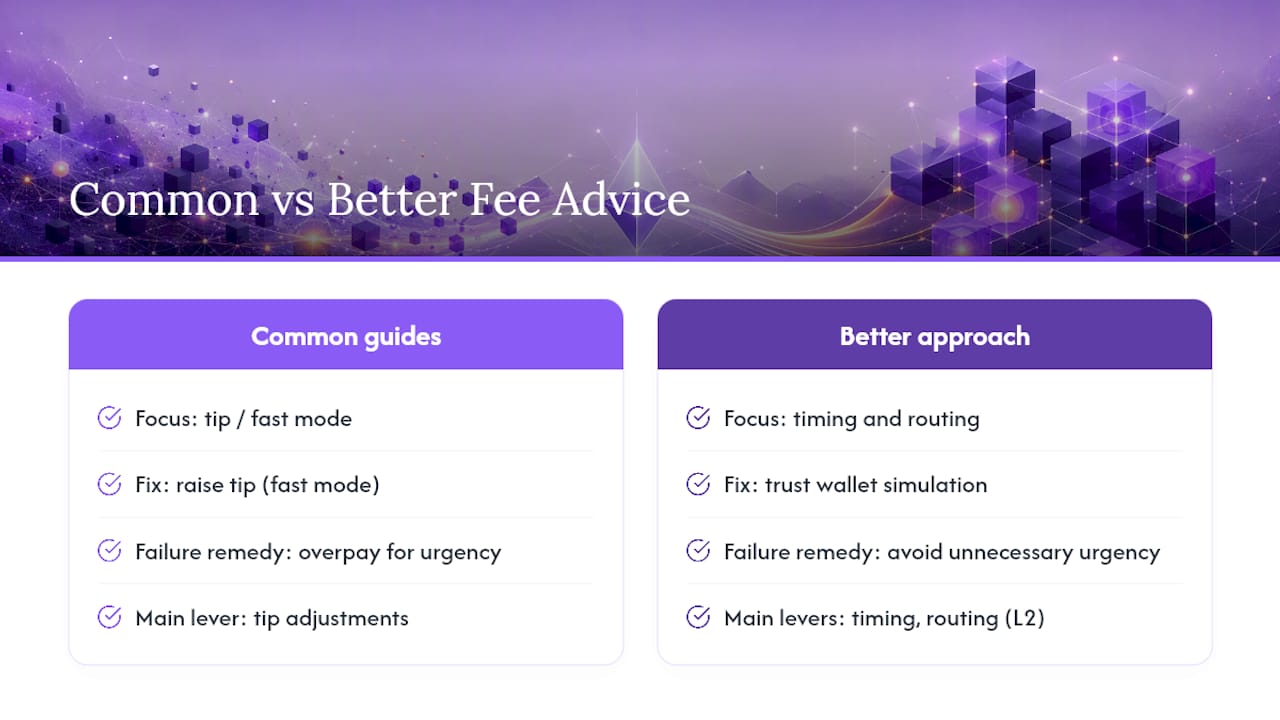
The conventional advice to "just use fast mode so it doesn't fail" is often backward. Fast mode solves a problem most non-urgent transactions don't have. A failed transaction from underestimating gas limit is a real risk, but the fix is trusting your wallet's simulation, not overpaying on the tip. Those are two separate variables, and treating them as one leads people to burn money on urgency they didn't need.
If you take one thing from this guide, prioritize the two levers that actually move the needle: timing (off-peak windows, watching the base-fee trend) and routing (checking whether a Layer 2 or an alternate path gets you the same outcome for a fraction of the gas). Tip adjustments matter less than either of those, despite getting the most attention in most tutorials.
— Emanuele
Compare Your Route Before You Pay for It
Every dollar you've just learned to calculate is a dollar OmniRout helps you avoid overpaying. Instead of manually running the EIP-1559 formula on three different bridges to find the cheapest path, OmniRout's route comparison does that work in one screen, weighing fees, gas costs, and slippage across more than 30 blockchains side by side. You keep your own keys the entire time, since OmniRout never takes custody of your assets.
That matters most right after finishing a calculation like the ones above, when you know your ETH transfer or DEX swap should cost a certain range and want to confirm you're not paying above it. Rather than checking a tracker, then a bridge's own quote, then a second bridge's quote, one comparison view shows you where the fee difference actually comes from. Head to OmniRout and run a route comparison on your next swap before you confirm it.
Sources
- Calculate Ethereum transaction cost (EIP-1559) — Calxia
- Gas Fees Calculator - Real-Time Ethereum Gas Fee Calculator & Tracker
- How to estimate the gas fee | MetaMask Help Center
- ETH Transaction Fee – Live Ethereum Gas Tracker, Calculator & Chart