
EVM cross-chain swaps move a token from one Ethereum-compatible chain to another, and often convert it into a different asset, in a single user action instead of separate bridge-then-trade steps. The verdict: they're worth using when speed and a smooth experience matter more than routing every hop yourself, but every model trades some custody or trust assumption for that convenience. Traders should pick routes by comparing total cost, and developers should build around open standards rather than proprietary relayers.
TL;DR:
- Cross-chain swap costs include trading fees, relayer or bridge fees, gas on both chains, and slippage, which must all be evaluated together for accuracy.
- Verification methods vary: cryptographic storage proofs enhance security, while reliance on economic collateral or off-chain secrets increases trust assumptions.
- Liquidity pool models settle swaps quickly but risk imbalance and impermanent loss, whereas intent and escrow models depend on resolver competition or secret handoffs, respectively.
- Open standards like EIP-5164 and CCIP-Read aim to improve interoperability, security, and reduce trust reliance on proprietary relayers.
- Traders should compare full route costs and avoid trusting frontend confirmation, especially on thin liquidity pools or volatile pairs, to prevent overpaying or fund loss.
Table of Contents
- How Do EVM Cross-Chain Swaps Actually Work?
- Liquidity Pools vs. Intent Systems vs. Escrow Swaps
- How Secure Are Cross-Chain Swaps, Really?
- What Does a Cross-Chain Swap Actually Cost?
- Building Cross-Chain Swaps: APIs, SDKs, and Standards
- What Should Traders Check Before Executing a Swap?
- Where OmniRout Fits for Traders and Developers
- Where EVM Cross-Chain Swaps Are Headed
- Compare Routes Before You Bridge or Swap
- Sources
- FAQ
How Do EVM Cross-Chain Swaps Actually Work?
Every cross-chain swap follows a version of the same runtime sequence, whether it's routed through a liquidity pool, an intent system, or an escrow contract. The user signals what they want, a mechanism verifies and moves value, and a settlement step releases funds on the destination chain. What differs between protocols is who does the verifying and how much trust that requires.
A typical flow looks like this:
- Intent submission. The user specifies the input token, output token, destination chain, and acceptable slippage, either through a swap interface or directly via a smart contract call.
- Lock, escrow, or quote. Funds get locked in an escrow contract, deposited into a pool, or reserved against a quoted rate depending on the protocol model.
- Relay and verification. A relayer, resolver, or gateway carries proof of the source-chain action to the destination chain. This is where storage proofs generated with
eth_getProofcome in. They let a contract on one chain cryptographically verify state from another without blindly trusting a middleman. - Settlement. The destination contract releases the output asset, closes the escrow, or unlocks pool liquidity, and emits an event confirming completion.
The key distinction to understand early: a bridge-then-swap flow moves a wrapped or bridged token first, then executes a separate trade on the destination chain, usually as two transactions with two fee events. An integrated cross-chain swap collapses that into one signed action, with routing and settlement handled behind the scenes. For someone comparing routes, that difference shows up directly in gas cost and time to finality.
Liquidity Pools vs. Intent Systems vs. Escrow Swaps
Three architectures dominate EVM interoperability solutions today, and each optimizes for a different combination of speed, capital efficiency, and trust.
- Liquidity-pool models hold unified pools of assets on each chain and settle swaps against those pools, giving the user the native asset on arrival rather than a wrapped placeholder. This is capital intensive for the protocol (someone has to fund every pool on every chain) but it's fast for the user, since settlement doesn't wait on cross-chain message confirmation.
- Intent and voucher models let the user post a desired outcome, then let resolvers or liquidity providers compete to fill it. Across Protocol's design is the clearest public example: the user isn't manually routing anything, and competition among fillers tends to compress the spread the user pays. This tends to be the most capital-efficient model, since resolvers only commit funds when they win the fill, not ahead of time.
- Escrow and atomic-swap models deploy a fresh escrow contract per swap, often called EscrowSrc and EscrowDst, and rely on off-chain secret distribution between the two sides to complete the trade. The 1inch cross-chain swap implementation uses exactly this pattern, deploying deterministic escrow clones so a safety deposit can be posted before the order even fills.
The failure modes differ too. Pool-based systems are exposed to pool imbalance and impermanent-loss-style risk during volatility. Intent systems depend on enough resolver competition to keep pricing honest. Escrow systems depend on the off-chain secret-passing step completing correctly, and a stalled handoff can leave funds locked until a timeout triggers.
Pro Tip: If a route quote looks unusually good, check which model is behind it. An intent-based route winning by a wide margin usually means active resolver competition, but a pool-based route with a great price on a low-liquidity pair is more likely a sign the pool is imbalanced and about to reprice against you.
How Secure Are Cross-Chain Swaps, Really?
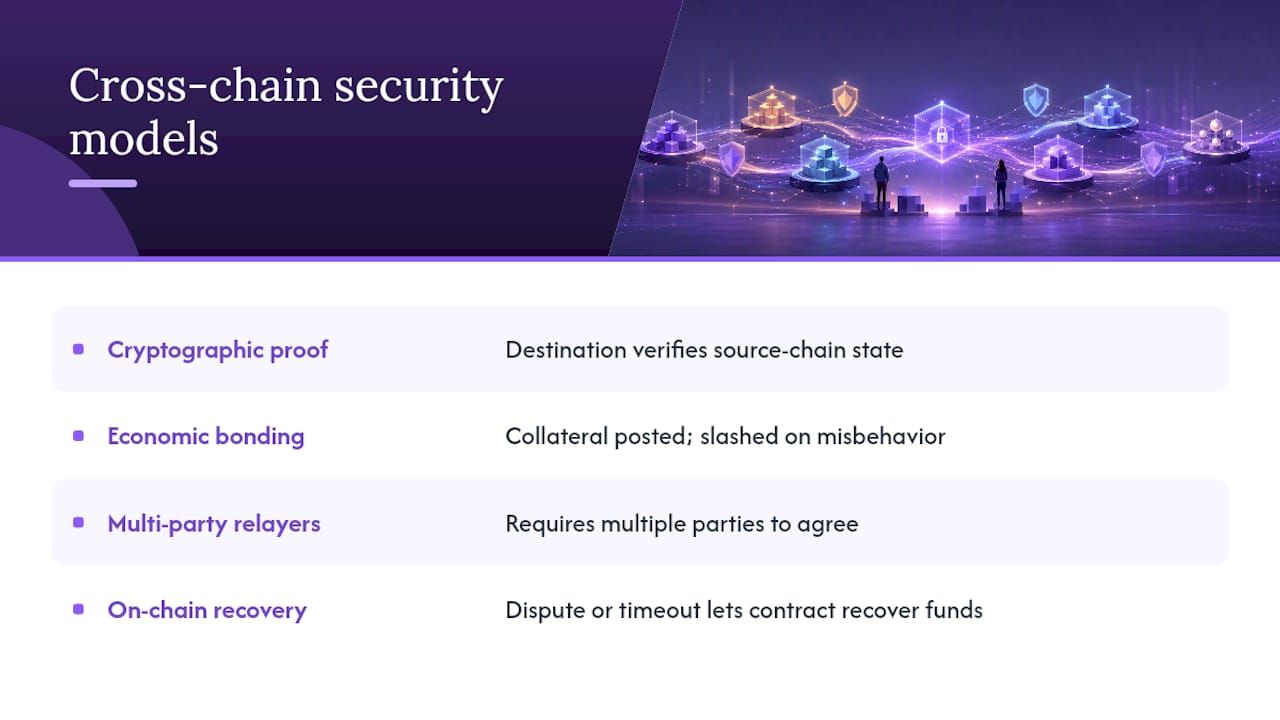
Security in EVM cross-chain swaps comes down to one question: does the destination chain verify what happened on the source chain, or does it trust someone's word for it? Storage proofs generated through eth_getProof, read and checked by CCIP-Read style gateways, let a contract confirm source-chain state cryptographically rather than accepting a relayer's claim at face value, as described in the evmgateway framework.
Where full on-chain verification isn't practical, protocols fall back on economic bonding. Liquidity providers or relayers post collateral, and provable misbehavior gets that collateral slashed, an approach that eth-infinitism's EIL contracts use to keep custody self-directed rather than handing funds to a service that could hold them indefinitely.
A useful audit heuristic: the strongest cross-chain designs let a user's on-chain contract, not a company's server, hold or verify custody at every step. When you're reviewing a protocol's audit, check specifically whether it examined the relayer's authority. Can a single relayer censor or delay a message, or does the design require multiple independent parties to agree before funds move? Recovery mechanisms matter as much as prevention. A protocol with no on-chain dispute or timeout path forces you to trust support tickets over code.
What Does a Cross-Chain Swap Actually Cost?
Total cost on a cross-chain swap isn't one number. It's a stack of four separate charges, and skipping any of them when you estimate a trade is how "cheap" swaps end up expensive.
- Trading fee: what the DEX or pool charges for the swap itself, usually a small percentage of the trade.
- Bridge or relayer fee: payment to whoever carries the message or liquidity across chains, whether that's a resolver, relayer, or bonded liquidity provider.
- Gas on both ends: origin-chain gas to initiate, destination-chain gas to settle. On busy chains, destination gas can rival or exceed the trading fee.
- Slippage: the gap between quoted and executed price, which widens on thin destination-chain liquidity.
Aggregated route comparison tools sum all four before you sign anything, which is the only reliable way to spot a route that looks cheap on the trading fee but loses on gas or slippage. Before executing, check the quote's total against at least one alternative route rather than trusting the first number you see.
Building Cross-Chain Swaps: APIs, SDKs, and Standards
Developers integrating cross-chain swap logic have real standards to build against now, instead of one-off bridge integrations. EIP-5164 defines a cross-chain execution interface with relayer and receiver contracts, so a contract on one EVM chain can call a contract on another with a defined batching and delivery pattern rather than a custom bridge every time.
A practical integration path looks like this:
- Pick your verification layer. Use CCIP-Read style gateways when you need a contract to fetch and verify state from another chain without trusting the gateway operator, since the L1 verification step checks the proof, not the gateway's word.
- Handle chain-specific quirks early. Address formats, finality assumptions, and RPC support for
eth_getProofall vary by chain, and the evmgateway integration checklist is a good baseline before you assume any new chain "just works." - Design settlement callbacks defensively. Build for reorgs on the origin chain and delayed finality on the destination chain, and test both paths, not just the happy one.
Pro Tip: Don't assume eth_getProof behaves the same everywhere. Some rollups expose different RPC primitives entirely, and a proof strategy that works on one chain can silently fail on another if you haven't tested it directly against that chain's node.
What Should Traders Check Before Executing a Swap?
Cost and custody risk on a cross-chain trade come down to a handful of checks you can do in under a minute before signing anything.
- Compare full routes, gas plus slippage plus bridge fee together, not just the headline trading fee.
- Set slippage tolerance conservatively on thin destination-chain pairs, and confirm the destination pool actually has enough depth for your size.
- Use a wallet you control the keys to, and favor non-custodial swap flows over anything that takes indefinite custody of your funds.
- After execution, check the destination-chain settlement event yourself rather than trusting a frontend's confirmation screen.
Where OmniRout Fits for Traders and Developers
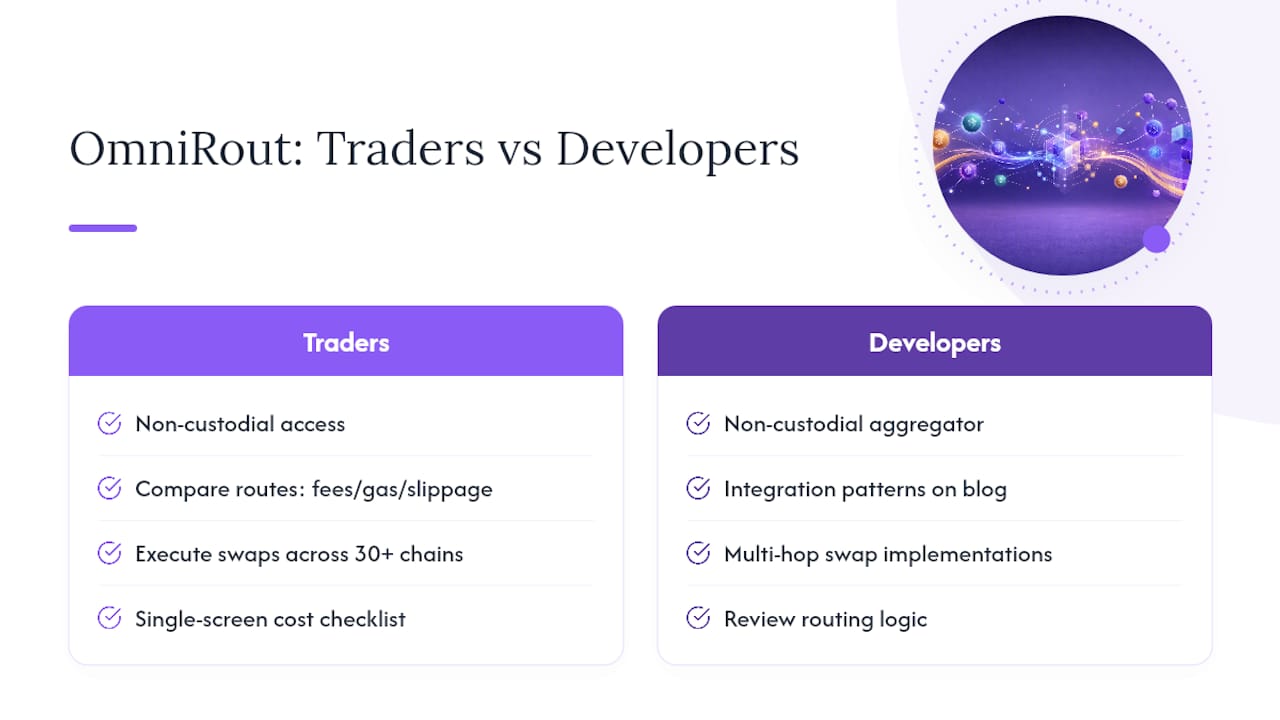
OmniRout is a non-custodial DEX and bridge aggregator that lets you compare and execute swaps across more than 30 blockchains without giving up your keys. Its route comparison feature shows fees, gas, and slippage side by side before you commit funds, which turns the cost checklist above into a single screen. Developers building routing logic can review integration patterns on the OmniRout blog for multi-hop swap implementations.
Where EVM Cross-Chain Swaps Are Headed
Expect wider adoption of open standards like EIP-5164 and CCIP-Read, stronger on-chain proof verification, and more bonding-based models replacing trusted relayers outright. Standardization is what finally makes cross-chain DeFi composable instead of a pile of one-off bridges.
— Emanuele
Compare Routes Before You Bridge or Swap
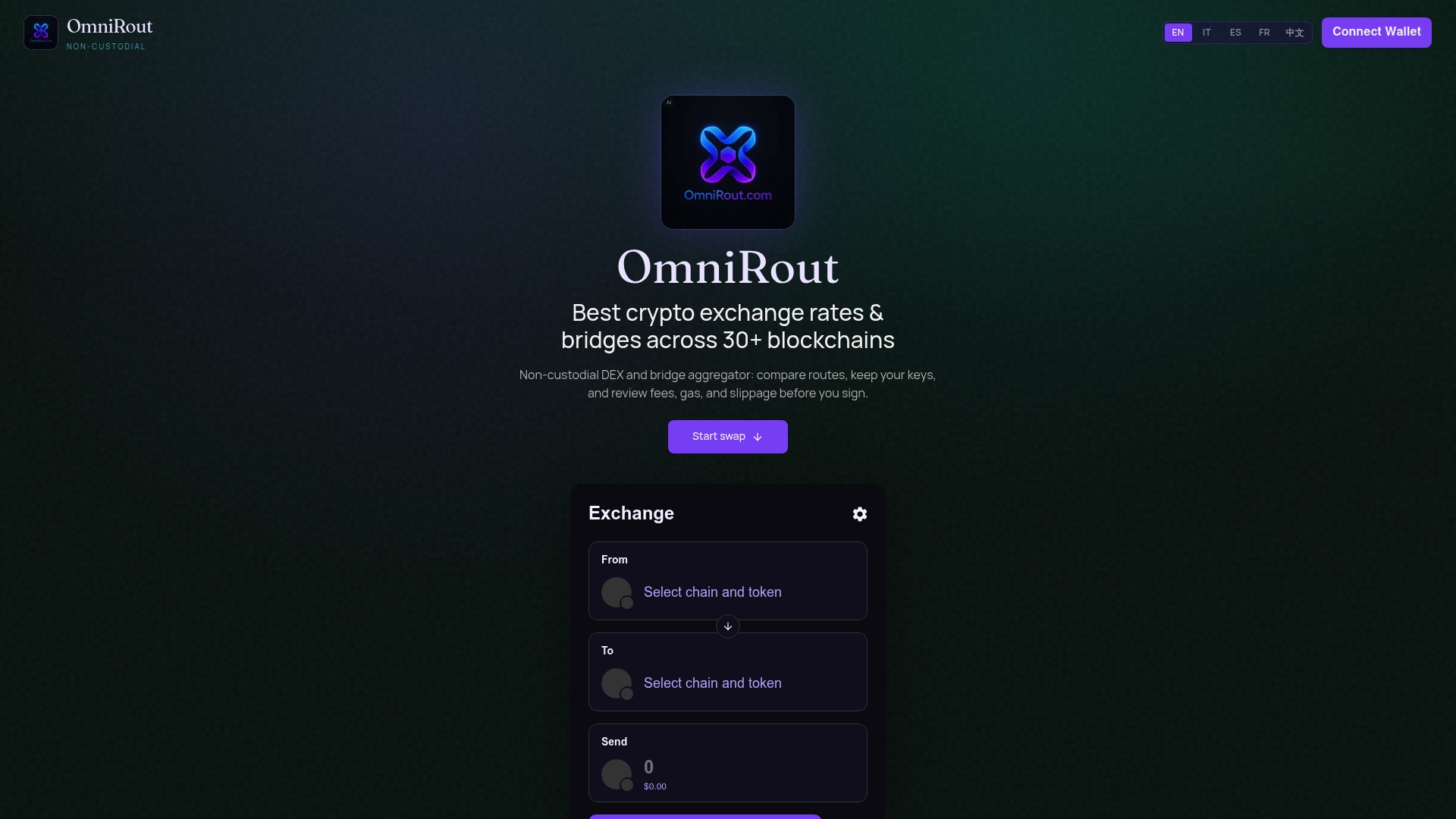
There's a real cost to guessing at the cheapest route: you either overpay on gas, get caught by slippage on a thin pool, or hand custody to a bridge you haven't vetted. This type of aggregator pulls quotes across multiple chains, lays out the trading fee, gas, and slippage side by side, and lets you keep your own keys the entire time.
That matters most on the exact scenarios covered above: escrow swaps with per-transaction gas overhead, intent routes where resolver competition varies by pair, and pool-based swaps where destination liquidity can be thinner than it looks. If you're bridging assets rather than swapping them outright, the guide to bridging crypto safely covers the same cost checklist in more detail. Head to OmniRout and run a route comparison on your next cross-chain trade before you sign anything.
Sources
FAQ
Which DEX Is Best for Cross-Chain Swaps?
There's no single best DEX for every route, since pricing shifts by pair, chain, and liquidity depth. Aggregators like OmniRout solve this by comparing routes across many DEXs and bridges at once, so you see the cheapest option for your specific trade rather than betting on one platform.
Is Solana an EVM Chain?
No. Solana runs its own virtual machine and account model, not the Ethereum Virtual Machine, so it isn't EVM compatible in the way chains like Polygon, Arbitrum, or Base are.
Why Can't I Swap Ethereum for Another Asset?
A failed swap on Ethereum is almost always caused by insufficient gas, slippage tolerance set too tight for current liquidity, or a destination pool that can't fill your order size. Checking a route comparison before you execute catches most of these issues in advance.
Is Stellar an EVM Chain?
No. Stellar uses its own consensus protocol and smart contract environment, separate from the Ethereum Virtual Machine, so standard EVM cross-chain swap tooling doesn't apply to it directly.
What's the Difference Between a Bridge and a Cross-Chain Swap?
A bridge moves the same asset from one chain to another, often as a wrapped token, while a cross-chain swap can move value across chains and change the asset type in one action, as covered in the cross-chain swap security guide.