
A DEX aggregator quote is built from four cost pieces: network gas, the underlying DEX pool fee, aggregator revenue, and slippage. Gas dominates on small trades, slippage dominates on large ones, and aggregator revenue is often the smallest line, when it's shown at all. Some platforms display these as separate charges; others fold them into the exchange rate itself, so two quotes that look identical can hide very different costs.
TL;DR:
- Network gas costs can vary widely, from cents on Layer 2 to dollars on congested Ethereum mainnet, making chain choice a key factor.
- Pool fees are baked into the rate, with some aggregators routing through lower-fee pools to reduce overall costs, especially on larger trades.
- Router overhead adds extra gas consumption for splitting trades across multiple pools, which matters most on small trades under a few hundred dollars.
- Large trades benefit from routing because slippage savings increase with trade size while fixed overhead costs stay constant, making aggregation more advantageous.
- Checking fee breakdowns, slippage policies, and whether positive slippage benefits are disclosed helps traders estimate real costs and avoid hidden charges.
Table of Contents
- Dex Aggregator Fees: The Four Cost Categories Explained
- How Do Dex Aggregators Make Money?
- What Fees Look Like at $100, $5,000, and $50,000
- How To Estimate Your Total Cost Before You Swap
- Reading a Route Comparison Like a Trader
- When Paying Aggregator Fees Is Actually Worth It
- See Your Real Costs Before You Trade With OmniRout
- Sources
- FAQ
Dex Aggregator Fees: The Four Cost Categories Explained
Every swap quote is really four numbers stacked together. Knowing which is which lets you read a quote instead of just trusting it.
Network gas is what you pay the blockchain itself to process the transaction, not the aggregator or the DEX. It's measured in gas units multiplied by the current gas price, and it swings wildly by chain. A swap that costs a few cents on a Layer 2 can cost several dollars on Ethereum mainnet during congestion. Chain choice is often the single biggest lever you control here.
Pool fees belong to the underlying automated market maker, not the aggregator. Uniswap's standard tier charges a small percentage fee per swap, and that fee is baked into the exchange rate you're quoted, according to Coinbase's explainer on decentralized exchanges. Many aggregators route through pools with lower fee tiers (0.05% or 0.01%) specifically to undercut that default.
Router overhead is the extra gas an aggregator's smart contract consumes to compare and split your trade across multiple pools. This overhead typically runs an extra 30,000 to 80,000 gas units compared to a direct single-pool swap, according to DEXTools' aggregator guide. On a $50 trade that overhead can matter. On a $5,000 trade it barely registers.
Slippage and surplus cover the gap between your quoted price and your executed price. Here's the part most traders miss:
- Negative slippage costs you money when the market moves against your trade before it confirms.
- Positive slippage happens when execution beats the quote, and what happens to that surplus depends entirely on the aggregator's policy.
- Some platforms return the full surplus to you; others keep a cut as undisclosed revenue.
How Do Dex Aggregators Make Money?
- Explicit protocol fees. Some platforms charge a flat percentage on every swap, visible directly in the quote breakdown. Matcha, for example, applies a small explicit fee on many trading pairs, according to CoinCodeCap's aggregator ranking. This is the most honest model because the cost is itemized before you confirm.
- Positive-slippage capture. When your trade executes better than quoted, the aggregator can keep a slice of that upside instead of passing it to you. ParaSwap has used a model that retains a fraction of positive slippage in certain configurations, per the same CoinCodeCap research. This only shows up in your favor, or against it, after the fact, which is why disclosure practices matter more here than anywhere else in the fee stack.
- RFQ and spread capture. Request-for-quote systems route your trade to market makers who compete on price, then embed their margin directly in the spread rather than as a line-item fee. You never see this fee named. You only see it in the final rate.
- Partner and API revenue. Aggregators that power other apps or wallets through white-label integrations often earn a referral cut from that traffic, a mechanism Startupik's breakdown of aggregator revenue models documents in detail. This layer of monetization almost never appears in your quote because it's a business-to-business arrangement, not a retail charge.
Pro Tip: Before confirming a swap, check whether the interface tells you what happens to positive slippage. If a platform can't answer that question in its own documentation, assume it keeps the surplus.
A newer model worth knowing: intent-based or solver-driven aggregators let independent solvers compete to fill your order, often absorbing gas costs into their bid rather than charging you directly, as CoW Swap's explainer describes. You pay neither a visible gas fee nor a separate protocol fee. The solver's margin is just baked into the price you get.
What Fees Look Like at $100, $5,000, and $50,000
Numbers make this concrete faster than any explanation. Here's how the fee stack behaves as trade size grows, using typical gas overhead and pool fee assumptions.
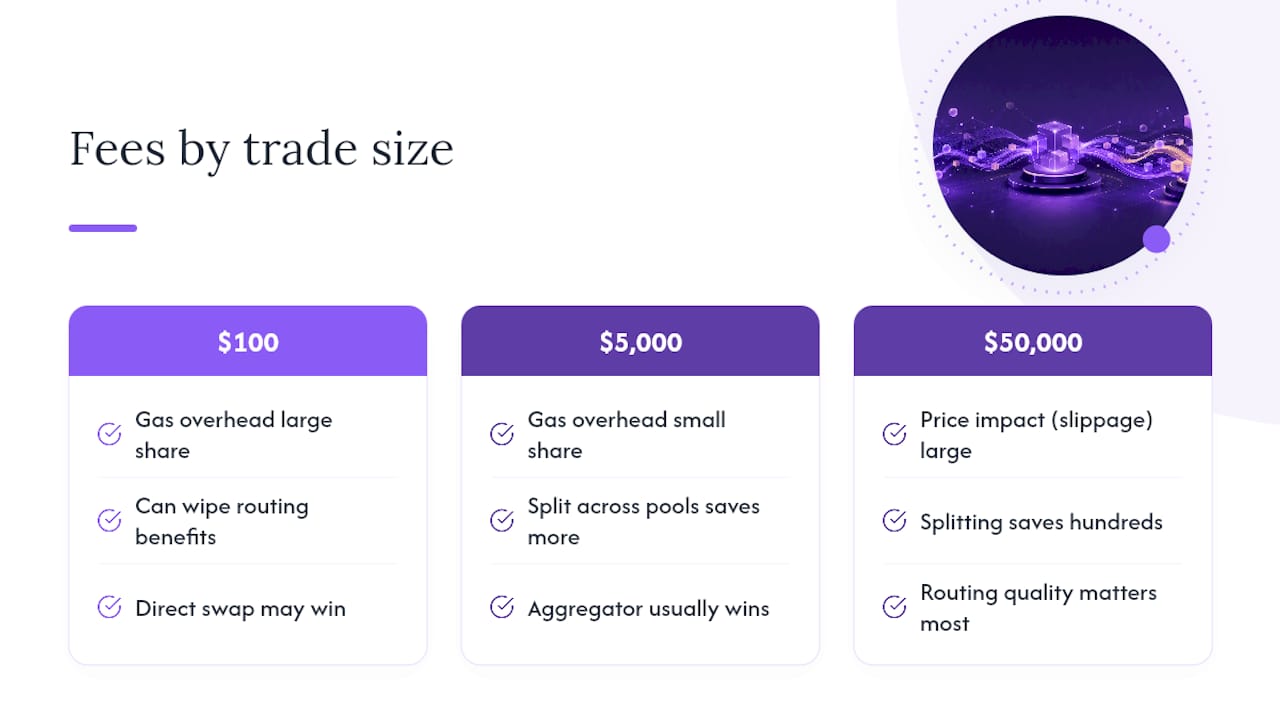
On a small swap, router overhead of added gas units can represent a meaningful portion of the trade on high-fee chains, sometimes wiping out potential routing benefits due to the cost of gas relative to trade size. This is the trade size where aggregators sometimes lose to a direct swap, particularly on Ethereum mainnet during busy periods.
At $5,000, the math flips. The fixed gas overhead barely moves as a percentage of the trade, but splitting the order across two or three pools to avoid price impact can save far more than that overhead costs. This is roughly the tipping point where aggregator routing starts winning consistently, since added gas costs stay flat while slippage savings scale with trade size.
At $50,000, a single-pool swap would push price impact into a range that can cost hundreds of dollars in slippage alone. Splitting that order across multiple liquidity sources, which is exactly what an aggregator's routing engine does, typically saves far more than the fixed gas overhead costs. The larger the trade, the less the fee model matters and the more the routing quality matters.
How To Estimate Your Total Cost Before You Swap
Every aggregator interface shows this information somewhere. The trick is knowing where to look and what to compare before you hit confirm.
- Open the route breakdown and check whether gas, pool fee, and net output are itemized separately or folded into one number.
- Compare the gas estimate against your trade size; if gas exceeds 2 to 3% of notional, consider waiting or switching chains.
- Look for a line on slippage tolerance and adjust it manually. Default settings on small trades are often set wider than necessary.
- For large orders, test whether the platform offers an RFQ or solver-based mode, which can reduce failed-transaction risk and sometimes beat AMM routing on price.
- Check whether the platform discloses what happens to positive slippage. Silence on this point is itself information.
- Confirm the underlying contracts have been audited. Aggregator interfaces inherit the smart-contract risk of every router and pool they touch, and security reviews of past incidents show how quickly that risk becomes real money.
Pro Tip: If you're trading under $200 in notional value, do the math on gas-to-trade ratio before comparing rates. A better price on paper doesn't help if the routing overhead cancels it out.
Splitting one large order into two or three smaller trades can also reduce price impact on illiquid pairs, though it adds gas cost each time, so this tactic pays off mainly above a few thousand dollars in size. Timing trades for lower network congestion, and favoring gas-efficient chains for smaller swaps, rounds out the practical checklist.
Reading a Route Comparison Like a Trader
Pre-trade route comparison exists to answer one question: what will this swap actually cost, all in, before you commit any gas. Omnirout, a non-custodial aggregator that routes across more than 30 blockchains, builds its interface around showing gas, pool fees, net output, and slippage as separate lines rather than one blended rate. That separation is what lets you catch a router-overhead problem on a small trade before it eats your margin.
Because Omnirout never takes custody of your funds, you approve and sign every transaction from your own wallet, and the route comparison happens before any funds move. A few habits carry over to any aggregator you use:
- Always expand the fee breakdown rather than trusting the headline exchange rate.
- Compare at least two routes on trades over a few thousand dollars; the cheapest route by gas isn't always cheapest after slippage.
- Watch the net output number, not the gross swap amount, since that's the figure that reflects every cost combined.
When Paying Aggregator Fees Is Actually Worth It
The math in this article points to a simple rule: size and liquidity decide whether aggregator routing earns its keep. Large trades, cross-chain bridges, and swaps in thin or exotic pools almost always benefit from routing across multiple sources, because slippage savings scale with notional while gas overhead stays roughly fixed.
Micro-trades tell a different story. On a $50 or $100 swap on a high-fee chain, the gas-to-notional ratio can wipe out any routing advantage, so a direct swap on a cheap Layer 2 network sometimes beats an aggregator outright. The one exception worth remembering: solver-based execution can justify its cost even on marginal price differences, because MEV protection and reduced failed-transaction risk have value that doesn't show up in the quoted rate at all.
— Emanuele
See Your Real Costs Before You Trade With OmniRout
Every fee category this article walked through, gas, pool fees, router overhead, slippage, shows up differently depending on which aggregator you use and how transparently it reports costs. Some aggregators address that problem by offering non-custodial DEX and bridge aggregation across multiple blockchains with transparent fee breakdowns before you sign anything.
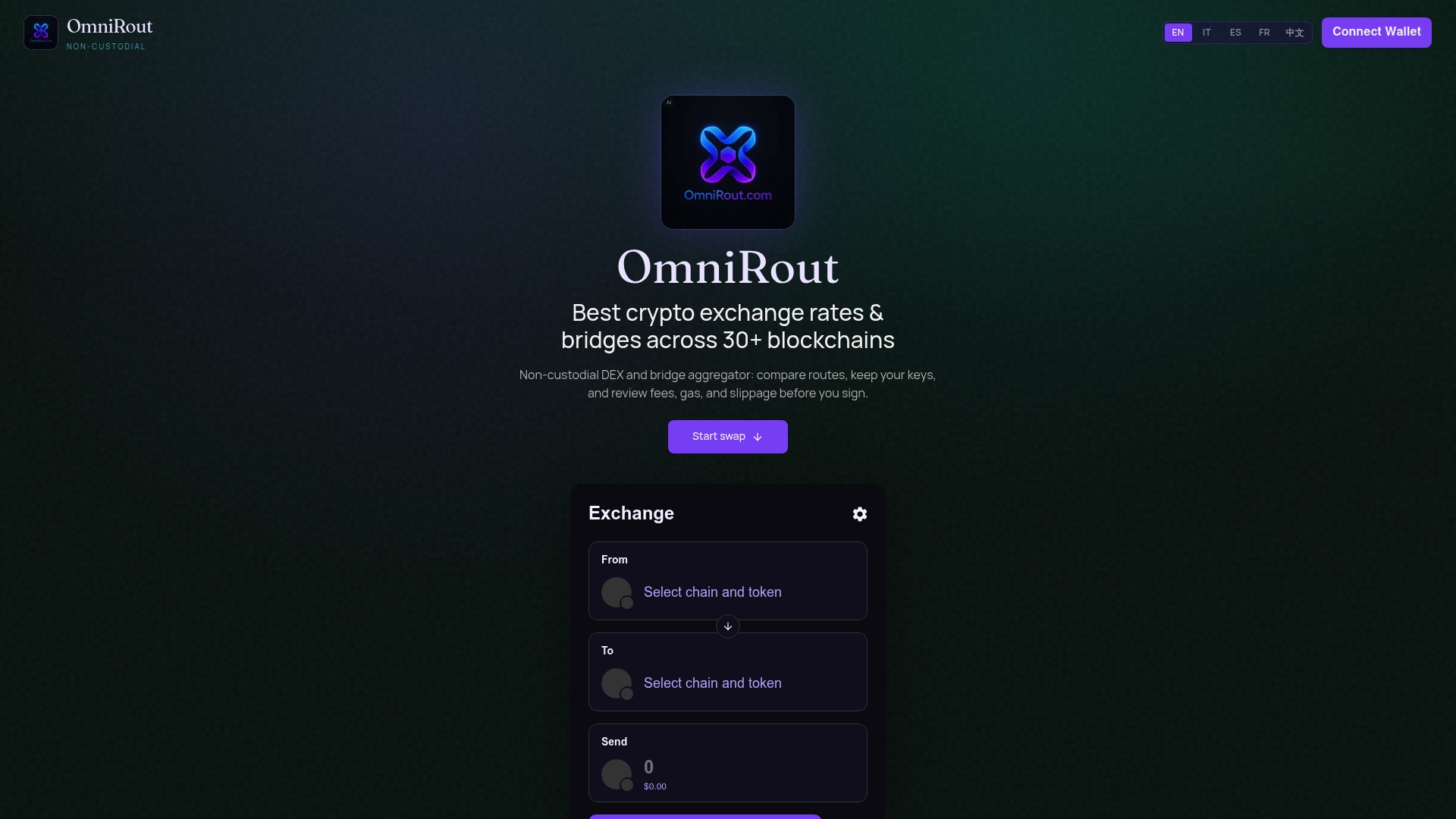
The workflow is straightforward. You enter a swap or bridge transaction, Some platforms pull quotes across multiple routes, showing gas, pool fees, and slippage broken out line by line instead of a single rate. You pick the execution mode that fits your trade size and keep control of your keys, since these platforms never take custody of your funds. If you want to see what a real quote looks like before committing a single dollar of gas, run a free route comparison on Omnirout and check the numbers for your next swap.
Sources
- What is a DEX — Coinbase Learn
- How DEX Aggregators Generate Revenue | Startupik
- Crypto DEX Aggregators: 9 Best Ranked 2026 | CoinCodeCap
- Explained: the Unizen hack — Halborn blog
FAQ
How much are DEX fees, typically?
Pool fees usually run between 0.01% and 0.3% depending on the fee tier, on top of network gas that varies by chain, from fractions of a cent on Layer 2s to several dollars on congested mainnet transactions.
What are DEX aggregators?
A DEX aggregator scans multiple decentralized exchanges and liquidity pools, then routes your trade, or splits it across several, to get a better net price than swapping on a single pool directly.
Which DEX aggregator is considered the best?
There's no single best option for every trader; the right choice depends on whether you prioritize fee transparency, multi-chain coverage, or non-custodial control, which is the gap Omnirout's route comparison is built to address.
What are the risks of using DEX aggregators?
The main risks are smart-contract vulnerabilities inherited from the routers and pools an aggregator connects to, plus MEV exposure and opaque handling of positive slippage, so checking audits and fee disclosure matters before you trade.
Do DEX aggregators always charge lower fees than trading directly?
Not always. On very small trades, added router gas overhead can outweigh the slippage savings aggregators typically deliver, which is why aggregator routing tends to pay off more clearly on mid-size and large swaps.