
Two categories dominate practical DeFi arbitrage right now: two-pool atomic arbitrage on Layer 2 networks, and flash-loan-powered yield or vault mispricing plays. Both let you start with modest capital and a simulation-first workflow. Triangular arbitrage and cross-chain bridge arbitrage carry higher theoretical margins but demand more infrastructure and tolerance for non-atomic risk. High-frequency MEV tactics need specialized infrastructure most builders shouldn't chase first. If you're starting from zero, build a two-pool atomic bot on an L2, wire in a hard profit floor, and simulate every send on a forked chain before it ever touches mainnet.
TL;DR:
- Starting with two-pool atomic arbitrage on Layer 2s offers the simplest, most reliable method, especially for those new to smart contract development.
- Proper trade sizing using live reserves and simulation on forked chains is critical to avoiding losses caused by slippage and inaccurate reserve data.
- Multi-leg arbitrage strategies like triangular or cross-chain involve higher complexity, infrastructure, and risk, requiring more advanced algorithms and risk mitigation.
- Market congestion impacts profitability significantly, as higher gas fees and delays can turn profitable spreads into losses quickly.
- Accurate transaction logging, route comparison, and risk modeling are essential for profitability and regulatory compliance in DeFi arbitrage.
Table of Contents
- Quick Strategy Map: Types, Margins, and Difficulty
- Atomic Two-Pool Arbitrage: Math, Calldata, and Safe Simulation
- Triangular and Multi-Leg Arbitrage: Pathfinding and Cost Accumulation
- Yield and Vault Arbitrage: Spread Triggers and Flash Execution
- Cross-Chain and Bridge Arbitrage: Cost Modeling and Settlement Risk
- Engineering and Execution Stack: Nodes, Mempool Access, and Ops
- Profitability Model and Risk Controls: The Net-Profit Formula
- Starter Roadmap: From Zero to First Live Fills
- Where OmniRout's Tooling and Technical Guides Fit In
- How Network Congestion Changes the Arbitrage Math
- Regulatory Considerations Relevant to DeFi Arbitrage
- Tax Implications of DeFi Arbitrage Profits
- Choosing Between a Trading-First and Engineering-First Path
- Check Your Route Costs Before You Simulate the Trade
- Sources
Quick Strategy Map: Types, Margins, and Difficulty
DeFi markets stay fragmented and inefficient enough to throw off short-lived price gaps constantly, but capturing them profitably means matching the strategy to your infrastructure and risk tolerance. Here's how the main categories break down before you commit engineering hours to any one of them.
Two-pool atomic arbitrage buys an asset cheap on one pool and sells it expensive on another in a single transaction. Spreads are usually thin, often small percentages on liquid pairs, but the atomicity means you either profit or the whole trade reverts with no loss beyond gas. Latency matters less on L2s than on Ethereum mainnet, which makes this the most approachable entry point.
Triangular and multi-leg arbitrage routes through three or more pools (ETH to USDC to DAI to ETH, for example) to capture pricing inconsistencies that don't show up in a simple two-pool comparison. It appears more often during volatile periods and requires algorithmic path detection since you can't eyeball dozens of possible routes manually.
Yield and vault arbitrage exploits the gap between an ERC-4626 vault's redemption rate and its secondary-market DEX price, or a stablecoin trading away from its peg. Margins can run wider than pool-to-pool spreads because fewer bots watch these specific relationships closely.
Cross-chain and bridge arbitrage captures price differences for the same asset across two blockchains. Margins tend to be the largest of the four categories, but you're exposed to settlement delay and bridge risk since the trade legs aren't atomic.
Match strategy to skill level:
- New to smart contract development: start with two-pool atomic arbitrage on an L2.
- Comfortable with graph algorithms: add triangular detection once your atomic bot is stable.
- Interested in protocol mechanics over speed: yield/vault arbitrage rewards patience over latency.
- Have capital and risk tolerance for settlement delay: cross-chain arbitrage, but size conservatively.
Atomic Two-Pool Arbitrage: Math, Calldata, and Safe Simulation
Atomicity is what makes this strategy forgiving for beginners. Because the buy and sell happen inside one transaction, either both legs succeed and you pocket the spread, or the entire transaction reverts and you only lose gas. Flash loans push this further by removing the need for upfront capital: you borrow the trade size, execute both legs, repay the loan plus its fee, and keep whatever remains, all within the same block. If the numbers don't work, the transaction never commits.

Sizing the trade correctly is where most beginners get it wrong. Dumping your entire working capital into the trade is a naive move. The better approach solves for the input size that equalizes marginal price across both pools, either through convex optimization or a binary-search heuristic that reads live reserves directly from the contracts rather than relying on cached price feeds. Overshoot the optimal size and slippage eats your spread; undershoot it and you leave profit on the table.
Here's the engineering sequence that keeps this safe:
- Pull live reserves from both pools via on-contract reads, not an API cache.
- Run the binary search or convex solver to find the input size that maximizes net output.
- Build calldata for a dispatcher contract that chains the flash loan, both swaps, and the repayment in one call.
- Add a
require(minProfit)guard immediately before the function returns, so any shortfall reverts the whole transaction. - Simulate the exact transaction on a forked chain before it ever reaches a real mempool.
That last step is non-negotiable. A Foundry or Hardhat fork lets you replay the current block state, sample reserves at the exact block height you're targeting, and confirm the trade clears your profit floor after gas. Log the predicted profit against whatever the fork actually returns; the gap between those two numbers tells you how good your reserve sampling really is.
Pro Tip: Set your minProfit guard in USD terms, not in the token you're arbitraging. A 2% spread on a volatile token can look profitable on paper and still net negative once gas and slippage are priced in native terms.
Expect a rough start. Early attempts commonly revert more often than they clear, mostly because someone else's bot claimed the spread first or the pool state moved between your simulation and your submission. That's normal. Tight profit floors and disciplined simulation are what separate a bot that survives its first month from one that bleeds gas fees into the void.
Triangular and Multi-Leg Arbitrage: Pathfinding and Cost Accumulation
Triangular arbitrage is a graph problem before it's a trading problem. Model each trading pair as a directed edge weighted by its exchange rate, take the negative logarithm of each weight, and a profitable cycle becomes a negative-weight cycle in the graph. That reframing is why Bellman-Ford shows up constantly in arbitrage engineering discussions: it detects negative cycles efficiently across graphs with hundreds of pools, something a brute-force path search can't do fast enough to matter.

The catch is cost accumulation. Every additional leg adds its own slippage and swap fee, and those costs compound multiplicatively rather than adding up neatly. A route that looks profitable across three legs at a glance can slip into a loss once you multiply out 0.3% fee, 0.3% fee, and 0.3% fee against the actual price impact each swap causes on its specific pool depth.
A few heuristics keep this manageable:
- Prune any path through a pool with total value locked under a threshold you're comfortable modeling slippage for.
- Cache path costs and refresh only the edges that changed since the last block, rather than recomputing the entire graph each time.
- Weight paths by real depth, not headline liquidity, since concentrated liquidity ranges can look deep and still slip hard outside the active range.
- Cap the number of legs at three or four; each additional hop rarely pays for the extra risk and gas.
Triangular arbitrage earns its complexity when two-pool spreads have compressed to the point where they no longer clear your profit floor, which tends to happen once a route gets crowded with competing bots. Until then, it's added engineering overhead for marginal extra opportunity.
Yield and Vault Arbitrage: Spread Triggers and Flash Execution
ERC-4626 vaults price shares by an internal redemption formula, but secondary markets often trade those same shares at a discount or premium once demand shifts faster than the vault's accounting updates. Stablecoins carrying yield mechanics show the same pattern when a de-peg event pushes the DEX price away from the underlying redemption value.
A monitoring setup for this needs a few specific pieces:
- A spread threshold is commonly set depending on the vault's typical liquidity and fee structure.
- A gas-multiplier profit floor that scales your minimum required spread as gas prices rise, rather than a fixed dollar figure.
- Redemption-limit checks, since many vaults cap how much can be withdrawn per block or per epoch.
- Reentrancy and oracle-edge-case guards specific to the vault's own contract, since these vary protocol to protocol.
Design pattern worth copying: open-source bots like Kestrel hardcode a strategy-specific profit floor as a dynamic multiplier on estimated gas cost plus a hard USD minimum per strategy. That combination filters out low-margin attempts before they ever reach the mempool, which is exactly the discipline that keeps a bot from bleeding gas on trades that were never going to clear.
Execution follows the same atomic pattern as two-pool arbitrage: flash-borrow, redeem from the vault at its internal rate, swap on the DEX at the market rate, repay the loan, keep the spread. The redemption step varies the most between protocols, so read the vault's actual withdrawal logic before assuming it behaves like a standard ERC-4626 reference implementation.
Cross-Chain and Bridge Arbitrage: Cost Modeling and Settlement Risk
Cross-chain arbitrage often shows the widest raw spreads of any strategy here, but none of it is atomic. You're moving value across two separate consensus systems, and that gap is where the risk hides.
Your cost model needs to account for more line items than an on-chain trade:
- The bridge fee itself, which varies widely between bridge types and can spike during congestion.
- Relayer or validator latency, since bridging speed differs significantly by protocol and a slow bridge widens your exposure window.
- Wrapped-versus-native conversion costs, which can eat into margin even before you account for wrapping fees on either side of the transfer.
- Gas costs on both chains, priced independently since congestion rarely correlates across networks.
The core risk that atomic strategies don't have is time-to-settlement. Between the moment you initiate the bridge leg and the moment funds land on the destination chain, the price gap you were chasing can close entirely, or move against you. Build that window directly into your profit model as a discount factor. A spread that clears your floor at initiation might not clear it by settlement if the bridge typically takes ten minutes and the pair is volatile.
Mitigations that actually help: stage your position in smaller sizes rather than one large transfer, work with liquidity partners who can front the destination-chain leg while you settle the source side, favor bridges carrying some form of insurance or a strong security track record, and size every position assuming the worst plausible settlement delay rather than the average one.
Engineering and Execution Stack: Nodes, Mempool Access, and Ops
The infrastructure layer decides whether your strategy math ever gets a chance to matter. Get this wrong and even a correctly-sized, correctly-simulated trade can lose the race to someone with a faster pipe.
Node access is the first decision. Self-hosting gives you full control over mempool visibility and eliminates rate limits, but it's real operational overhead: syncing, maintenance, and uptime monitoring. A managed RPC provider is faster to start with and fine for L2-focused strategies where mempool competition is less brutal than on Ethereum mainnet. Either way, use a WSS endpoint rather than polling HTTP, since subscription-based feeds push new blocks and pending transactions to you instead of forcing you to ask repeatedly.
Private transaction submission and builder relays matter more on mainnet than on most L2s, where sequencer models change the mempool game entirely. Some L2s process transactions in the order received with no public mempool to front-run; others behave closer to Ethereum's model. Know which one your target chain uses before assuming your transaction is safe from being copied and outbid.
Operational checklist worth running from day one:
- Test every strategy against a forked chain before any live send, replaying the exact block your bot would have acted on.
- Log predicted profit versus realized profit on every attempt, live or simulated, to catch drift in your reserve reads or gas estimates.
- Set a daily gas cap so a string of reverts during a bad market doesn't quietly drain your operating capital.
- Review revert patterns weekly; a rising revert rate on the same pool usually means a competing bot found your edge first.
- Use dynamic priority-fee bidding rather than a fixed gas price, so you're not overpaying during quiet periods or underbidding during contested blocks.
Pro Tip: Track your simulation-to-reality gap as its own metric. If predicted profit consistently overshoots realized profit by more than your gas buffer, the problem is almost always stale reserve data, not bad luck.
Profitability Model and Risk Controls: The Net-Profit Formula
Every arbitrage attempt boils down to one formula, and skipping it is how bots bleed capital on trades that looked fine at a glance:
Net Profit = Gross Spread − (Gas Cost + Protocol Fees + Slippage + Bridge Fees, if applicable)
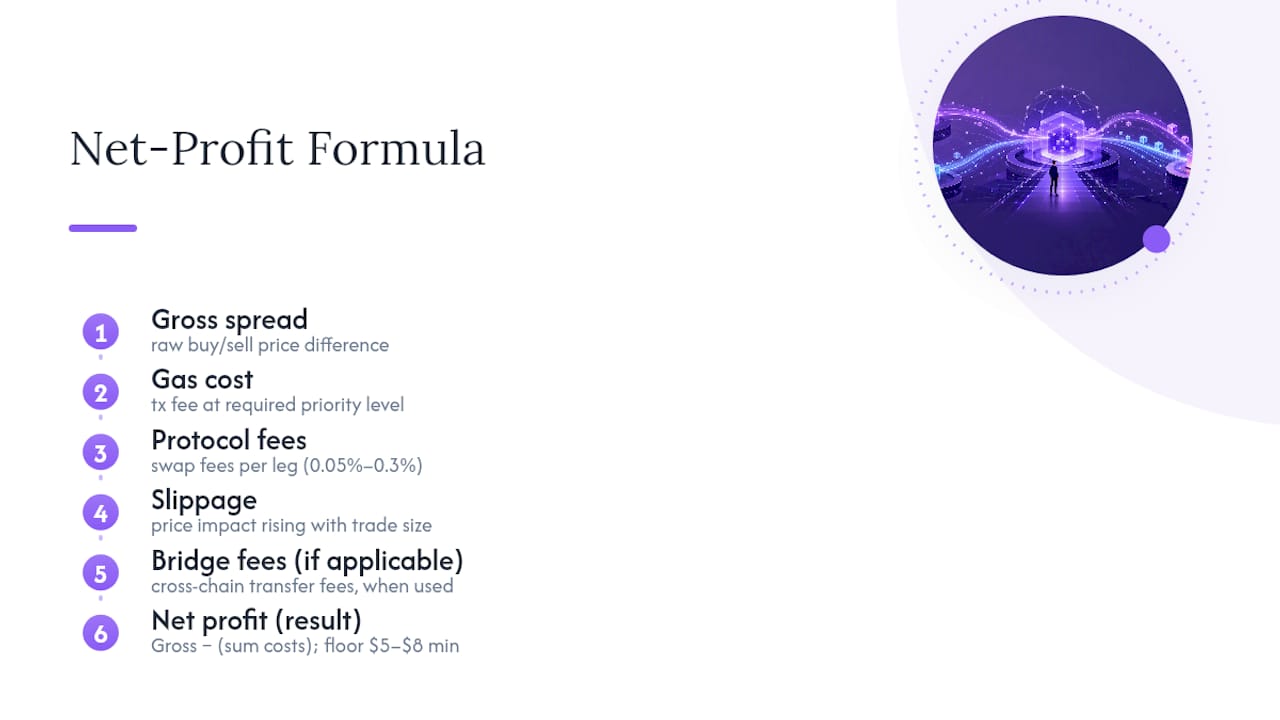
Gross spread is the raw price difference between your buy and sell legs before any cost is subtracted. Gas cost is your transaction fee at the priority level needed to land in the target block. Protocol fees are the swap fees each pool charges, typically 0.05% to 0.3% per leg. Slippage is the price impact your own trade causes, which grows with trade size relative to pool depth.
That $10.30 only clears if your profit floor is set below it. Set the floor too aggressively (say, requiring $15 net minimum on every $5,000 trade) and you'll pass on real, if thin, profit. Set it too loosely and gas spikes during congestion will eat the whole trade. A reasonable starting floor for this trade size is a hard $5 to $8 USD minimum plus a gas-price multiplier that scales up during congestion.
Log gross spread, each cost component, and net profit on every single attempt, executed or skipped. That log is what lets you tighten your filters over weeks instead of guessing.
Starter Roadmap: From Zero to First Live Fills
The minimum viable stack is smaller than most beginners assume: Foundry or Hardhat for contract development and forked-chain testing, a WSS RPC endpoint, a dedicated test wallet, and a modest amount of working capital on an L2.
- Build a monitoring script that watches two or three liquid pools for price divergence.
- Once a candidate spread appears, run the trade through your profit formula before touching a contract.
- Simulate the exact transaction on a block-for-block fork; abort if it fails your minProfit guard.
- Submit small live attempts on an L2 with a well-known, highly liquid pair, not an exotic long-tail token.
- Log every outcome, tune your spread threshold and gas multiplier weekly based on what the data shows.
The most common beginner mistake is chasing exotic pairs for bigger theoretical spreads. Thin liquidity means brutal slippage, which usually erases the entire advantage before gas even factors in.
Where OmniRout's Tooling and Technical Guides Fit In
Before submitting any arbitrage attempt, you need a fast way to compare fees, gas costs, and slippage across routes. A route comparison feature can do that kind of pre-trade cost check across multiple blockchains, which maps directly onto the cost-modeling step every strategy in this article depends on.
A few resources worth pairing with your own build:
- Gas-fee optimization techniques for tightening your net-profit formula.
- Cross-chain bridging guidance for modeling settlement risk on bridge arbitrage.
- Slippage tolerance mechanics for setting realistic caps on multi-leg trades.
None of this replaces forked-chain simulation. Treat any external cost estimate as a starting filter, never a substitute for testing the actual transaction.
How Network Congestion Changes the Arbitrage Math
Congestion doesn't just slow things down; it rewrites your profitability formula in real time. When a network's base fee spikes during heavy demand, gas cost stops being a rounding error and becomes the dominant term in your net-profit calculation. A spread that clears comfortably at normal gas prices can turn negative within a single block if congestion triples the cost to land your transaction.
Congestion also compresses your execution window. More pending transactions competing for the same blocks means a higher chance someone else's bot claims your spread before your transaction confirms, especially on chains with public mempools. On Ethereum mainnet, this dynamic is exactly what pushed serious arbitrage activity toward private transaction relays and builder networks instead of the public mempool.
L2 networks behave differently depending on their sequencer design. Some maintain relatively stable fees even under load because they batch transactions differently than Ethereum's fee auction model; others still see meaningful fee spikes during high-demand periods, particularly around major token launches or liquidation cascades. Know your target chain's specific congestion behavior rather than assuming L2 fees stay flat.
The practical takeaway: build your gas-multiplier profit floor to scale with observed network conditions, not a static number. A bot that hardcodes last month's average gas price will happily submit unprofitable transactions the moment congestion returns, and it will do so quietly, one small loss at a time, until the log shows why the strategy stopped working.
Regulatory Considerations Relevant to DeFi Arbitrage
DeFi arbitrage sits in a genuinely unsettled regulatory space, and the rules differ sharply by jurisdiction. Some regulators treat automated trading strategies executed through smart contracts as functionally similar to algorithmic trading in traditional markets, which can trigger registration or reporting obligations depending on trade volume and the specific assets involved. Others have issued little formal guidance specific to on-chain arbitrage, leaving builders to infer how existing securities, commodities, or money-transmission rules might apply.
The non-custodial nature of most arbitrage bots (you hold your own keys, the contract executes atomically, no third party takes custody of funds) puts this activity in a different category than centralized exchange trading in many frameworks, but that distinction isn't universally recognized or protective. Cross-chain and bridge arbitrage adds another layer of complexity, since moving value across jurisdictions through different bridge protocols can touch multiple regulatory regimes in a single transaction.
None of this is a substitute for actual legal counsel in your specific jurisdiction. Rules around automated trading, money transmission, and asset classification vary enough between countries, and even between states or regions within a country, that a general statement here would do more harm than good. If you're running arbitrage at meaningful volume, or building tooling you plan to offer to other traders, get jurisdiction-specific legal advice before scaling. What's a straightforward technical strategy in one country's framework can carry licensing requirements in another.
Tax Implications of DeFi Arbitrage Profits
Arbitrage profits are taxable income in most jurisdictions that have issued any crypto tax guidance at all, but how they're categorized varies. Many tax authorities treat each successful arbitrage trade as a taxable event: the moment you swap one asset for another, you've realized a gain or loss relative to your cost basis, even though the whole cycle completed inside a single atomic transaction and you never held the intermediate assets for more than one block.
That creates a genuinely tedious recordkeeping problem. A single two-pool atomic arbitrage transaction can involve two or three separate taxable swaps depending on your jurisdiction's rules, and a triangular arbitrage bot running dozens of trades a day can generate an enormous volume of individually taxable events. Manual tracking becomes unworkable fast, which is why serious arbitrage builders integrate transaction logging into their bot from day one rather than trying to reconstruct a year of on-chain activity later.
Flash loans complicate this further in some frameworks, since the borrowed capital never actually belongs to you and exists only within the transaction. Whether tax authorities treat the flash-loan leg itself as a taxable event, versus just the net profit that lands in your wallet, isn't consistently answered across jurisdictions.
Treat tax obligations as a design requirement, not an afterthought. Log every swap, every gas cost, and every net result at the transaction level, and talk to a tax professional familiar with crypto specifically. General tax software built for stock trading often handles this poorly, and the penalties for getting crypto tax reporting wrong tend to compound the longer inaccurate records go uncorrected.
Choosing Between a Trading-First and Engineering-First Path
The honest tradeoff here is time versus money, and most beginners guess wrong about which one they're short on. If you can code but can't afford to hire, start trading-first: a simple two-pool atomic scanner on an L2 teaches you more about real spread behavior in a week than reading engineering posts for a month. If you have capital but not the hours, hiring a contract engineer to build the monitoring and simulation pipeline is worth it, but write the profit-floor logic yourself first so you actually understand what you're paying someone to automate.
On MEV ethics specifically: sandwich attacks and toxic front-running degrade trust in the ecosystem you're profiting from. Atomic arbitrage and vault mispricing capture, by contrast, mostly correct genuine inefficiencies without harming a specific counterparty. That distinction is worth holding onto as you decide which strategies to build toward.
— Emanuele
Check Your Route Costs Before You Simulate the Trade
A tool can give you a faster way to run the first pass of the cost-modeling step every strategy in this article leans on: comparing fees, gas costs, and slippage across routes before committing capital to a trade. Because it is non-custodial, you're checking route costs across multiple blockchains without handing over your keys to a third party, which matters whether you're sizing a two-pool arbitrage leg or estimating the bridge cost on a cross-chain attempt.
Use it as a pre-check, not a substitute for your own simulation. Pull a route estimate to sanity-check gas and slippage assumptions, then still run the actual candidate transaction through a forked-chain test before it goes anywhere near mainnet or an L2 sequencer. For the bridge leg specifically, comparing routes ahead of time can also surface cheaper transfer options than whatever bridge you'd default to out of habit. Head to OmniRout to run a route comparison on your next planned swap or bridge transfer before you size the trade.
Sources
The CoinMarketCap primer on DeFi arbitrage covers why fragmented liquidity keeps generating opportunities. The technical framework paper formalizes two-point and triangular arbitrage math. The Hackernoon engineering deep dive explains MEV dynamics and pathfinding in practical terms. The Kestrel repository shows a working profit-floor implementation worth studying line by line.
- Arbitrage Opportunities in DeFi | CoinMarketCap
- Practical Strategies for DeFi Efficiency: A Technical Framework for Arbitrage, Liquid Staking Redemption, and Yield Farming
- Building Your First Atomic Arbitrage in 2026:… | FRB Agent
- Kestrel (MEV / yield-stablecoin arbitrage) GitHub repo